To collect Harry Potter editions without overpaying, decide which print point you actually want, prove it from the copyright page, judge the condition honestly, and then compare recent completed sales rather than the asking price on the listing in front of you. That order matters, because almost every expensive mistake in this market comes from buying first and identifying afterwards.
The uncomfortable truth, which the collector forums say over and over, is that outside a very small number of print points, supply is far higher than demand. Collectors on r/BookCollecting put it plainly: there are so many copies floating around that there is more books than demand, and paperbacks even more. So the goal of this guide is not to find a hidden treasure. It is to help you buy a shelf you are proud of, at a price you would still be happy with five years from now.
There is one more thing worth saying up front, because it saves beginners a lot of money. Almost every edition is a perfectly good book. The premium versions buy you art, paper engineering and a gift-worthy object, not better reading. Know which one you are shopping for before you start comparing prices.
Table of Contents
- What You Need
- Step-by-Step: How to Collect Harry Potter Editions Without Overpaying
- 1. Set a collecting budget and choose a target edition
- 2. Identify the exact printing before comparing prices
- 3. Learn the edition and printing differences that matter
- 4. Inspect condition and completeness carefully
- 5. Compare recent sold prices, not just asking prices
- 6. Check sellers, listings, and return policies
- 7. Keep records and buy deliberately
- Common Mistakes
- Frequently Asked Questions
- Are Harry Potter first editions worth any money?
- How do I tell if my copy is a first edition?
- Which Harry Potter editions are the most valuable?
- What are the differences between the Bloomsbury and Scholastic versions?
- Where is the best place to buy Harry Potter books cheaply?
- How much should a collector budget for a complete set?
- Conclusion
What You Need
You need far less than most sellers imply. None of it costs serious money, and the whole setup fits in a drawer beside the bookshelf.
- A reference for print points. Any reliable guide to first-edition identification, or a saved checklist of the copyright-page features that matter. This is the single most useful item on the list.
- A magnifier and a good light source. Number lines and printing lines are set small, and an angled lamp stops you from mistaking paper texture for print.
- Access to completed sales. A marketplace search filtered to sold listings, plus an auction archive for rare copies. Asking prices are marketing; completed sales are data.
- A phone camera. You will photograph the copyright page, the spine, the corners and any damage the moment a book arrives, while you still have grounds for a return.
- A notebook or spreadsheet. ISBN, printing, publisher, condition, date, seller, price paid. Ten minutes of record keeping prevents most duplicate purchases.
- A way to identify editions you do not own. Library catalogues, publisher pages, and the ISBN on the copyright page. Most identification puzzles end with a number, not a guess.
What you do not need is a spend budget set by somebody else’s taste. Decide your ceiling before you look at a single listing, because a rare book in front of you is a terrible salesperson.
Step-by-Step: How to Collect Harry Potter Editions Without Overpaying
1. Set a collecting budget and choose a target edition
Collectors fall into three groups, and each one needs a different plan and a different budget.
A reading collection is the cheapest and most common goal. You want seven copies that are comfortable to read, look decent on a shelf and cost a fraction of what a premium set does. Ordinary later printings, house paperbacks and a good used box set all serve this perfectly well.
A first-printing collection is a research project rather than a reading habit. It needs patience, real knowledge of print points, and the discipline to walk away from anything the copyright page cannot prove. This is the group most likely to overpay, because the vocabulary around it sounds more authoritative than it is.
An illustrated or boxed collection is a display and gifting choice. You are buying art direction, paper engineering and presentation, and you should judge it on those terms rather than on resale potential, because that is where the money goes.
Write down your total budget and your maximum price for any single book before you start. If a copy exceeds your personal ceiling, it is not a bargain, regardless of what the listing claims or what a forum post says it is worth. Sellers on collector forums regularly quote asking prices as though they were results, and that gap is where the money disappears.
2. Identify the exact printing before comparing prices
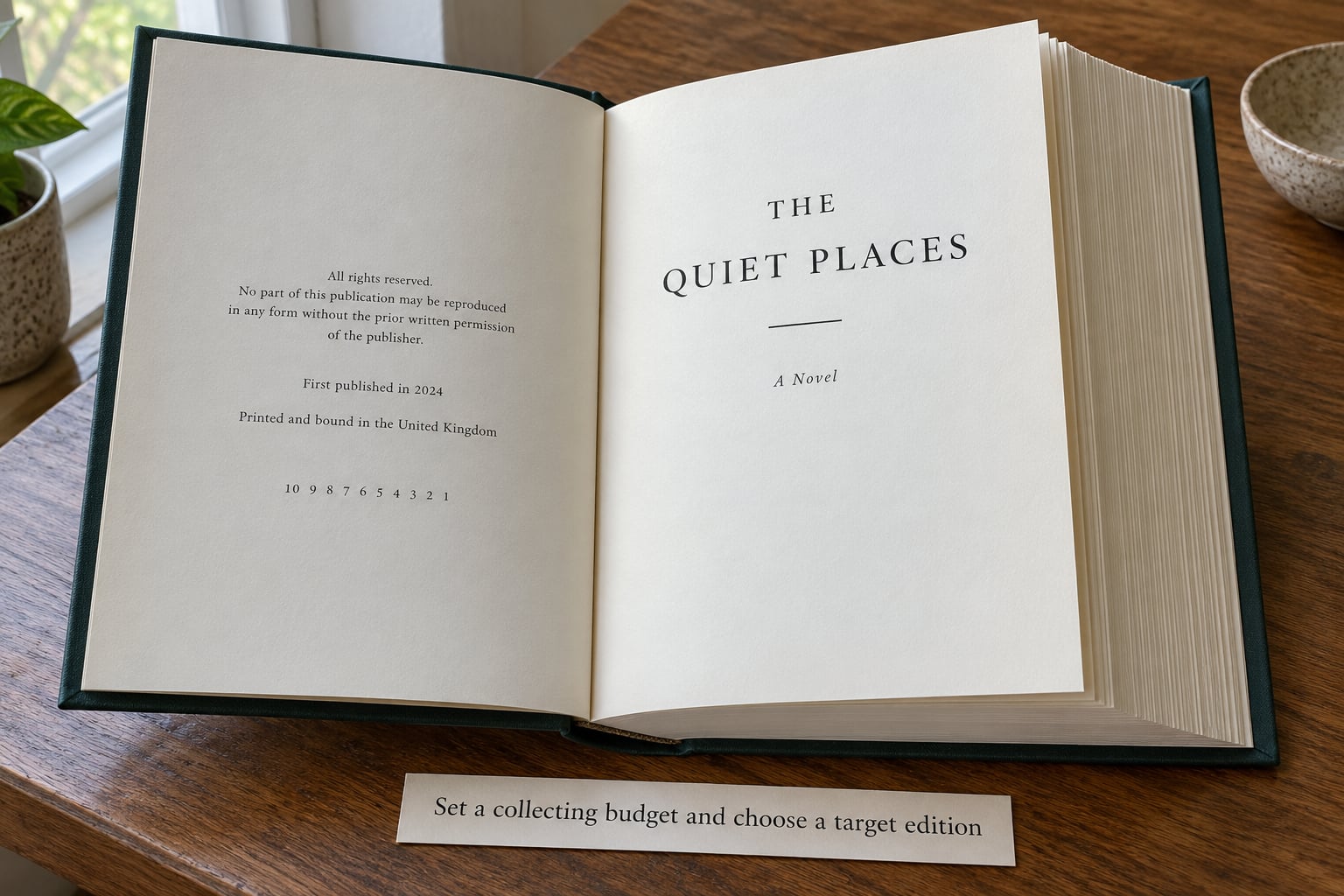
The only way to know what a book is worth is to prove what it is, using the copyright page, before you compare it to anything.
Look at these points, in order, and note them:
- Publisher. Bloomsbury published the original UK editions; Scholastic published the US editions. A Scholastic printing is not a UK first, no matter how it is labelled.
- Title and title page. The UK Book 1 is Harry Potter and the Philosopher’s Stone. The US Book 1 is Harry Potter and the Sorcerer’s Stone. The book being present under both names in the same collection is a decision, not an accident.
- The number line. A number line counting down from 10 through 1 on the copyright page signals a first printing. No number line generally means a later printing. This single line has caught out more inexperienced buyers than anything else.
- The printing line. It tells you who printed the book and where. The printer and the wording change between printings, and one of the most recognisable early features on certain UK first printings is the line announcing the book was sold out of print.
- The copyright statement and edition wording. Wording that shifts between printings is the giveaway collectors use to separate a first state from a second state of the same printing.
- Paper, binding and cover. Paper quality, board thickness and the finish of the wrapper all shift across a run. A glossy later printing can look newer than a genuinely early one.
- The ISBN. The last and often most decisive check, because the number identifies a specific published edition, while the copyright page identifies a specific printing within it.
A number line is the row of numbers printed on a copyright page, usually counting down from 10 to 1, that booksellers use to identify the printing.
If a seller will not photograph the copyright page, treat that as the answer. A cropped image of that page is the single most common trick in this market, and it is always in the same direction: away from the evidence you need.
3. Learn the edition and printing differences that matter
Different covers are not automatically rare, and that is the misunderstanding behind a lot of wasted money.
Within a single edition, a later printing can look nearly identical to a first and be worth a small fraction of it. The identifying evidence sits on the copyright page, not on the shelf. This is why two copies side by side can carry wildly different values while looking the same from a metre away.
UK and US editions differ in publisher, title, jacket design and the print points collectors chase. Neither is automatically more valuable. UK first printings have the deepest following and the thinnest supply, but a US first printing is a genuine first printing too, and plenty of collectors collect them.
Illustrated editions have their own hierarchy. The fully illustrated and interactive MinaLima volumes cover the first three books, Jim Kay illustrated the first five, Karl James Mountford took on the interactive Book 4, and Levi Pinfold picked up Books 6 and 7 as the artist line changed hands. House editions, with a different book per house and bonus content, are a display product first and foremost. Collectors note that the Slytherin house volumes move faster than the other three, which is a demand signal, not a value signal.
Box sets need the same scepticism. A later printing bound into an attractive slipcase at several times the price of the individual books is the most common padded deal in the series, and forum sellers describe exactly that pattern repeatedly.
A handful of print points do carry real money, and it is fair to name them. Documented completed sales for Harry Potter include a signed UK Prisoner of Azkaban uncorrected proof, from a print run of roughly 150 copies, at a five-figure result; a Chamber of Secrets uncorrected proof from a run of about 250; a UK Philosopher’s Stone first printing paperback; and an Azkaban first printing in first state. An uncorrected proof is a pre-publication copy printed before the final text was corrected, which is why the top of this market is genuinely tiny and why the printed copies are also where counterfeiting concentrates.
Collectors also hunt specific errors, including the Chamber of Secrets printing with the misspelled name, the Chamber printing that shows Rowling on the cover, and a Ginny Weasley spelling change between printings. These are interesting to specialists, expensive to chase, and a poor use of a first collecting budget. Treat them as a later hobby with money already set aside.
4. Inspect condition and completeness carefully
Condition moves value more than almost anything else you can check, and it is the part buyers skip because it is boring in a listing photo.
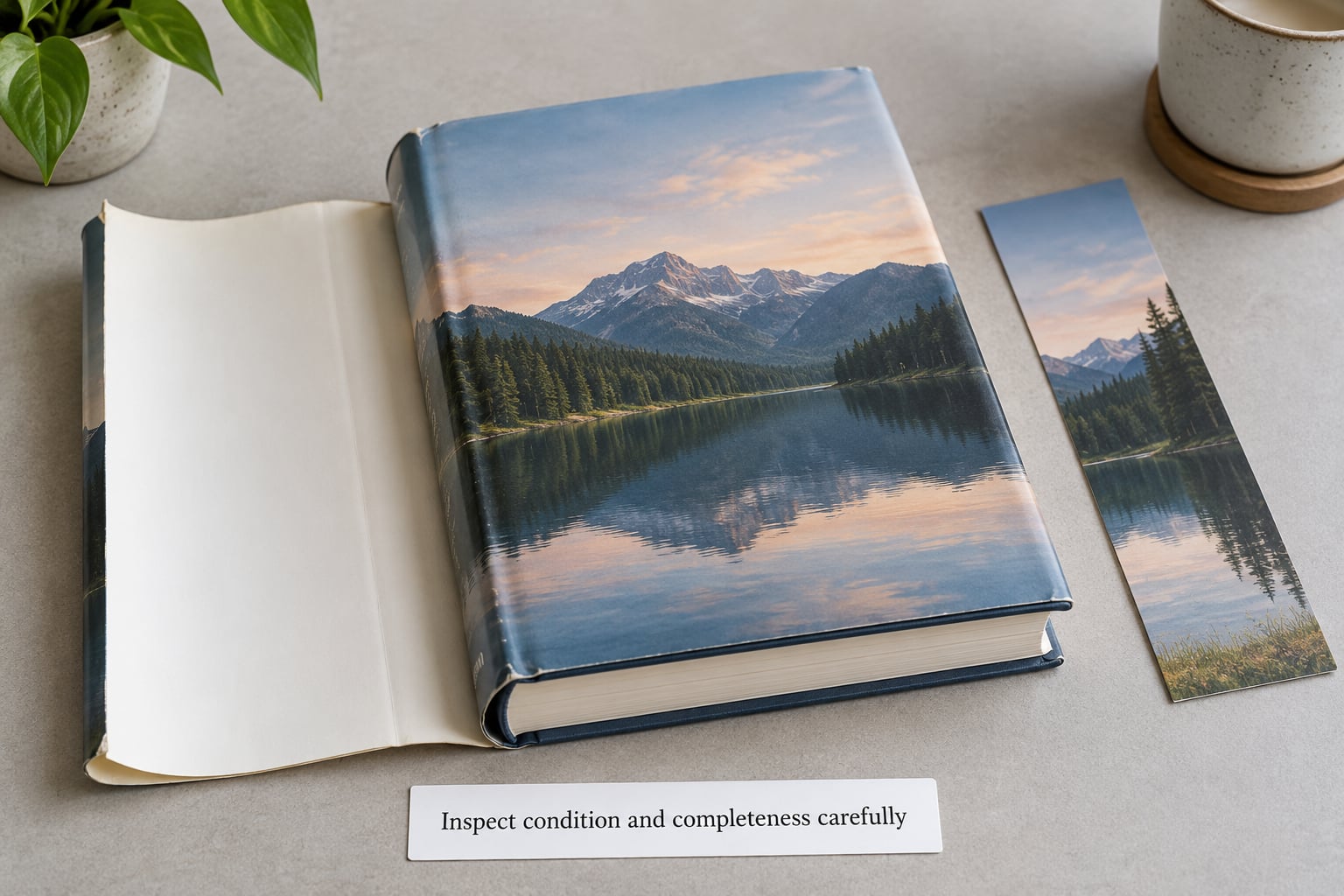
Read the grading terms properly, because they are used loosely online. Fine and Near Fine mean light wear only. VG means the book is sound but shows shelf wear, and VG+ means better than that with minor flaws. A wrapper is the printed paper covering a hardback, and it matters: a hardback without its original wrapper is usually valued well below the same book with it. The text block is the gathered block of pages, and problems there are worse than problems on the cover. Foxing is the brown spotting that shows on older paper. A colophon is the closing statement that identifies the printer.
Then run the physical checklist:
- Wrapper and jacket. Creasing at the spine, rubbed corners, sun fading, a price sticker residue, or a publisher barcode sticker left on the cover. All of these cut value, and the last one is easy to miss entirely.
- Spine lettering. Check for fading, chips, and lettering that has been retouched or re-lettered. Compare the spine colour against the cover, because a sun-faded spine on an otherwise clean jacket is a common sign of long display rather than careful storage.
- Hinges and boards. A cracked hinge means the board is working loose from the spine. Gently press each board flat and watch the joint. Boards that flex have usually been repaired at some point.
- Corners and edges. Sharp corners on a book that has clearly been read a hundred times are a sign of a repaired copy, not a lucky one.
- Pages and text block. Check for loose or missing pages, a separated signature, and any repair that uses tape or modern binding adhesive. Tape on a spine is a rebuild, and a rebuilt book is a rebuilt book to any serious buyer.
- Inserts and extras. House editions include bonus material, and illustrated editions may include fold-outs and tipped-in pages. A house volume missing its extra pages is incomplete, and completeness is what set buyers care about.
- The box or slipcase. Boxed sets lose value fast through corner wear and sun damage, because a reader opens the box and closes it thousands of times.
Repairs, professionally done or not, are the thing most sellers leave out. A repaired spine or a re-backed wrapper should reduce what you offer, and a seller who does not mention one is not being straight with you.
One practical note on premium illustrated books: they are physically fragile. Pop-ups tear, fold-outs crease along the fold, and sprayed edges rub. If you buy them, buy one volume rather than a full set, read it with a bookmark instead of a finger, and accept that you are choosing between reading the book and preserving it.
5. Compare recent sold prices, not just asking prices
Asking prices tell you what a seller hopes. Completed sales tell you what the book is actually worth, and the difference between the two is where overpaying happens.
A workable routine takes about fifteen minutes per book:
- Search the edition precisely. Use the ISBN, the publisher, the specific wording of the printing line and the edition name, not a general series search. Broad searches mix editions together and produce numbers that mean nothing.
- Filter to completed transactions. Sold or sold-listing filters exclude the aspirational prices, and they are the only figures worth recording.
- Read the condition notes on the sales, not just the figures. A completed sale of a wrapperless hardback is not a comparable for a fine copy with its jacket.
- Look at the recent window. Markets move, and a result from several years ago tells you about a market that no longer exists. Weight the last few transactions more heavily.
- Check the spread, not the average. If identical copies sold at wildly different numbers, something is different between them. Find what, or treat the whole set of results as unreliable.
- Note the numbers that repeat. When the same figure keeps appearing across multiple completed sales, that is your working market value for that edition in that condition.
For a set, price the individual volumes and add them up. A single seller asking for a figure for all seven has simply applied a premium for convenience, and you can do the arithmetic yourself in a minute. Experienced sellers on the forums describe the same pattern from the other side: a full set of UK hardbacks listed at a modest headline number usually settles below it, and selling volumes one at a time over time often does better than waiting.
6. Check sellers, listings, and return policies
A correct book from a dishonest seller is still a problem, and the listing itself carries most of the evidence.
Check these before you commit:
- Seller history and feedback volume. Long-standing accounts with a large volume of completed feedback are safer than a new account with five perfect reviews.
- Photographs that answer your questions. You want the copyright page, the spine, the corners, the back of the wrapper, and any damage. A book photographed only in bright three-quarter lighting is being hidden from you.
- Descriptions written by a person. Real listings mention flaws, list the printer, and state the grade. Canned copy with a wall of unrelated books in the photos is a bulk reseller.
- Grading vocabulary used accurately. If the description uses terms like first state, uncorrected proof or advanced reader copy, check that the copyright page supports the claim rather than the adjectives.
- Packaging for a valuable book. A first printing should travel in a rigid mailer with cardboard stiffening. A thin poly bag for a fragile book is a warning, not a detail.
- Payment protection and return windows. Use a payment method that holds funds until delivery is confirmed, and check the return window before you buy, not after. Photograph everything on arrival the same day.
For rare copies, buy only from sellers who publish authentication detail and who will answer questions about the printing. Provenance is what separates a real first state from a very confident photograph of one.
7. Keep records and buy deliberately
Collecting without records is how shelves end up with three copies of Book 2 and no Book 5.
For every book, write down the ISBN, the printing and state, the publisher, the condition grade with your own notes on flaws, the date, the seller, the price you paid, and the photos you took on arrival. A simple spreadsheet with one row per book does the job; a notebook works just as well if you are the kind of person who will actually use it.
Records pay you back twice. They stop duplicates, and they tell you honestly whether the collection you built is coherent, which is the thing that matters when you eventually want to sell or hand it on. A set of seven matching printings from one publisher is a collection. Seven mixed printings in seven wrappers is a pile.
Then buy on a schedule, not on impulse. One book per month, or one per payday, with a standing rule that you revisit the shortlist rather than the search page. Collectors who chase the wrong print point spend years and end up with less than they started with.
Common Mistakes
Paying for a desirable cover. The UK hardcover with the classic jacket design is the most requested object in the fandom, and sellers price accordingly. The correction is simple: judge the book on the copyright page, and let the cover be a preference you can live with or without.
Treating a later printing as a first. The most expensive mistake by far, and the one sellers facilitate. Missing number line, changed printing line, different edition wording: any of these means it is not the first printing, whatever the listing headline says. Check the page before you check anything else.
Ignoring condition entirely. A fine copy and a read copy of the same printing are different products, often separated by a wide margin. Read the grade, then look at the same three places yourself: corners, spine, hinge.
Trusting stock or borrowed photographs. A listing showing a different book, or an image lifted from a sale that already completed, tells you nothing about the copy in front of you. Ask for fresh photographs of the exact copy, including the copyright page.
Buying an incomplete or mismatched set. A seven-book set where six are first printings and one is a later printing is not a first-printing set, and a buyer will treat it accordingly. Check the printing of every volume before committing to a set price.
Buying a box set that is a slipcase full of later printings. Higher price, ordinary books inside. Ask for the printings, and be willing to walk away from the presentation.
Ignoring the return policy. A book that arrives with a cracked hinge or a replaced wrapper is usually a return, not a negotiation, provided you act inside the window. Keep the photographs that prove it.
Falling for doctored jackets and rebinding. Original wrappers get re-backed, re-lettered or replaced with a modern printing, and ordinary copies get dressed up as rarities. There is a genuine market in fakes at the top, so if the price is a serious sum, buy authentication and provenance rather than photographs.
Collecting the wrong tier. The clearest fix is the honest one. If you want to read the series, buy readable copies and put the money you saved into one volume you will actually display. Chasing print points you will never verify is expensive entertainment with a bad return.
Frequently Asked Questions
Are Harry Potter first editions worth any money?
Some are, and most are not. A first printing only carries real money when the copyright page proves it, with a first-printing number line, an early printing line and matching first-state features. Ordinary later printings, which is what most people own, are worth roughly what a used copy of the same printing fetches. Expect a comfortable shelf, not an investment, unless you are buying at the very top of the market.
How do I tell if my copy is a first edition?
Open to the copyright page and check four things: the publisher, the title page wording, the number line, and the printing line. A number line counting down from 10 to 1 points to a first printing, and no number line usually means a later one. Then confirm the edition with the ISBN. If the page is cropped in the listing or the seller will not photograph it, assume it is not a first until proven.
Which Harry Potter editions are the most valuable?
The top of the market is very thin. UK uncorrected proofs and signed pre-publication copies come first, including a signed UK Prisoner of Azkaban proof from a run of roughly 150 and a Chamber of Secrets proof from around 250. Below those sit first printings in first state, particularly UK hardbacks, and certain first printing paperbacks. The valuable tier is genuinely small, which is exactly why fakes concentrate there.
What are the differences between the Bloomsbury and Scholastic versions?
Bloomsbury published the UK editions and Scholastic the US editions, and they differ in title, jacket design, print runs and the print points collectors chase. Book 1 is the Philosopher’s Stone in the UK and the Sorcerer’s Stone in the US. UK first printings have the deepest following, but neither side is automatically worth more. What matters is the printing inside the book, not which publisher’s name is on the cover.
Where is the best place to buy Harry Potter books cheaply?
Used book shops and charity shops, library sales shelves, secondhand chains, estate sales and book fairs are the cheapest channels, and the series is common enough that you will usually find at least one volume. Online, filtered completed-sale listings beat asking prices every time. For a full set, buying volumes individually over time usually costs less than any box set, and you can inspect each printing before you pay.
How much should a collector budget for a complete set?
Work out your ceiling before you start. A readable set of seven in a later printing costs a fraction of an illustrated collection, which in turn costs a fraction of a premium house or boxed set. The spread across the whole market is enormous, so the honest answer depends entirely on the tier you have chosen. Set a number, stick to it, and refuse the upgrade that is not the version you decided you wanted.
Conclusion
The safest first move is small: choose one target edition, photograph the copyright page, check the number line and printing line, compare recent completed sales in the same condition, and set a maximum price you wrote down before you looked. Then repeat that for one volume at a time.
That routine is the whole difference between collecting Harry Potter books and paying for the idea of them. The books are genuinely good. The knowledge is what keeps the spending honest.