The seven Harry Potter novels are read in publication order, and for the main series that order is also the order the story happens in. Book one is Harry Potter and the Philosopher’s Stone in the UK, Harry Potter and the Sorcerer’s Stone in the US. Start there, finish book seven, and only then decide whether you want the spin-offs. The whole run is about 3,400 pages, so most people get through it in three to four weeks of steady reading.
I’ve read the series twice, once straight through and once out of curiosity after the films, and the order matters far more than most guides admit. Rowling plants clues in book one that only pay off in book seven, and a couple of the middle books genuinely do not work if you jump into them cold. This guide walks the sequence book by book, then covers the five mistakes that trip people up.
Table of Contents
- What You Need
- How to Read the Harry Potter Books in Order: Step-by-Step
- 1. Read Harry Potter and the Sorcerer’s Stone
- 2. Read Harry Potter and the Chamber of Secrets
- 3. Read Harry Potter and the Prisoner of Azkaban
- 4. Read Harry Potter and the Goblet of Fire
- 5. Read Harry Potter and the Order of the Phoenix
- 6. Read Harry Potter and the Half-Blood Prince
- 7. Read Harry Potter and the Deathly Hallows
- Common Mistakes
- Frequently Asked Questions
- What is the correct order for reading the Harry Potter books?
- Should I read the Harry Potter books before or after watching the movies?
- Are the Sorcerer’s Stone and Philosopher’s Stone different books?
- Do I need to read the Harry Potter spin-off books to finish the main story?
- How long does it take to read all seven Harry Potter books?
- Conclusion
What You Need
You need one thing: book one. Everything else is a preference decision you can defer until later, and deferring it is why people stall out for weeks deciding which edition to buy.
The main series is seven novels published between 1997 and 2007, and each one covers roughly one school year at Hogwarts. That is the whole reason publication order and story order are the same list. There is no flashback trilogy to slot in afterwards, no prequel you have to read first, and no mid-series reimagining to worry about.
Pick a format and go. Physical books suit people who like a visible shelf of progress, and the paperback editions stack in a satisfying way as the pile grows. E-readers are the most convenient option for long commutes, since the whole series takes up very little space. Audiobooks work well for anyone who reads slowly or falls asleep before finishing a chapter.
Whichever you choose, buy all seven at once if you can. Coming back for book four two years later is the single most common way people abandon the series, and it is entirely avoidable.
One naming thing to settle before you start: the first novel is Philosopher’s Stone in the UK, Australia and most of Europe, and Sorcerer’s Stone in the US, Canada and Japan. It is the same book, the same pages, a different title. Rowling disliked the American change, which is why the UK name is the one British readers quote and American readers usually learn second. If you pick up whichever cover your local shop stocks, you have not made a mistake.
How to Read the Harry Potter Books in Order: Step-by-Step
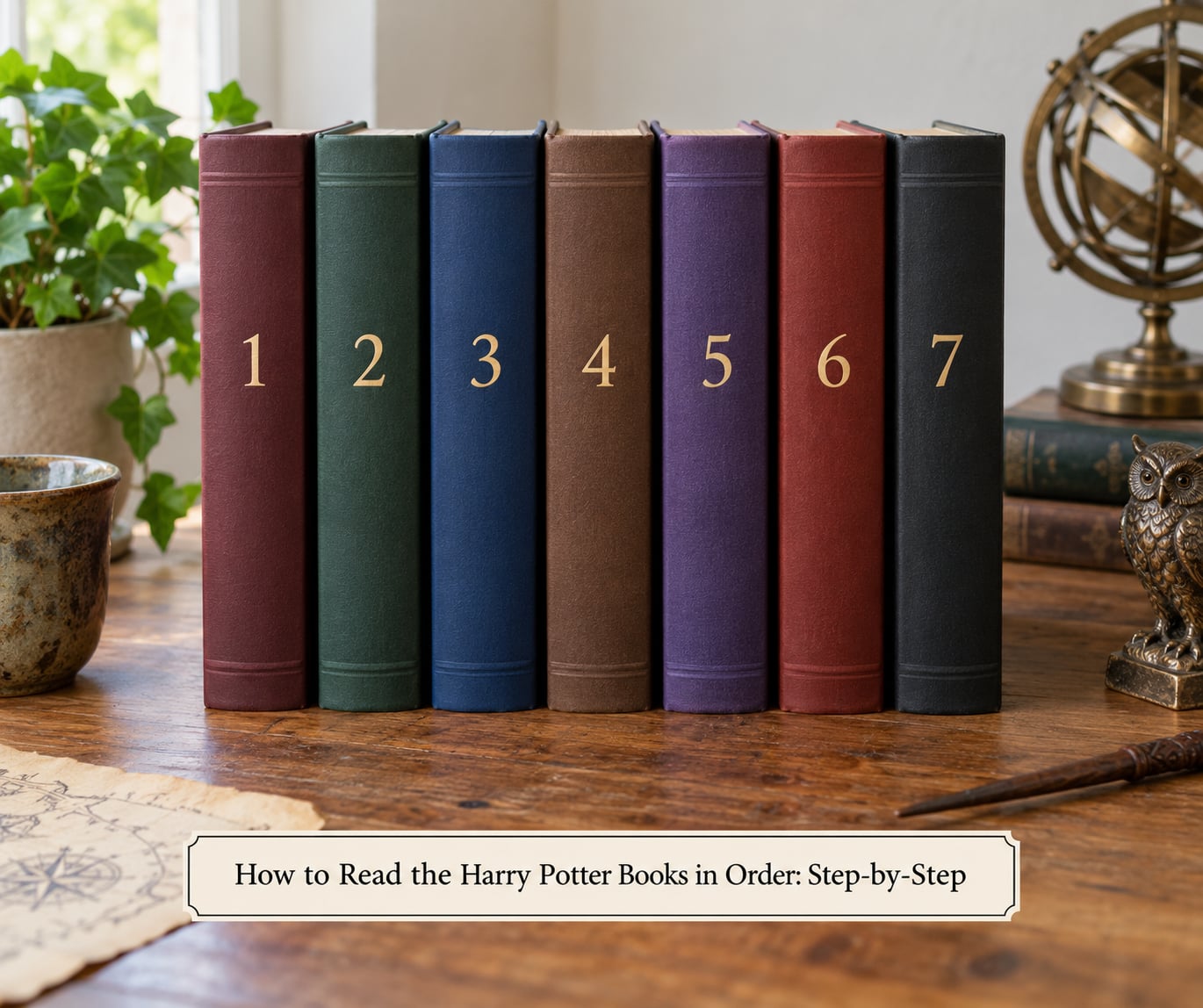
Here is the sequence, with what each book gives you and what to expect going in.
1. Read Harry Potter and the Sorcerer’s Stone
Book one, published 1997, is where the reading order question really gets answered. It spends its first third establishing a world Harry does not understand, and once the sorting happens the plot moves quickly. You are meant to be slightly lost for a while.
Your reading goal is orientation rather than prediction. Pay attention to the teachers, because at least two of them matter enormously later. Notice what Harry does not know, since a lot of the book’s power comes from the reader knowing things the hero does not.
Check yourself at the end by asking a simple question: can you explain why the book is called that, and who was protecting the thing it is named after? If you can answer both, you understood the plot. Details about the villain’s motives are fair game to forget, because they are not fully explained yet.
The one spoiler-free warning: book one is the shortest of the seven at roughly 75,000 words, and it is the most child-friendly. If it feels slow, that feeling is common and it passes in book two.
2. Read Harry Potter and the Chamber of Secrets
Book two, published 1998, drops Harry into a second year with a problem that predates his arrival. Read it straight after book one rather than pausing, because a few details from the first year are assumed rather than explained again.
The backstory is the point of this one. It is the first book where you meet a character through someone else’s memory of them, and the emotional weight lands much harder if you already know the version you met in book one.
A few names catch people out. Fawkes, the poltergeist, is easy to forget and easy to misread on a first pass. Hagrid introduces himself in a hurry, and Lockhart is deliberately obnoxious for a reason the book makes plain before the end. If you cannot keep a name straight, keep reading anyway; Rowling assumes you will.
Book two is where the complaint about slow pacing shows up most often. It is genuinely a slower book than the first, and it rewards you for being patient with it.
3. Read Harry Potter and the Prisoner of Azkaban
Book three, published 1999, is the fan favourite of the original seven and the first one most adults read alone at midnight. It is also where the series gets properly dark for the first time, so readers expecting the first book’s tone should expect a shift.
The plot is a mystery, and it is fairly clever. Rather than telling you to guess the reveal, which would spoil it, here is a better method: keep a short list of the adults Harry distrusts and one line about why. Most readers who do this can solve the central twist on their own.
Two other things to watch for. The first is a large cast of new students and family members arriving at once, which is disorienting on purpose, so reread a name once or twice when it appears. The second is that some chapters are told from another character’s point of view, and those switches are the strongest writing in the book.
If you only read one of the first three, make it this one.
4. Read Harry Potter and the Goblet of Fire
Book four, published 2000, is the hinge of the entire series. The school-year structure breaks, the world opens well beyond Hogwarts, and the stakes stop being a child’s problem. It is also the longest book at roughly 120,000 words, so give yourself room.
Continuity matters more here than anywhere before it. Rowling introduces a new school head, several new families with long histories, and a political context that will explain a lot of book five. If a name or an old event is mentioned without explanation, that is a deliberate loose thread, not a mistake.
Here is your comprehension milestone, stated without naming anything: when you reach the last third of the book, you should be able to feel that the world has changed permanently, even if you cannot yet say how. If you get to the final chapters and nothing has shifted for you, go back and reread the middle section, because the setup for book five is hiding in plain sight there.
This is also the book where parents reading aloud usually stop. More on that below.
5. Read Harry Potter and the Order of the Phoenix
Book five, published 2005, is the most polarising of the seven, and the most commonly skipped. Do not skip it. It is also the longest single volume in the series at roughly 135,000 words, only because Rowling wrote it in the voice of a teenager who has stopped trusting anyone.
What changes is the structure. Harry is isolated, angry and unemployable for most of the book, and the plot reflects that: nothing happens for long stretches, then a great deal happens fast. Readers who complain about it are usually readers who expected book three’s momentum.
Tracking the cast is the practical challenge. Order of the Phoenix is where the Ministry, the Order and Dumbledore’s own plans all pull in different directions, and characters who mattered in book four recede. If names blur, keep a one-line note on who is on which side; the payoff in book six depends on it.
The tonal shift is the point of the book. Set aside the idea that a fantasy novel about a school should feel reassuring.
6. Read Harry Potter and the Half-Blood Prince
Book six, published 2007, is the most commonly skipped book in the series, usually because readers want the ending. Skipping it is a mistake, because this is the book where the title character is finally explained and where the reader learns the thing that makes the finale devastating rather than just sad.
Its structure is unusual. Part of it is a Harry and Dumbledore conversation at a cottage, and part of it is a mystery in which a teenage Harry spends a long time reconstructing his own past. Both halves feed directly into book seven, so read it as setup rather than filler.
Two things to hold onto: the memories, which are the book’s whole engine, and the relationships that change when old loyalties are examined. The final chapters do very little context-setting of their own, and they assume you read this one carefully.
It is also the shortest of the last three at roughly 100,000 words, so the slog people fear at this stage does not really happen.
7. Read Harry Potter and the Deathly Hallows
Book seven, published 2007, closes the original seven-book story. It is the shortest of the final three at roughly 100,000 words, and it is structured as a road story with a hunt attached, which is a real change of setting from six years of school corridors.
Spoiler-free preparation: read the last two chapters of book six carefully, because book seven opens by continuing them. Pay attention to objects rather than plot. A title, a ring and a story three brothers were told matter more here than most of the action sequences do.
Set expectations for the pace too. The middle is a series of linked missions that read quickly, and the tone gets darker than anything before it. If you are sensitive to that, warn younger readers before they start rather than stopping mid-book.
When you finish it, you have completed the seven-book arc Rowling originally planned, and the story is genuinely closed. The Cursed Child, Fantastic Beasts and the Hogwarts Library books are additions layered on top, not chapter eight, and reading them now will spoil the ending for you.
Common Mistakes
Almost every reading-order problem I see traces back to one of five mistakes.
Starting with the films. A lot of people arrive at book one having already seen the movies, decide they know the story, and quit by chapter five. The fix is not a warning about spoilers, it is a reframing: the films are a heavily abridged adaptation. Roughly half the dialogue is gone, several characters are cut entirely, and whole motivations are compressed into gestures. Book one is where you find out how much you were never shown.
Reading them out of sequence. It happens when someone lends you a book or you see a spin-off mentioned online. The fix is simple: return the book, put the borrowed one on a shelf, and start at number one. Rowling’s clue-planting only pays off in sequence, and several reveals in books six and seven are impossible to enjoy out of order because the setup is in books one and three.
Confusing Sorcerer’s Stone with Philosopher’s Stone. Readers often assume these are two different books and try to find both. They are the same novel under two titles, so if you own one, the other is not on your list.
Starting the spin-offs too early. Fantastic Beasts and the Cursed Child both assume you have finished the seven novels, and both involve events that happen after or alongside them. The Cursed Child in particular is a stage play script rather than a novel, with stage directions, and it assumes a working knowledge of how magic behaves. Finish book seven first.
Losing the timeline. The books span about ten years of Harry’s life, and several flashbacks overlap confusingly. The fix is a simple running note with three lines: what year you are in, who is teaching, and who you currently trust. Two pages of notes at the end of book five is enough to make book six click.
Tips for the Best Reading Experience
Set a pace you will actually keep. Most people who abandon the series do it in weeks three and four, not because the books got bad but because life got busy. One book a week is a realistic commitment that finishes the series in about two months. Two books a month is a comfortable, unhurried alternative that takes the better part of a year.
Use a spoiler-free character list as a reference, not a crutch. Something like a name and a house or role for each of about fifteen characters is plenty. Write it yourself as you go and the act of writing does as much work as the reference.
Take notes if you like that, but keep them free of predictions. A prediction you wrote in book one is a spoiler to yourself in book five, and the disappointment of being wrong often gets blamed on the writing.
Talk about the books with someone who has read them, but restrict the conversation to the year you are in. A reader two books ahead is not safe to talk to, and asking them to avoid spoilers rarely works well.
For audiobooks, stay with one narrator across all seven books if you can. Jim Dale’s US recordings and Stephen Fry’s UK recordings are both complete, both award-winning, and stylistically very different, so switching mid-series is jarring. Pick the voice samples you like and commit.
For younger readers, book four is the usual stopping point for parents. Books one to three are gentle and funny, and book five contains sustained scenes of a teenager in real emotional distress. Many families read one to three together, hand book four to an older child or teen, and pick the series back up together after the finale.
Frequently Asked Questions
What is the correct order for reading the Harry Potter books?
Read them 1 to 7 in publication order: Philosopher’s Stone, Chamber of Secrets, Prisoner of Azkaban, Goblet of Fire, Order of the Phoenix, Half-Blood Prince and Deathly Hallows. Publication order and story order are the same list for the main series, because each novel covers a single year at Hogwarts. There are no flashbacks to slot in and no prequel to start with.
Should I read the Harry Potter books before or after watching the movies?
Before, if you can. The films leave out large chunks of dialogue, cut several characters completely and compress motivations into gestures, so watching them first often makes people feel they already know the story and give up on book one. Watching afterwards is fine too, and it is a good way to catch the changes, but do not let a film ending spoil the seventh novel for yourself.
Are the Sorcerer’s Stone and Philosopher’s Stone different books?
No, they are the same novel with different titles. Bloomsbury published it in the UK as Harry Potter and the Philosopher’s Stone, and Scholastic released it in the US as Harry Potter and the Sorcerer’s Stone. Rowling preferred the UK title and has said so more than once. Whichever name is on the cover you own, it is book one and the story inside is identical.
Do I need to read the Harry Potter spin-off books to finish the main story?
No. The seven novels tell a complete story that ends in Deathly Hallows, and nothing further is required to have read the whole of Rowling’s original plan. The Cursed Child, the Hogwarts Library companion books and the Fantastic Beasts screenplays are optional additions set after or alongside the main events, and they read much better once you have finished book seven.
How long does it take to read all seven Harry Potter books?
The seven novels run to roughly 460,000 words, so most adult readers finish in three to six weeks of steady reading, and slower readers in a few months. The shortest are books one, six and seven at about 75,000 to 100,000 words, while Order of the Phoenix is the longest at roughly 135,000. The full audiobook run, narrated by Jim Dale or Stephen Fry, is a little over 30 hours.
Conclusion
Publication order, chronological order and story order are all the same list for the main series: Sorcerer’s Stone, Chamber of Secrets, Prisoner of Azkaban, Goblet of Fire, Order of the Phoenix, Half-Blood Prince, Deathly Hallows. There is no cleverer order, and no prequel to slot in front.
Start with book one, whatever it is called on your shelf, and set aside the spin-offs until the ending is behind you. Once you reach book five, remember that the slowness is deliberate and the payoff is close. Updated for 2026, this order still holds.