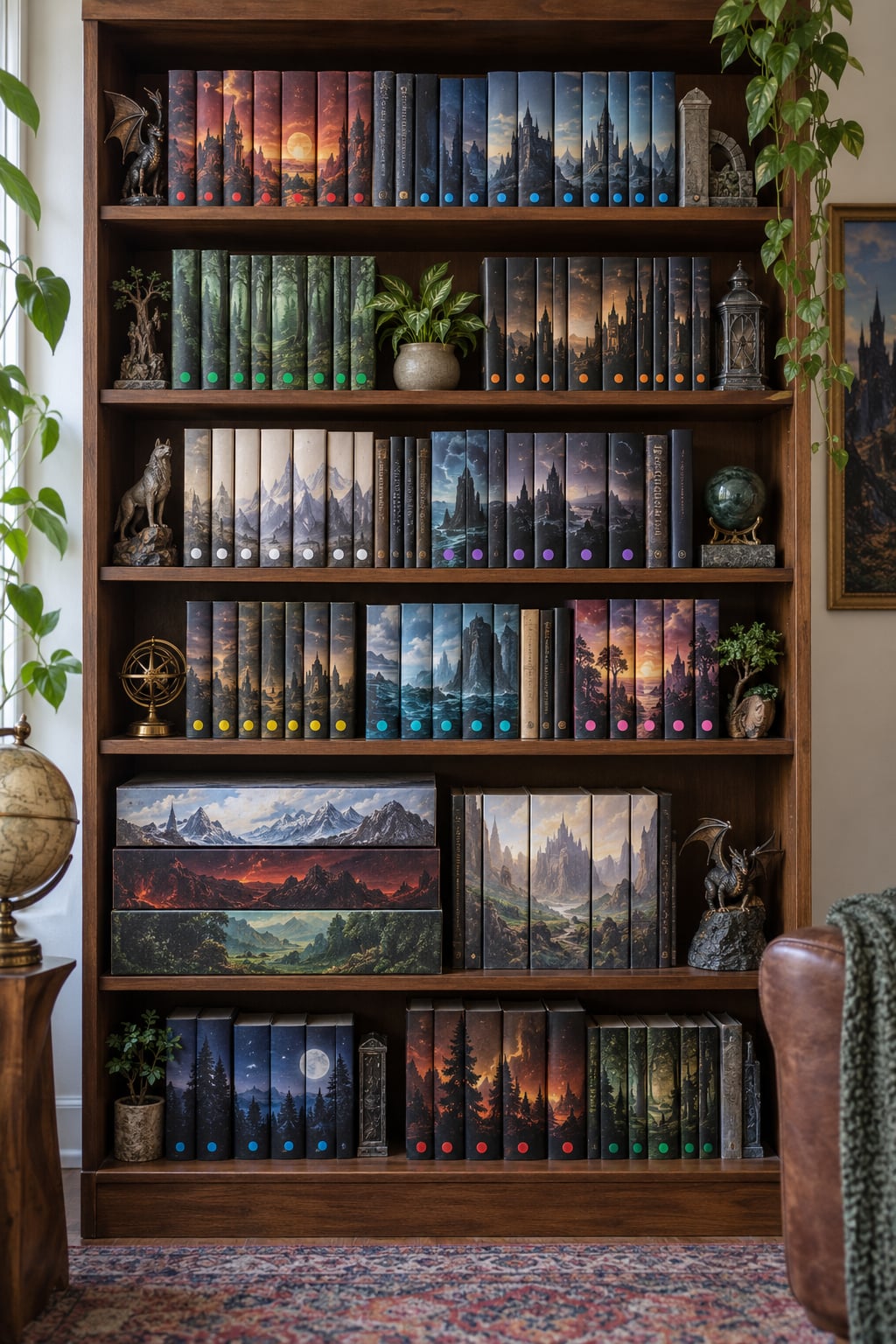
The easiest way to organize a large fantasy book collection is to shelve by series rather than by author alone: each series gets one contiguous block in reading order, sub-genres become the shelf bays, and a simple tracking sheet records what you own. Budget a weekend for the initial sort, then fifteen minutes a month to keep it.
Fantasy shelves break normal organizational advice because one world can sprawl across fifteen volumes of novels, four novellas, two prequels and a box set, and a single author might own six separate series. A flat alphabetical shelf looks tidy for a year and then stops telling you anything useful. The fix is not a more complicated system, it is a different priority: series integrity first, alphabet second.
What follows is the process I would hand a friend with six shelves of fantasy and no plan. It works at 200 volumes and it still works at 800.
Table of Contents
- What You Need
- Step-by-Step: How to Organize a Large Fantasy Book Collection
- Common Mistakes
- Frequently Asked Questions
- What is the best way to organize a large fantasy book collection?
- Should I organize fantasy books by series, author, or reading status?
- How do I keep track of books in a large collection?
- How do I organize books when I own multiple editions of the same title?
- Should I shelve books in publication order or reading order?
- How often should I reorganize my fantasy book collection?
- Conclusion
What You Need
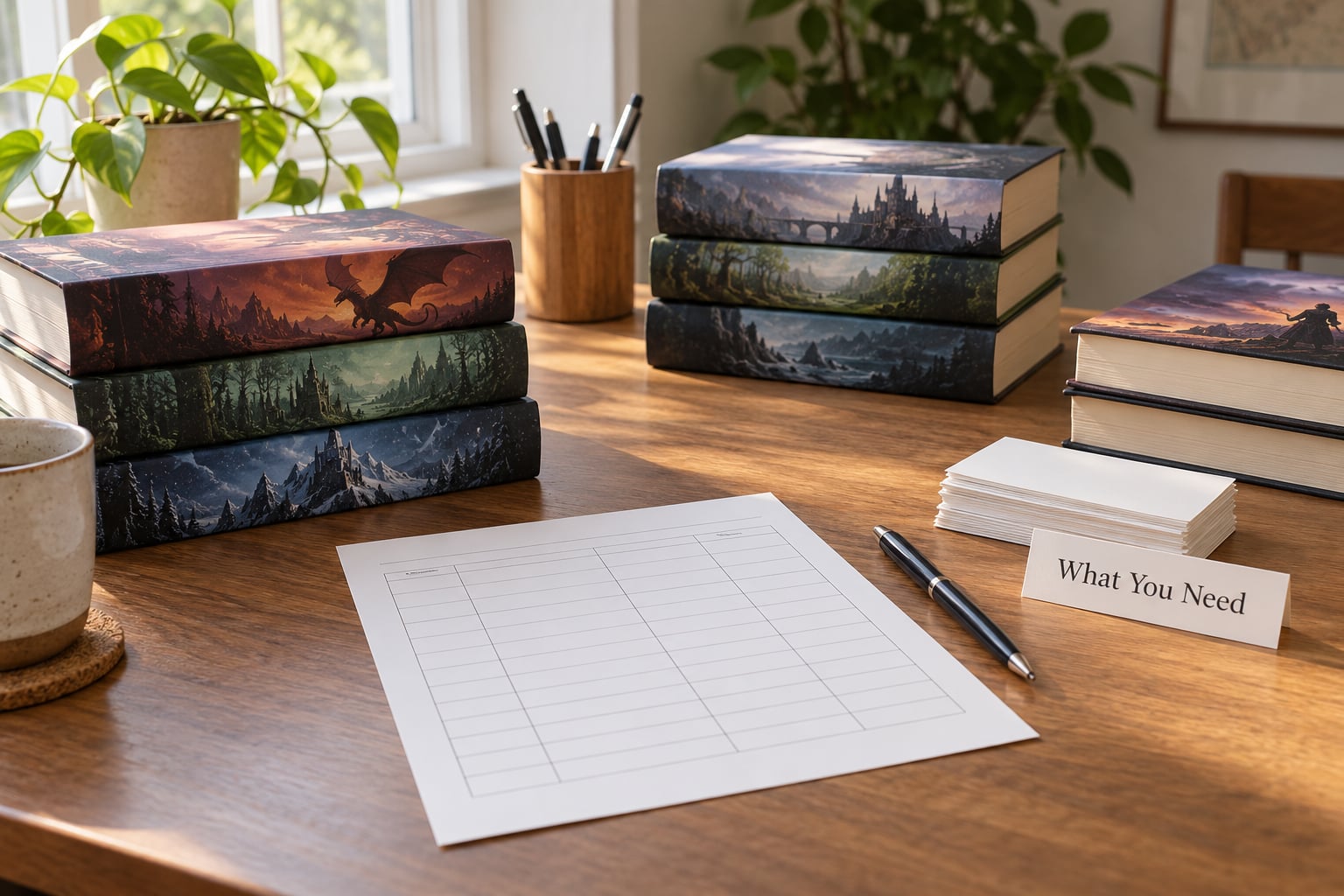
Gather four things before you touch a single shelf, because a system built on whatever was within reach on Saturday evening is the system that fails by February.
- A tracking method. A single spreadsheet, notebook, or app where every book you own gets one row. The columns that matter are title, author, series, series number, format, and read status.
- Shelf labels. Removable adhesive labels or card stock cut to your shelf width, plus a marker. Cheap, and they get replaced often.
- Storage hardware. Bookends for the ends of series blocks, and something sturdy for the heavy stuff: deluxe editions, illustrated hardcovers, and multi-volume box sets.
- A sorting surface. A table or the floor. You need space to lay out piles, and a floor you can walk over twice is better than a table you have to clear for dinner.
Optional: a cataloging app. Goodreads, StoryGraph, Fable, and LibraryThing all track series and editions, and a plain Google Sheet still beats nothing once you pass a few hundred titles. Pick one, not four.
Step-by-Step: How to Organize a Large Fantasy Book Collection
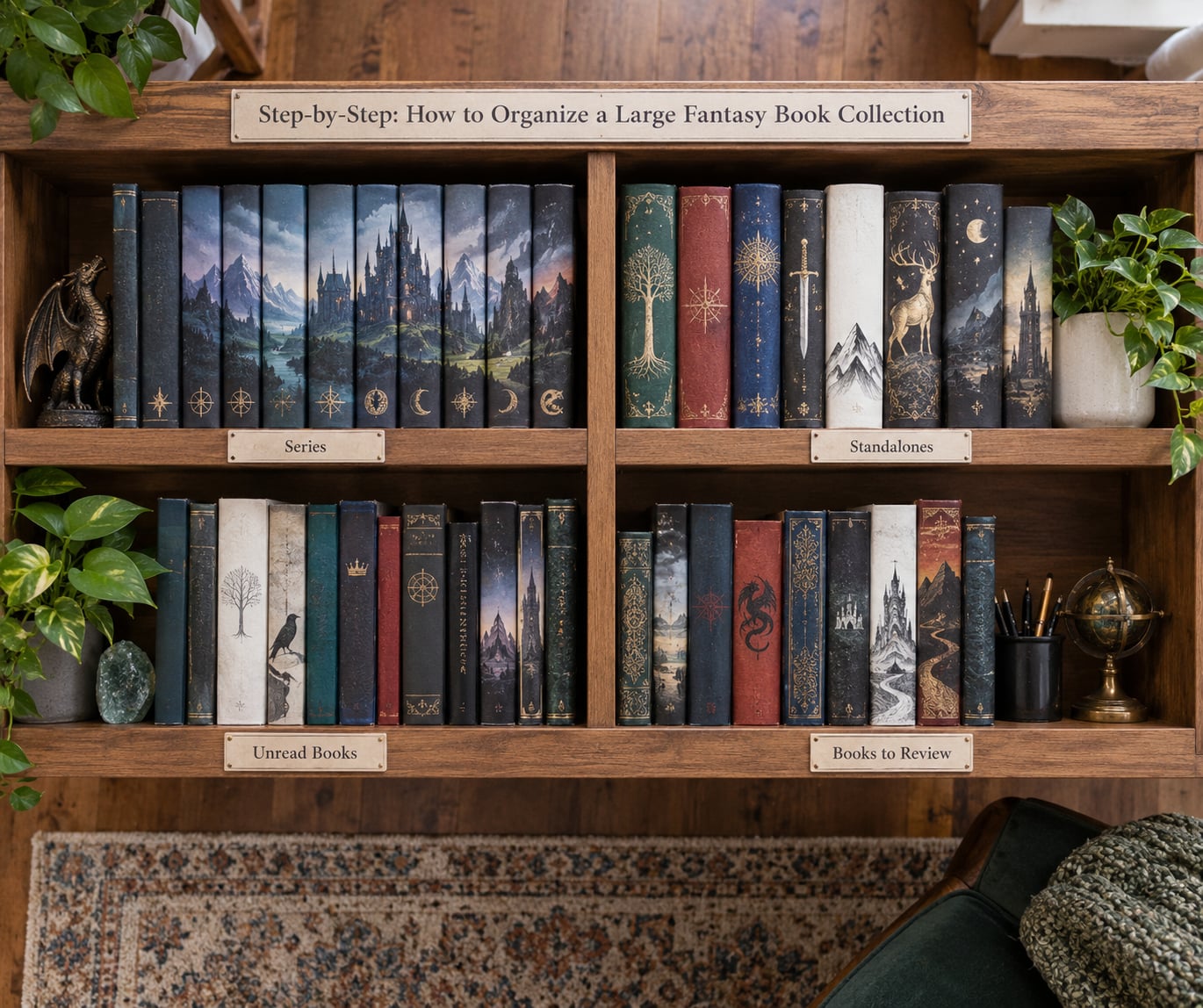
The order matters more than the details. Inventory first, declutter second, choose a system third, and only then move physical books. Readers who start by pulling everything off the shelves end up with a floor covered in books and no memory of what they decided.
Step 1: Decide What You Own
Pull everything you own of that genre into one place and record it before you sort it. Sit down with your tracking sheet and work shelf by shelf, writing one row per book.
Capture four things per title: the series it belongs to and its number in that series, the format you actually own, your read status, and whether it is a duplicate. Duplicates are the big one in a fantasy collection. Most of us own the hardcover of a book two and the mass market paperback of book one, plus a box set that contains both. Decide now which copy is your reading copy and whether the others are staying or going.
This pass takes longer than it sounds. Budget an hour per two shelves, and resist the urge to shelve anything while you record it. The value of the inventory is that it turns a memory problem into a lookup problem, and you can only do that if the sheet matches the shelf exactly.
You will also catch condition problems now rather than in a move three years from now: cracked spines, water rings, missing dust jackets, and the one page in book three that always falls open.
Step 2: Choose a Simple Organization System
Pick one primary system and let everything else be secondary. For a large fantasy collection the strongest options are below, ranked by how well they hold up as the collection grows.
| System | Best for | Main drawback | Effort | Holds up at 500+ books |
|---|---|---|---|---|
| Series-first blocks, sub-genre bays | Readers with many ongoing series | Breaks the alphabet on purpose | Medium | Yes |
| Author alphabetically, series in order within | Smaller collections, few series per author | Fails as one author accumulates series | Low | Partly |
| Sub-genre only (epic, grimdark, romantasy) | Browsing by mood, buying decisions | Splits a series across two bays | Low | Partly |
| Reading status (to-read, read, DNF) | Deciding what to read next | Says nothing about what a book is | Low | No |
| Format (hardcover, paperback, box set) | Collectors with duplicates | Separates series members | Low | No |
| Publication order across all series | Nobody, honestly | Loses every series relationship | High | No |
| Color gradient | Photography and looks | You cannot find anything | Medium | No |
| Mood or theme shelves | Readers who read by feeling | Impossible to maintain honestly | High | No |
The hybrid that works for almost everyone is two layers: sub-genre bays at the shelf level, series blocks in reading order inside each bay, and the author’s name alphabetized only among their standalone titles. A worked example helps. In an epic fantasy bay, give The Realm of the Elderlings its own block of six with a bookend at each end, Wheel of Time a block of fourteen, and put Brian Staveley’s books together as standalones alphabetized by title rather than wedging them into an author’s series run. Nothing is lost, because every one of those blocks carries the author’s name on the shelf label.
Color sorting is worth a sentence: it looks wonderful in a photograph and fails the moment you want to find book four. Treat it as decoration for the shelf you do not read from, not as your filing system.
Step 3: Give Every Series a Home
Every series gets one uninterrupted run of shelf space, and within that run the books sit in reading order. Not publication order, not alphabetical by title, not the order you happened to buy them. Reading order is the sequence the story is meant to be read in, including prequels, interquels, and standalones that belong to the same world.
Reading order and publication order disagree more often than fantasy readers expect. Novellas released between novels often need to be read at a specific point, and a prequel printed years later sometimes lands before the opening book. If you are unsure of a sequence, write the order on a slip of paper and tuck it inside the first volume of the block. That slip is worth more than any app when the series runs to eleven books.
Bookends do the real work here. Every block gets one at each end so a series never bleeds into its neighbor, which is the single most common way a fantasy shelf falls apart. If you skip bookends, the shelf still looks fine in June and is unusable by December.
Leave space. A completed six-book series needs shelf room for a seventh and an eighth book, and readers who reserve a gap instead of squeezing avoid reshuffling the whole bay every time a new volume arrives.
Step 4: Separate Books by Reading Status
Reading status is the one category that changes constantly, so keep it out of the main series shelves and give it its own small space. Six labels cover nearly everything: to read, currently reading, finished, paused, did not finish, and lent out.
The did-not-finish shelf solves a problem almost every large collection has. Those books belong to you, they are not trash, and they do not belong in a series block either because the gap confuses everyone including you. Give them a labeled shelf, set a reminder to revisit them once a year, and move on.
A lent-out shelf matters in shared households. A strip of masking tape with the reader’s name and the date goes inside the front cover, and the book gets a slot on the shelf. Books do not vanish so much as migrate into other rooms.
Decide what finished books do. The popular answer is that they stay shelved in series order, because a collection you can browse beats a trophy wall of read books. If you want them moved instead, a “read” box by the door that empties into donation is the version that actually happens.
Step 5: Label Shelves and Containers
A shelf label should answer three questions in under two seconds: what category lives here, in what order, and what is not here. A bay label reading “Epic Fantasy – Series in Reading Order” does that. Add the author’s name to the front edge of each individual series block, and a small card at the end of any series with a complicated order listing novellas and prequels.
For sub-genres, write your own short list and stick to it. The seven that cover most shelves: epic, grimdark, sword-and-sorcery, dark academia, romantasy, progression fantasy, and folkloric. Dark academia and romantasy overlap constantly, so decide once that a series lives in whichever bay you read it for, and stop relabelling.
Use a simple color dot on the spine of each book to encode status: a dot for unread, two for finished, one for paused, and a strip of tape for lent. Readers who share a collection pick this up in a day because it only requires reading two states at a glance.
For boxes and overflow, label the outside with the bay name and the box number, like “Epic – Box 2 of 3.” Then keep a list of what is in each box somewhere other than the box itself, in the same spreadsheet as your inventory. Labeled boxes with no index are the fastest way to lose a series permanently.
Step 6: Maintain the System
Systems die at the intake point. The rule that keeps this one alive is simple: a new book never goes straight onto a shelf. It goes into an intake slot, and once a week you process that slot by adding the book to your tracking sheet, placing it in its series block in order, and moving anything finished forward.
That weekly loop is about fifteen minutes. Once a quarter, spend longer: walk each bay, check that the bookends still hold, confirm the tracking sheet matches the shelf, and pull anything you have not touched in a year into a review pile. The review pile is where donation and resale decisions happen, on a schedule, instead of during a frustrated reshuffle.
Set a numeric donation threshold and stick to it. A collection of a thousand volumes needs a real answer for what happens at volume 600, whether that is a library donation drop, a school drive, or resale listings, and choosing the outlet ahead of time makes the decision much easier.
If more than one person reads from the collection, make the intake rule shared. Everyone drops new arrivals in the same slot, and one person owns the weekly processing. Two people maintaining two systems is how a shelf ends up with two half-alphabetized halves.
Common Mistakes
Overcomplicated categories. Twelve sub-genres, four status codes, and a rating system means no one remembers the rules by month two. Three or four labels beat twelve every time. The fix is to cut the taxonomy to what you actually browse by and let the rest go.
Inconsistent series numbering. Books three and four in a series end up on different shelves because one was shelved during a move. The fix is to record the number in your tracking sheet and check the number, not the position, when you shelve.
Duplicate editions nobody has decided about. Two copies of the same novel in hardcover and paperback is normal; not knowing which one you are reading from is the problem. Pick a primary edition per title, and let the rest be display or trade material.
Vague labels. “Misc” and “Shelf 2” force you to re-scan the whole shelf every time. Labels should name a category and an order, and containers should carry a number tied to an index.
Perfecting instead of finishing. Spending three weekends re-sorting by color, then by publication date, then by author, is the trap. A system that is 80 percent consistent in one afternoon beats a beautiful system you abandon in month three. Pick the version you will still be using in a year.
Shelving the unread pile in series order. Starting a series at book one when book three is the one you are actually craving means the block never gets opened. Keep unread series in order too, but let your read-status shelf carry the “start here” books.
Ignoring weight. Illustrated deluxe editions, art books, and full multi-volume box sets are heavy. Put them on a lower shelf, spread the load across a full shelf rather than a half-empty one, and add a center support to a long span if the shelf bows. Stacking horizontally is fine for overflow, but the middle and bottom books will be awkward to reach and they collect dust.
Frequently Asked Questions
What is the best way to organize a large fantasy book collection?
The best method is series-first: give each series one uninterrupted block of shelf space in reading order, use sub-genres as your shelf bays, and alphabetize only among an author’s standalone books. A tracking sheet with title, series, number, format, and read status keeps the shelf and your memory aligned. Bookends at both ends of every block stop series from bleeding into each other.
Should I organize fantasy books by series, author, or reading status?
Use all three at different layers. Sub-genre bays hold series, each series block is arranged in reading order, and reading status lives on a separate small shelf. Author alphabetical order is useful only among standalone titles. Putting status on the main shelves splits every series you own, which is the opposite of what a fantasy collection needs.
How do I keep track of books in a large collection?
Use one tracking tool and keep it current weekly. A spreadsheet with columns for title, author, series, series number, format, and read status is the most flexible option. Goodreads, StoryGraph, Fable, and LibraryThing all handle series and editions if you prefer an app, though list functions are their most-cited weakness. One tool you maintain beats four you half-use.
How do I organize books when I own multiple editions of the same title?
Choose one primary reading copy per title and file the extras separately, usually by format, in a display or trade shelf. Never split editions of the same novel across two places within a series block, because finding book two becomes a two-shelf hunt. Record every copy in your inventory so the duplicates are a known list rather than a mystery.
Should I shelve books in publication order or reading order?
Reading order, almost always. Publication order puts a prequel at the end of the block and scatters novellas that were written to be read mid-series. When a sequence is genuinely complicated, write the order on a card and stand it at the end of the block. That card answers the question faster than any app or memory will.
How often should I reorganize my fantasy book collection?
Process new arrivals weekly in about fifteen minutes, and do a fuller reset once a quarter. A quarterly walk lets you check bookends, reconcile the tracking sheet with the shelf, and pull untouched books into a donation or resale review. Full reshuffles twice a year are unnecessary once the intake and status rules are in place.
Conclusion
Start with the inventory sheet, not the shelves. Write down what you own, series and number and format and status, and the decisions about duplicates fall out of that on their own. Then build one shelf at a time in the order given here: sub-genre bay, series block, reading order inside the block, bookends at both ends.
Once that is done, protect it with the smallest possible habit: new books go into one intake slot, and you process that slot for fifteen minutes each week. A modest system you actually keep beats a beautiful one you rebuild every spring, and it will still make sense to you when the collection is twice this size.