
Full spoilers for all seven books and the finished films.
The honest answer to why Snape hated Harry Potter has almost nothing to do with Harry himself. Severus Snape resented the boy for carrying James Potter’s face, resented him for being the living proof that Lily chose his bully, and resented him for the attention and affection Snape never got. Underneath all of that sat grief over Lily, guilt about Godric’s Hollow, and a cover story he had to keep up in front of people who would kill him on the spot if they guessed the truth.
So the cruelty was real, and it was deliberate. It was also, in large parts, a performance. Those two facts are not in conflict, and holding both of them is the only way to make sense of a character who spent seventeen years insulting a boy he kept alive.
Table of Contents
- Why Snape Hated Harry Potter
- The short answer: James’s son was not the real enemy
- Why Snape blamed Harry for being a Potter
- The Lily humiliation and Snape’s resentment
- Why Snape treated Harry cruelly in Hogwarts
- Grief, love, and divided loyalties
- The evidence that Snape was protecting Harry
- Did Snape actually hate Harry, or was he protecting him?
- Frequently Asked Questions
- Conclusion: Start with the resentment, not the simple hatred
Why Snape Hated Harry Potter
Snape hated Harry because Harry was James’s son, and James was the boy who humiliated him at school, won Lily’s affection, and was dead while Snape was not. The resemblance was close enough that Snape never had to look at Harry to see James, and the memory of Sirius Black calling Lily a Mudblood in front of him turned that hatred into something permanent.
Add the part almost every reader misses. Snape never had the freedom to simply be nice to Harry, because Voldemort and the Death Eaters were watching and a friendly potions master would have exposed him immediately. The hatred had to stay loud. The protection had to stay quiet.
The short answer: James’s son was not the real enemy
Six layers stack up underneath Snape’s behaviour, and the first two explain most of it.
What Snape’s hatred of Harry actually consisted of
The hatred for James Potter
- James and Sirius hung Snape upside down in the Great Hall for the fun of it, which is the memory Harry sees at the end of the last book.
- Lily chose James, and Snape never got over it, whatever he told himself about why.
- Harry looks like James, and Snape compares the boy to his father constantly and almost never to his mother.
The mix of guilt and protection
- Snape let the prophecy reach Voldemort, then shouted it out so Voldemort went for the baby instead of the adult.
- Lily’s sacrifice attached itself to Harry, and Snape spent the next seventeen years working inside that protection.
- He had to be publicly cruel, because a kind potions master would have been reported within a month.
That is the whole argument in short form. The rest of this piece takes it apart piece by piece.
Why Snape blamed Harry for being a Potter
Snape never separated the boy from the father, and the books make that plain through the one comparison he repeats. He calls Harry arrogant, a show-off, a cheat and a disappointment, and almost every time the comparison ends with his father. Fans who argued about this on the Fandom boards for years landed on the same reading, and the films added to it with a mirrored shot of Snape watching his own reflection while Harry is in the room.
| What Snape reacted to in James | What Harry gave him in return |
|---|---|
| Being second to Sirius in every joke | A godfather who loudly defended him |
| Being second to James in Lily’s heart | A son Lily died for, and grieved for |
| Being humiliated by his own house | Years of being the most famous student in the school |
| Never having been told he mattered | Attention, praise and prophecy-level fuss |
Look down that table and the pattern is uncomfortable. Every grievance points at something Harry received rather than anything he did. Snape resented popularity he was never offered, and Harry arrived carrying popularity like luggage.
There is a fairness point worth naming here, because the films pushed fandom hard in this direction. James bullying Snape in the fifth-year memories is ugly and real. At the same time, Sirius was a grown man laughing at a child in a cloak, and the books make clear that Snape was a genuinely vicious fourteen-year-old before any of it happened to him. Both of those things are true, and the only bad answer is pretending the second one cancels the first.
The Lily humiliation and Snape’s resentment
The friendship with Lily is the part the films softened, and it changes how the whole character reads. They were close at Hogwarts, close enough that he used her given name as a pet name. Then she ended it, in a corridor, with an insult about the word Mudblood, the slur the Marauders used to sort her out as worthless.
That argument is the hinge of the entire story. Snape said the word about Lily to a teacher, was told it was ugly, and effectively lost her. He later repeated the same slur about her in front of Dumbledore, and Dumbledore let him know she was a witch and that she had died for it anyway. The insult belonged to Sirius, and Sirius used it in the Shrieking Shack in front of a boy who had spent an evening comforting a werewolf.
Snape’s reaction there is the most honest glimpse of his inner state that the series gives us. Sirius tells him that Lily is dead, so what does it matter that she loved him. The line is designed to be unbearable, and it is, because the insult was never really about blood status. It was about who got to say the worst thing first.
Everything after that is resentfulness sharpened by class. Spinner’s End, the drunk father, the mother who was afraid of him, the second-hand robes, Lily arriving years later with James in tow and a baby who made everyone tell him how special he was. Snape did not resent Harry for being talented. He resented Harry for being rewarded in a world that had never rewarded him.
Why Snape treated Harry cruelly in Hogwarts
The five years of lessons are the evidence fans argue about, and both readings survive the argument. On the surface it is simple: arbitrary detentions, unfair marks, the detention that ran through most of Harry’s fifth year, and a potions master who seemed to take pleasure in it.
Then there is Neville, who was punished for a cauldron Snape probably did not see him break, and Hermione, who was called a know-it-all in front of the class in her first term. The cruellest version of this reads as a man punishing children for resembling the world that failed him.
Look at the pattern underneath it, though. Snape takes points from Gryffindor constantly and gives them almost never, but the two exceptions are both aimed at a defensible target. The points he gives Gryffindor go to Harry for standing up to a Death Eater, and again for the Shrieking Shack. The Nymphadora Tonks incident makes the same point in reverse: he refuses to award a point simply because a Death Eater’s daughter asked nicely.
He also slips in the other direction. He tells Harry he is not a bad boy, a half-blood, and that the Half-Blood Prince really was a Half-Blood Prince. Under a regime where being associated with Slytherin is grounds for arrest, a teacher who quietly tells a half-blood child that he has standing is doing something specific with that moment.
There is also the thing he says in the cave in the second half of the final book. He was not finished, he tells Harry, even after everything. The man is not finished, and a man who has stopped caring would have walked away.
Read the harshest episode as guilt rather than contempt and it becomes more coherent. During Harry’s O.W.L.s, Snape watches the boy he resented nearly die and then walks out of the hall without saying a word about it. Dumbledore’s reaction is immediate and furious, and the argument ends with the boy being sent away for his own safety. Guilt does not produce a speech. It produces an exit.
Hermione’s case is the one that softens over time. He calls her a foul-mouthed know-it-all in her first term, then says she is much better than the average of her kind, and he admits he does not know why he says it. He is not a good man. He is a man whose cruelty narrows as he spends more time actually looking at the person in front of him.
Grief, love, and divided loyalties
Snape’s loyalties ran in four directions at once, and none of them won. He loved Lily, despised James, served Voldemort, and obeyed Dumbledore. A double agent, plainly, is one person who is secretly on one side while appearing to serve the other.
He went to Dumbledore after the murder at Godric’s Hollow, made an Unbreakable Vow to do whatever Dumbledore asked in exchange for Dumbledore doing the same for him, and then spent decades finding out what that vow cost. He killed the people closest to him to stay credible. He taught at Hogwarts under a regime that would have killed him for his house, because it was the post Dumbledore was able to protect him in, and the only subject Dumbledore let him keep was the one that had been Lily’s.
Split that four ways and the behaviour stops looking contradictory. He was a grieving man running three accounts at once, and the balance kept tipping in the wrong direction. Loyalty to Lily was the only line he never broke. It is also the reason he was able to make promises to both sides at all, and the reason every promise turned out to be about Harry.
The evidence that Snape was protecting Harry
Here is the timeline, grievance against action. Almost every row has both, and that is the pattern nobody usually lays out.
| Period | What Harry cost Snape | What Snape did about it |
|---|---|---|
| School years | Nothing yet; he was still James’s victim | Hung upside down, robes torn, mocked in front of the whole hall |
| 1971, Godric’s Hollow | Everything, in a single night | Shouted the prophecy aloud so Voldemort went for the baby |
| 1972 onward | Guilt he never once said out loud | Carried Lily’s body back and began a double life |
| 1981 | He had to work with a baby he could not look at | Reported the prophecy to Voldemort, which is exactly why Voldemort went to the house |
| 1981 to 1982 | Nothing; Harry was just a first year | Gave him his father’s broom and the password to the trophy room |
| 1991 to 1992 | A live reminder of James in the next room | Jinxed the Quidditch brooms, then caught Harry out and freed the team |
| 1992 to 1993 | Sirius had just finished humiliating him about Lily | Wrote the passwords so Ron and Hermione could rescue Harry from the Shack |
| 1995 to 1996 | Harry refused every instruction he was given | Blocked Umbridge’s forced mind reading, then handed him the Remembrall |
| 1996 to 1997 | Harry exposed his book in front of Voldemort | Let Harry’s cover stand and told Voldemort the book was worthless |
| 1997 to 1998 | Harry was the only one left who had ever doubted him | Refused to kill him at the graveyard, then gave up the memories |
Two of those rows deserve more than the rest.
At the graveyard, Voldemort orders Snape to kill Harry and watch. Snape argues that the prophecy might be wrong and asks whether Voldemort wants him on his side. The order is dropped, and that is the only time in the whole series Snape openly disobeys Voldemort. He gets away with it for one reason, which is that Voldemort already believes Harry must die by Voldemort’s hand.
His last two lines, in the books and the cave scene, are the whole character in miniature. He is bleeding, Voldemort is standing over him, and he keeps talking about Harry. The line everyone quotes is Look at them, which is the other half of a thought about Harry and Voldemort looking alike, and it is not a threat. It is Snape trying to make sure Voldemort still sees Harry as connected to him rather than disposable. He dies a few seconds later without ever explaining it to anyone.
Did Snape actually hate Harry, or was he protecting him?
Both, and the order of the two matters more than the fact of them. Snape never loved Harry, and the popular version of that claim flatters Snape and insults Harry. What he felt was far stranger and more durable: attachment to Lily surviving in the only shape left to him, filtered through a face that was not hers.
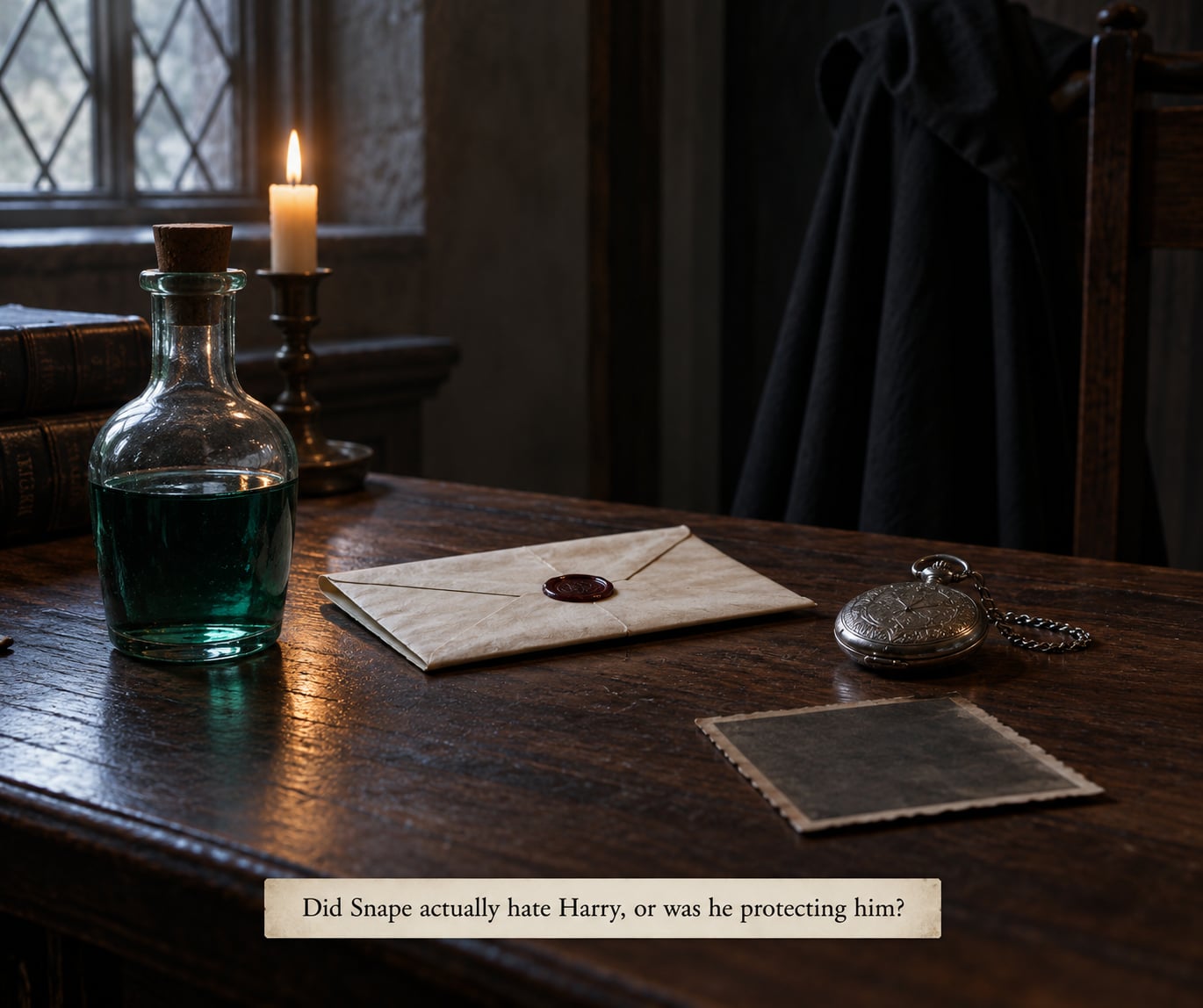
Image: a desk holding the objects Snape kept close, one photograph deliberately turned facedown.
There is a specific theoretical reason his behaviour is so hard to read. He could only act openly on the theory that Voldemort would never see it, and Voldemort read minds. A potions master who punished Harry in public and did nothing in private was safe precisely because the public version was so obviously complete. Once you allow for that, several of the cruellest moments turn into the safest ones, and the pattern stops looking like a contradiction.
What is left over is not tenderness. It is a man who found one person in the world worth loyalty, lost her, and then spent every remaining year keeping the boy she died for out of reach of the people who had killed her. He was not nice about it. He never once apologised to Harry. But he kept his side of the only promise he had ever bothered to make, which came to the point of giving Harry his own memories.
Harry is the one who finally sorts it out, at the very end, when the Pensieve shows a man covered in blood and repeating his given name. That scene reframes the whole relationship in about ninety seconds, which is why so many readers describe it as the moment the series changed their mind about him.
Frequently Asked Questions
Why was Snape so cruel to Harry?
Three reasons, in order of weight. Harry looked and behaved like James Potter, the boy who humiliated him and won Lily. Lily chose James and Snape never recovered from that. And because Snape was a double agent, cruelty toward Harry was the cover that kept him alive in front of Voldemort. The detention and the bad marks were usually the punishment he could explain if anyone asked.
Did Snape actually hate Harry?
Yes, in the way that matters day to day. He never showed Harry warmth, never said anything kind about him without an excuse, and compared him to his father for seven years. But the hate was aimed at a memory more than a person, and the same man put his neck on the line twice to keep Harry alive. The honest version is that Snape hated Harry and protected him, and did not separate the two.
Would Snape have hated Harry if he had been sorted into Slytherin?
Probably not the same way. Slytherin would have given Harry something Snape understood, and the projection of James would have had less room to work because the rivalry itself would have gone quiet. The counterfactual fans raise most often goes further and asks whether a Harry who looked like Lily would have been hated at all. Snape would likely have found that harder rather than easier, because he never separated Harry from James in the first place.
Did Harry Potter ever forgive Snape?
He said so, plainly, to Dumbledore in the hospital at the end of the war, and he named his second son Albus Severus, which is the clearest answer the series gives. That forgiveness was real and it was also late. Harry spent years hating a man who never explained himself, and the reconciliation came with the memories rather than before them, so forgiveness arrived after the harm rather than instead of it.
Why did Snape treat Neville and Hermione so badly?
Both grudges are canon and both get less clear the closer you look at them. Neville was the child the prophecy was about but not the child Voldemort chose, which made him the wrong Harry in the wrong year, and Snape’s memory of Lily dying for the right one made that unbearable. Hermione was an eager, mouthy Gryffindor who kept answering back, and she also happened to be Lily’s friend, which Snape found easy to hate and, eventually, hard to.
Who is the least liked character in Harry Potter?
Severus Snape, consistently and by a wide margin, in fan polls and informal counts. Voldemort usually comes second even though he is the villain, and Umbridge is the only character who regularly beats him. The reason Snape wins is not the cruelty, which is extreme, but how long he spends on screen being unredeemable before the story explains any of it.
Conclusion: Start with the resentment, not the simple hatred
If you only remember one thing about why Snape hated Harry Potter, make it the projection, not the protection. Snape looked at Harry and saw James, and he punished Harry for a rivalry that had already ended with James dead and buried. Everything else, the double agent, the vow, the graveyard, grew out of that one wound.
Start there, and the kindness he never showed Harry reads as grief that had nowhere left to go. It does not make the cruelty forgivable. It just makes it legible.