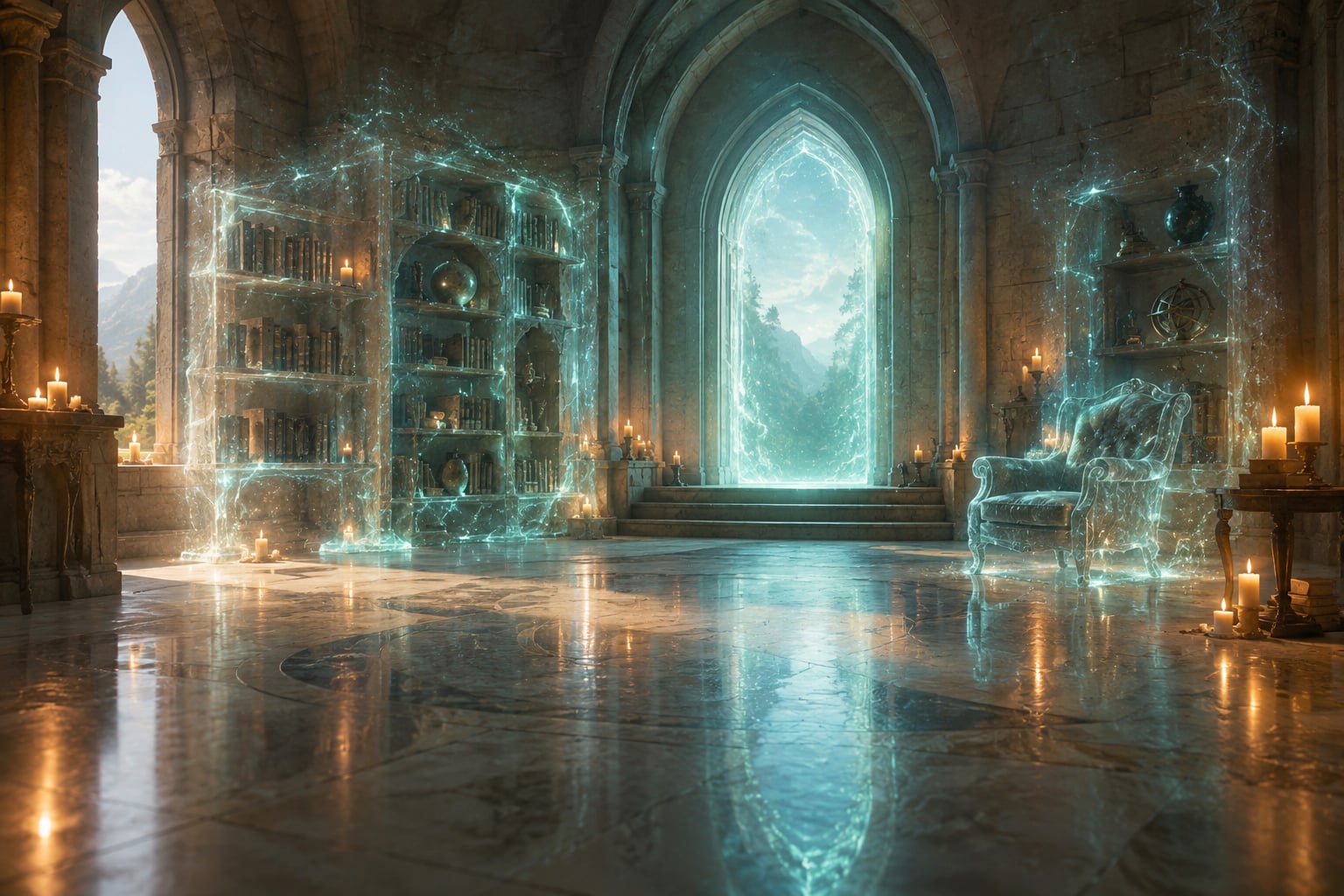
The Room of Requirement is a hidden chamber on the seventh floor of Hogwarts that opens when you walk past the right stretch of wall three times with a clear, genuine need in mind. It then reshapes itself into whatever you asked for. It cannot create food, it stays off the Marauder’s Map, and it does not answer everybody who knows it exists.
That is the short version. The long version is stranger, because the room never explains its own rules and Harry never fully works out where it came from. After seven books and eight films, it is still the most useful piece of magic at Hogwarts and the one nobody can pin down.
Table of Contents
- How the Room of Requirement Works
- Who Created the Room of Requirement?
- Why Does the Room Change What It Provides?
- What Can the Room of Requirement Create?
- Can Anyone Use the Room of Requirement?
- What Are the Room of Requirement’s Limits?
- How Did Harry Use the Room in the Half-Blood Prince?
- Why Did the Room of Requirement Disappear?
- Frequently Asked Questions
- How do you call the Room of Requirement?
- Why does knowing the password still not let you find the Room of Requirement?
- Can Polyjuice get you into the Room of Requirement?
- Can the Room of Requirement create absolutely anything?
- Why can’t a Marauder’s map find the Room of Requirement?
- Why did the Room of Requirement disappear after Harry used it?
- Conclusion
How the Room of Requirement Works
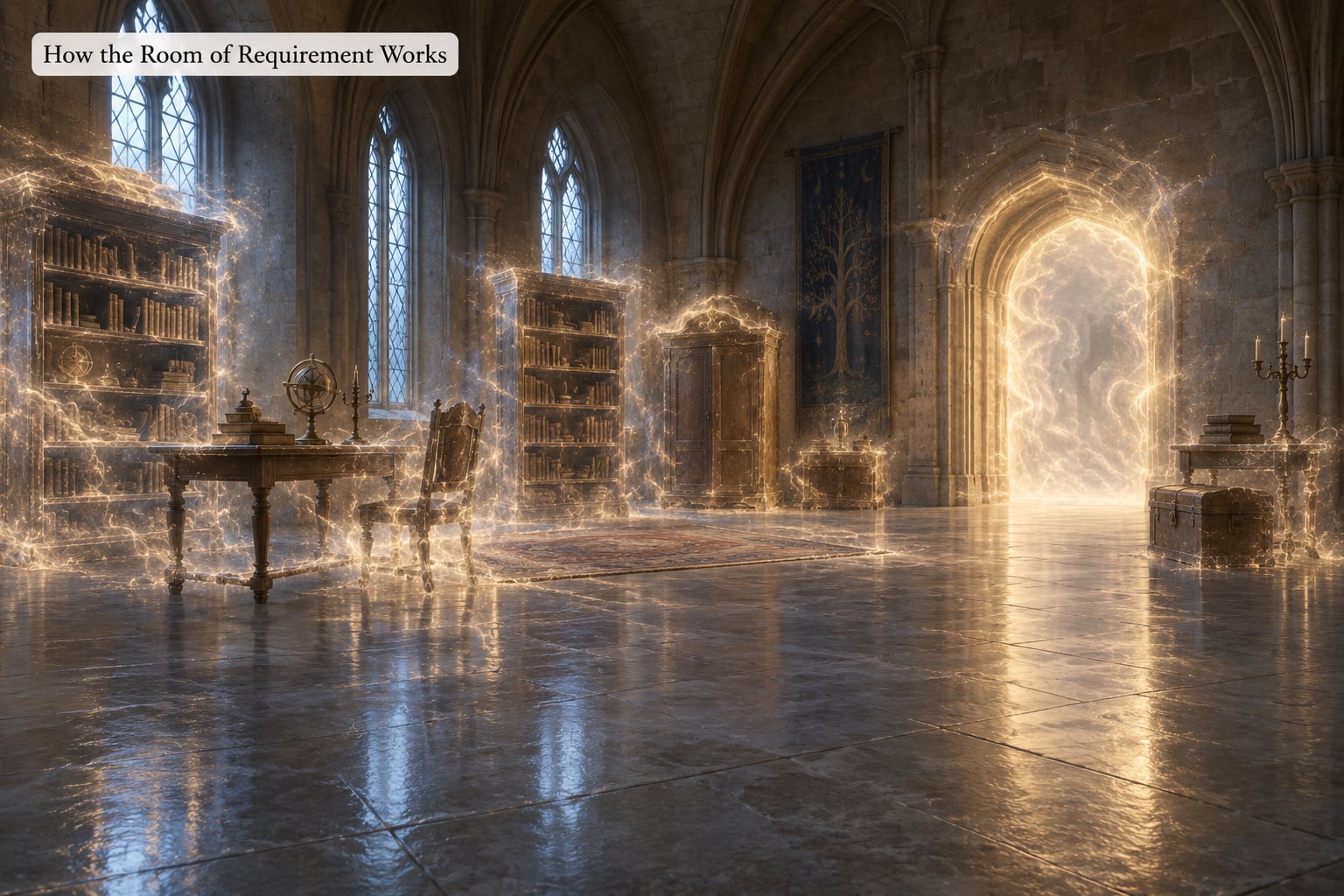
The room works on two conditions: you have to genuinely need something, and you have to know precisely what that something is. No one explains this at the door. You learn it by walking past a wall three times and seeing what happens.
- Go to the seventh floor. The entrance is opposite the tapestry of Barnabas the Barmy, a cheerfully dishonest medieval wizard advertising a jar of hair of the hippogriff.
- Walk past the wall three times. First past it one way, then turn round and go past the other way, then back again. Two passes do nothing at all.
- Keep your purpose in your head. Think about what you are there for, not what you are hoping to browse.
- Step through when the door appears. The plain stone becomes a doorway, and the room behind it has already rearranged itself around your request.
Two further details matter. The room is unplottable, so it never shows up on the Marauder’s Map or any other map. And it blocks Apparition into itself, so once you are inside, anyone outside cannot simply blink their way in after you.
Why the Room of Requirement Works Without a Clear Task
Because it reads the need behind the request rather than the words. Harry’s private bathroom is the clearest proof. He wanted a place where nobody could follow him or hear him, and the room handed him a toilet with a working flush, a sink, taps, plumbing and a door that locks. It solved the whole problem, not just the part Harry bothered to say out loud.
Hermione Granger worried about this in Order of the Phoenix. She was the one who understood that the room responds to precision, and Harry still walked in with a vague plan and came out with exactly what he needed. The room seems to treat a need and a well-formed request as two routes to the same destination.
Who Created the Room of Requirement?
Nobody in the books knows, and the mystery is deliberate. The phrase first turns up in Rita Skeeter’s notes on the second Triwizard Tournament, describing an ancient practice of summoning a space by walking past an empty wall three times. That places the ritual in the tournament’s records, not in any founding-era legend.
The strongest clue points at Rowena Ravenclaw. In Order of the Phoenix, Dumbledore confirms that Ravenclaw’s diadem was hidden in the Room of Requirement, which puts one of the four founders’ objects inside it. Her own legacy was intelligence, so a room that responds to what you actually need sits neatly with her character rather than with Slytherin’s ambition or Gryffindor’s nerve.
Other theories attach the room to Horace Slughorn, who has used Hogwarts’ hidden spaces for illegal trading, or to a student of Ravenclaw’s. Treat all of it as theory. The books give you a name in Dumbledore’s testimony and nothing firmer.
Why Does the Room Change What It Provides?
Because transformation is the whole point. The room never builds anything from scratch, as far as anyone can tell. It rearranges, extends and subdivides the space it already has, which is why an unused room can hold a full table, a fireplace, shelves of gear and a wall of hidden objects at the same time.
It also responds to different people differently, and the form changes with the user. Dumbledore asked for somewhere to work without being disturbed and got a workroom. Neville asked for somewhere safe and got a hideout. Ginny asked for fire and got fire. Each request produced a room shaped for that one purpose.
The Room of Hidden Things is the version most readers meet first, and it is the room at its strangest. Neville stumbled into it with no plan at all, and found a junkyard of hundreds of hidden objects: an old mirror, a brooch, a fake nose and teeth, hats, a cabinet, and objects students had hidden from a room that was supposed to answer needs rather than collect contraband.
That hoarding is worth pausing on, because it explains the one question everyone asks about the room’s junk pile. Over decades of unsupervised access, students walked in, asked for something small, and quietly used the space for the rest of it. The room never cleared anything out. What Neville found was less a magical curiosity than a record of how many people had exploited it.
That is also why the room could hold so much at once. Its capacity is not a fixed number of shelves; the magic reshapes to fit whatever is genuinely inside, so every hidden object is arguably one more thing the room is providing.
What Can the Room of Requirement Create?
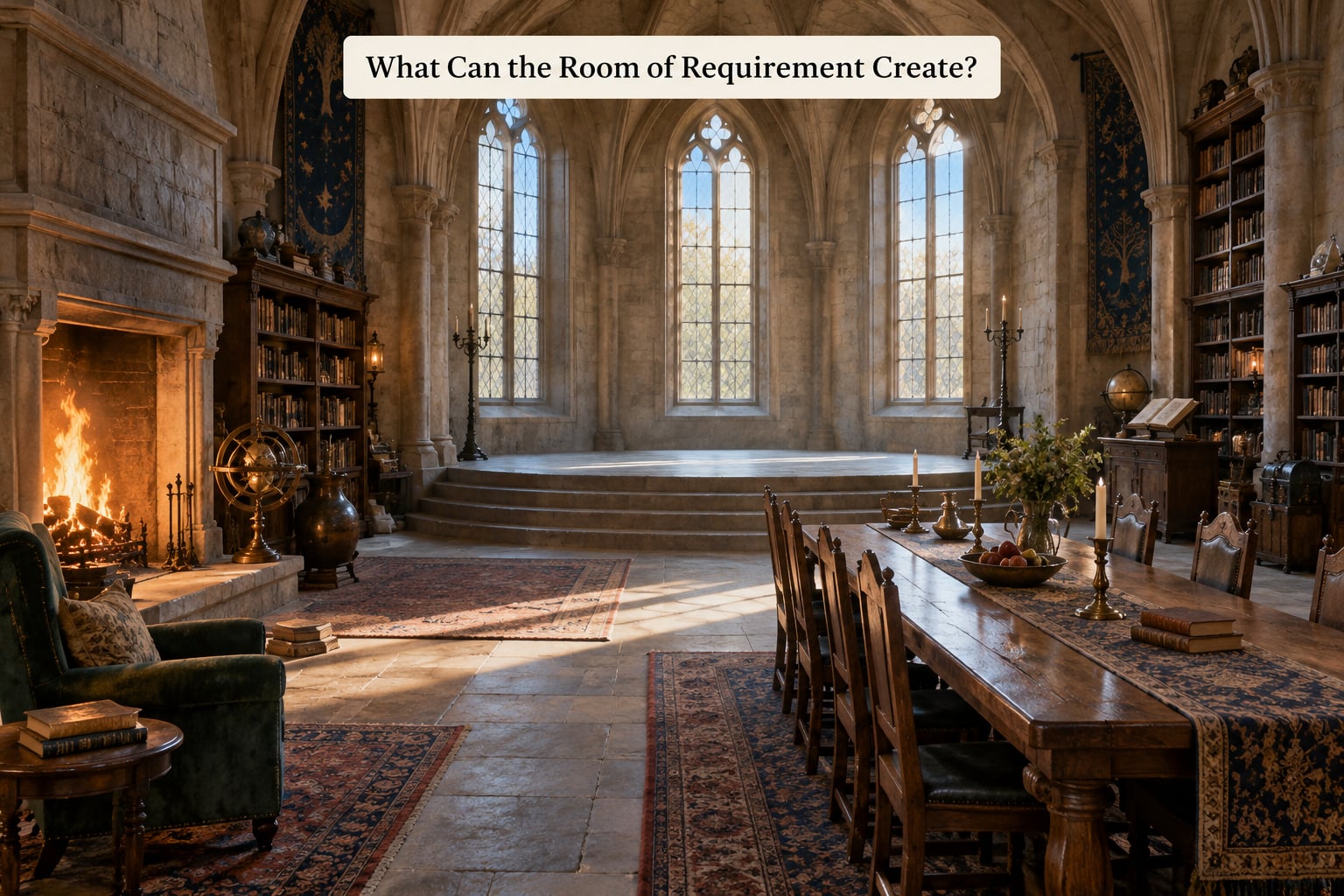
Almost any object or environment, as long as the request is specific and no food is involved. Purpose matters more than phrasing. Here is what the books actually show.
| User | Request | Outcome | Book |
|---|---|---|---|
| Harry | Somewhere private, no one following | A bathroom with a locking door | Order of the Phoenix |
| Ginny | A fire | A room she could burn the Yule Ball dress in | Order of the Phoenix |
| Dumbledore’s Army | A place to train | A practice room with the equipment they needed | Order of the Phoenix |
| Harry’s group | Something to eat | Nothing, so they picked up food from the kitchen instead | Order of the Phoenix |
| Harry | A drink for Slughorn | Slughorn at twelve, a bottle of butterbeer and the memory of the conversation | Half-Blood Prince |
| Neville and others | Somewhere safe to hide | A door that opens onto Hogsmeade through the Hog’s Head | Deathly Hallows |
| Voldemort | A place to hide a Horcrux | The Room of Hidden Things, where the diadem stayed for years | Deathly Hallows |
Note what that table leaves out. The room never creates food, never creates a person, and never once performs an action. It provides spaces and objects. Anything that requires a spell to be cast rather than an object to be placed sits outside what the books show it doing.
Can Anyone Use the Room of Requirement?
No, and that is the question readers argue about most. Knowing the room exists is easy. Knowing where it is, walking past the wall three times and standing there with a real need is what actually gets you in.
Harry, Ron and Hermione spend months hunting the Room of Hidden Things with a list of every trick they can think of. Invisible cloaks fail because the entrance needs your intention, not your clothing. Polyjuice changes your face and voice, not your magical signature. Flying at the wall does nothing. The Marauder’s Map is useless because the room is unplottable. Hermione’s logic, that the room might belong to someone else, turns out to be right more often than she wanted.
Dumbledore knows about it from the beginning, which is why he could direct Harry toward the bathroom in Order of the Phoenix. House-elves cannot Apparate into it at all, which is how Dobby and Winky had to be physically walked in by Harry rather than summoned.
How Dumbledore knows is one of the loosest threads in the series. He claims in Goblet of Fire that he had no idea a room like that existed, then uses it repeatedly and warns Harry about it later. Other material, including the Fantastic Beasts films, has him asking the room for something during his own wandering years. Most readers treat his Goblet of Fire line as the odd one out rather than the rule.
The room also excludes people on request. In Half-Blood Prince Harry asks Dumbledore for permission to use it to trap Malfoy, then asks for a room Malfoy cannot enter, and Malfoy ends up locked in with the Vanishing Cabinet with no way to call for help. Get that detail right and the room becomes a trap; get it wrong and your ally walks in mid-conversation.
Order of the Phoenix supplies the sharpest case study. Dumbledore’s Army asks for a training room and then asks for a room with no Carrow sympathisers in it. The room produces a space where no Carrow supporter is willing to come, which does nothing at all about the Carrows themselves. The magic read the request literally. That is a fair warning for anyone planning their own spell.
The same literal reading explains Voldemort’s diadem sitting untouched in that room for most of the war. He wanted one place nobody would think to look, and that is exactly what he got. He simply forgot that the room answered genuine need, not secrecy, and a girl who needed somewhere safe would eventually walk in. Ask a room for something and you will get that something, faithfully, whether or not it was the smart idea.
Other users never surface their reasons at all. Dobby and Winky are physically escorted in by Harry to hide inside Hogwarts, which is the cleanest proof that the room needs company and intent from a person it trusts. Slughorn is rumoured to have used Hogwarts’ hidden spaces for his trading, though the books never confirm a specific trip to this room.
What Are the Room of Requirement’s Limits?
The limits are real, and several of them have bitten users badly.
- No food. The single hardest rule. Harry’s group asks for dinner and gets nothing, which is why the kitchen run matters so much.
- A genuine need, not a whim. Wandering in curious rarely works. The Room of Hidden Things is the closest the books come to an exception.
- Specificity matters. Vague requests get misread, and misread requests produce rooms with loopholes in them.
- You can lock people out. Ask for a room someone cannot enter and they cannot enter it, whatever they try.
- It is unplottable. No maps, no Marauder’s Map, no reliable directions from anybody who has not been inside.
- No Apparition in. Followers cannot blink in behind you, and house-elves cannot arrive at all.
- It gives, it does not act. Objects and spaces only.
The food rule has a canonical explanation. Gamp’s Law of Elemental Transfiguration bars creating food or drink from nothing, with a set of exceptions, and since the room’s magic is transformation, the law applies to it too. Most readers still find it arbitrary, and they have a fair point.
Which raises the question everyone asks: why not simply ask it to destroy the Horcruxes? Because the room hands over objects and rooms, not actions, and because the people using it mostly did not know where the Horcruxes were. Harry wanted Voldemort’s memories of Horcrux locations, and that required a memory from a living person, which is a different category of request entirely. Ginny and Luna pointed out at the time that asking for the destruction of a soul-splitting object was not the sort of thing anyone expected the room to interpret charitably.
The films also loosen the rules in places. Neville walks past the wall once on screen instead of three times, which quietly breaks the one mechanic the books were specific about. If you are watching rather than reading, treat the three-pass rule as the version everything else has to match.
Hogwarts Legacy players meet a third thing entirely. The room in that game is a permanent player base with potion stations, planting beds, gear upgrades and a vivarium, chosen by the player rather than dictated by a need. It shares the name and the location and almost none of the rules, so if you read a Legacy guide and then go looking for the three-pass entrance, that is the gap.
How Did Harry Use the Room in the Half-Blood Prince?
Harry first tries it in the middle of the school year, hoping it will hand him something useful. It does not, which is exactly the point: the room provides, it does not solve. He goes back later with a clearer plan, and that second visit is where the rules show up in practice.
For the second visit he needs a way to get Slughorn talking, so he doses himself with Polyjuice Potion and turns up as Professor Slughorn. The disguise on its own gets him nothing. The Room of Requirement is not on any map, and the real Slughorn has no reason to walk a stranger into a secret chamber he has never seen.
Then comes the memory. Drunk on aged butterbeer, Slughorn tells Harry about an object he took from a girl he had known at Hogwarts, a tiara, and how he felt bad about it afterwards. Harry now has both halves of what he needs: he knows what was discussed, and from Hermione’s research he knows the room’s name is Merrilin, misspelled on a bottle Slughorn kept as a bookmark.
How the room of requirement works here is almost bureaucratic. Harry goes to the seventh floor with one clear purpose in mind, walks past the wall three times, and the door opens. He steps in, takes the memory he needs, and is out. Nobody asked the room to solve the problem. Harry did the thinking, then used the room as a cupboard.
Why Did the Room of Requirement Disappear?
The short answer is that the room stopped answering, and Harry never worked out why. Late in Half-Blood Prince, when he is hunting Horcruxes and badly wants help, he goes back to the seventh floor and gets nothing. Dumbledore tells him the room is no longer responding to anyone, Harry included.
The most quoted explanation belongs to Luna Lovegood. She had said months earlier that the Chamber of Secrets had been opened again and that people would die this time, and many readers have tied the two together: the Chamber wakes, the Room of Requirement goes quiet. Dumbledore’s own explanation is thinner. He suggests overuse and a growing indifference to what happened inside it, which is a plausible magical rule rather than a proven one.
Treat the cause as unconfirmed. What is certain is the sequence: Harry abuses the room across two years, it finally refuses, and the people who depended on it, including Dumbledore’s Army, lose their safe space and their war room in the same stretch of the story.
Frequently Asked Questions
How do you call the Room of Requirement?
Go to the seventh floor and find the blank stretch of wall opposite the tapestry of Barnabas the Barmy, the medieval wizard selling fake hair of the hippogriff. Walk past the wall three times, once each way and then back again, keeping the purpose of your visit firmly in mind. The wall becomes a door and the room forms around what you asked for. Two passes do nothing, and a vague purpose usually gets you a vague and unhelpful room.
Why does knowing the password still not let you find the Room of Requirement?
Merrilin is the name of the room, not a password, and knowing it changes very little on its own. The entrance responds to a person standing at the wall with a real need and walking past three times. Harry only learns the name after Slughorn shows him the bottle, and he still has to do the walk. It is also a badly spelled name, which tells you how casual the whole arrangement is.
Can Polyjuice get you into the Room of Requirement?
No. Polyjuice changes your face, your voice and your clothes, but it does not change the one thing the entrance responds to, which is the person and their genuine need. Harry uses Polyjuice to fool Slughorn, then still has to go to the seventh floor and pass the wall three times himself. Wearing a borrowed identity gets you the conversation; it does not get you the door.
Can the Room of Requirement create absolutely anything?
No. It cannot create food or drink, which is the limit everyone remembers, and it does not produce people, creatures or working portals. In practice it provides spaces and objects, sometimes enormously elaborate ones, and it reads your request literally enough that a badly worded request can leave a loophole in the result. It also lets you exclude specific people, as Harry does with Malfoy.
Why can’t a Marauder’s map find the Room of Requirement?
The room is described as unplottable, so it does not register on any map that works inside Hogwarts, the Marauder’s included. The protection also runs the other way: it blocks Apparition into itself, so a map is not your only problem. Even students who know exactly where it is and stand in the right corridor still need to walk past the wall three times with a purpose in mind.
Why did the Room of Requirement disappear after Harry used it?
Nobody in the books gives a firm answer. Harry tries it near the end of Half-Blood Prince and it does not respond, and Dumbledore says it has stopped answering anyone. One popular reading links it to Luna Lovegood’s theory that the Chamber of Secrets had been reopened. Overuse is another explanation Dumbledore floats, though he presents it as a guess rather than a law.
Conclusion
The Room of Requirement answers three questions in order: do you genuinely need something, do you know what that something is, and are you willing to say it to yourself three times in front of the right wall. Meet all three and a hidden space rearranges itself for you. Miss any one and you get an empty corridor.
The practical takeaway for readers is the gap most people misjudge. Knowing the incantation, the name and the floor is the easy half. Finding the wall, holding a real need in your head and closing the loopholes in your own request is the half that actually decides whether the room opens.