If you want to know how to spot a first edition Harry Potter book, open to the copyright page on the reverse of the title page and read the number line at the bottom. If the sequence counts all the way down to 1, you are looking at a book from the very first print run. The whole check takes about ten minutes with a good lamp and a steady hand, and it is the step that settles most arguments between sellers.
Most confusion comes from treating any old-looking copy as valuable. Paper yellows quickly, so a book printed decades later can look older than a shelf copy that sat in a cupboard. The evidence that actually matters is printed on the page, not in the colour of the spine.
This guide walks through the seven checks in the order that saves you the most time, from the copyright page through to the dust jacket and the cross-check against specialist references. It covers the UK Bloomsbury copies, the US Scholastic editions, and the traps that catch new collectors.
Table of Contents
- What You Need
- Step-by-Step: How to Spot a First Edition Harry Potter Book
- Common Mistakes
- Frequently Asked Questions
- Does 10 9 8 7 6 5 4 3 2 1 mean first edition?
- Is 10 9 8 7 6 5 4 3 2 1 a first edition?
- What does the number after Printed in the U.S.A. mean on a Scholastic Harry Potter?
- Is a first American edition different from a UK first edition?
- Should I remove library stickers and lending stamps before selling?
- Is a deluxe edition more valuable than a first edition?
- Conclusion
What You Need
You need very little, and all of it is probably already in a drawer somewhere.
- The book itself, ideally with its dust jacket still attached. If the jacket is missing, note that and keep reading — a jacketless copy can still be identified, it just tends to be worth less.
- Bright, neutral light. A daylight-balanced desk lamp beats a warm bulb, because yellow light makes cheap paper look like decent paper.
- A magnifying glass or your phone camera. The number line is set small, and a zoomed photo is often easier to read than the book at arm’s length.
- A flat surface. A hardcover with a tight spine will not lie open far enough to see the copyright page without pressing, and pressing is how you create damage.
- An edition reference. A collector’s checklist or a specialist auction house’s identification guide. You are checking your reading, not guessing from memory.
- A notebook or your phone. Write down what you see on the copyright page before you look anything up, so the record stays honest.
Also photograph anything unusual on the way through: lending stamps, library labels, school ownership inscriptions, a price sticker on the jacket. Those markings are part of the book’s history, and they affect how specialists read it.
Step-by-Step: How to Spot a First Edition Harry Potter Book
1. Check the copyright and publication page
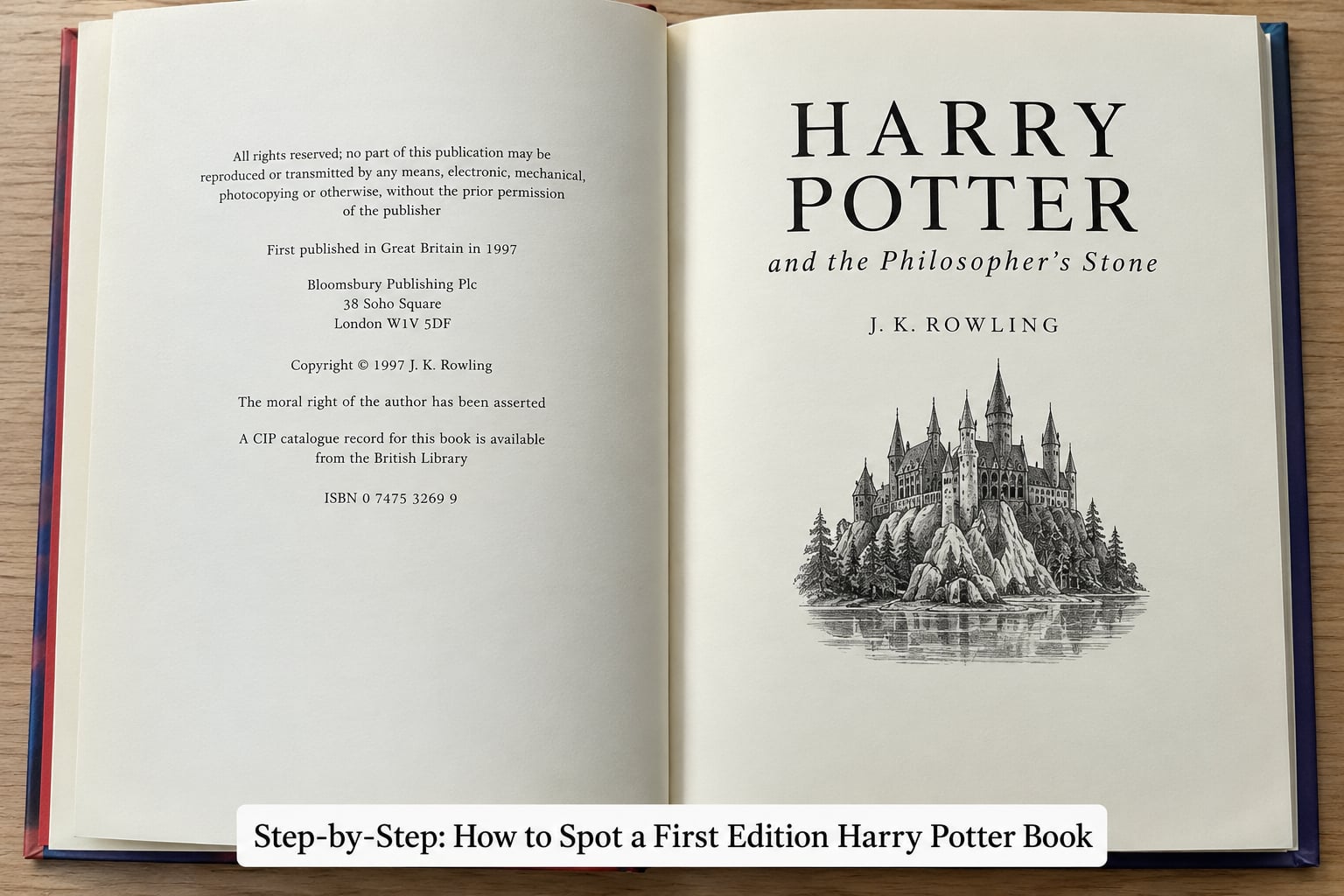
The copyright page, which collectors call the title verso, is the page directly behind the title page. It carries the publisher, the copyright year, the edition statement and, at the very bottom, the number line.
Read the number line from left to right. A first edition, first printing of a UK Harry Potter shows a complete descending sequence — 10 9 8 7 6 5 4 3 2 1 — with a 1 in the run. Later impressions drop the early numbers, so a copy reading 9 8 7 6 5 4 3 2 1 came out of a later batch.
Then read the year line. A genuine first edition lists the original publication year only. If you see extra years stacked beneath it, or wording such as “reprinted” or a second date, the book was printed again and is not a first printing.
Early Bloomsbury titles sometimes print the words “First Edition” on the copyright page instead of a number line, so treat the two systems as equivalent rather than looking for one specific format.
2. Verify the title-page wording and publisher
Turn forward one page. The title page tells you which market the book was printed for, and UK and US copies differ here.
A UK first edition carries Bloomsbury as the publisher. A US copy carries Scholastic. Check the byline too: the 1997 UK first editions credit Joanne Rowling, not the later J.K. Rowling branding, and a change in byline is often the fastest way to date a copy.
US first printings also carry an explicit edition statement — “First American edition, October 1998” for Sorcerer’s Stone — which settles the market question before you go any further.
3. Examine the ISBN and barcode
Every reprint from a new printing plant gets its own ISBN. A later Scholastic printing usually shows a different ISBN from the first American edition, so check the number against a reference rather than assuming a barcode means recent.
Be careful in the other direction too. A missing or covered barcode is a warning sign rather than proof, because jackets get swapped and covers get replaced. Treat the ISBN as supporting evidence that confirms or undermines the number line, never as a substitute for it.
4. Look for edition-specific printing details
Physical construction is the fourth layer of evidence. First printings used different board weights, paper grades and jacket artwork from later runs, and the differences are visible once you know where to look.
Check the jacket art against the first-edition design for that title, look at whether the spine is bumped or unbumped, and note the paper colour. Collectors on book-collecting forums report that copies from different printing facilities can differ in paper weight and jacket shade even inside the same first printing, so do not treat one physical detail as decisive on its own.
Two famous issue points get quoted constantly. The first is the back cover of the 1997 Philosopher’s Stone, which misspells the title as “Philospher’s”. The second is page 53, where a shopping list repeats “1 wand” instead of “2 wands”. Both are associated with the first edition, and both need the caveat in the next step.
5. Compare the copyright dates and printing history
Once you have the number line, publisher and year in front of you, work out which print run the book belongs to — then check that the issue points match that run rather than a different one.
US number lines work differently from UK ones. A first American edition of Sorcerer’s Stone shows an odd pattern, 1 3 5 7 9 10 8 6 4 2, followed by a year sequence such as 8 9/9 0/0 01 02. The lowest number in each group is the print run, and the first year in the year group is the issue year. The 1 sits at the start rather than the end, which trips people up constantly.
The trailing code on Scholastic pages is a printer code, not a mystery. “Printed in the U.S.A. 23” identifies the facility that produced that batch — collectors on the DVD Talk book forum have traced the numbers to specific plants, and Mexican printings are simply labelled “Mexico” with their own number. It tells you about the plant, not about the printing order, so it cannot make a late impression into a first edition.
One more trap: a “Reinforced Library Edition, November 2003” binding can carry a full number line, because the line refers to that specific library run.
6. Inspect the dust jacket and condition
Condition is where copies separate from each other. An unclipped jacket means the publisher’s price has never been printed on it; if there is a price, the jacket was clipped or swapped, and a swapped jacket is the most common form of counterfeit in this market.
Compare the jacket against known first-edition artwork for the title and year, check that the folds are still sharp, and look for library lending stamps, protective covers and catalogue numbers. Library copies are legitimate and widely collected, but the marks are permanent and specialists price around them.
Also look at the endpapers, the binding tightness and the corners. Faded spines, colour-shifted covers and a loose headcap all tell the same story about where the book has lived.
7. Confirm with more than one source
Cross-check before you act. Compare your notes against at least two independent references — a specialist auction house’s identification guide and a second checklist — and pay attention to where they disagree.
If the two sources conflict, or if the book looks valuable and you are not certain, get a bookseller or grader to look at it. That costs a small fee and removes the guesswork from a decision that is likely to be worth much more than the fee.
While you are checking, stay alert to the mistakes below. Most misidentifications happen because a genuine clue gets read in isolation.
Common Mistakes
Assuming an old-looking book is a first edition. Paper yellows in decades, sometimes faster in warm rooms. Colour tells you about storage, not about print run, and it tells you nothing at all about edition.
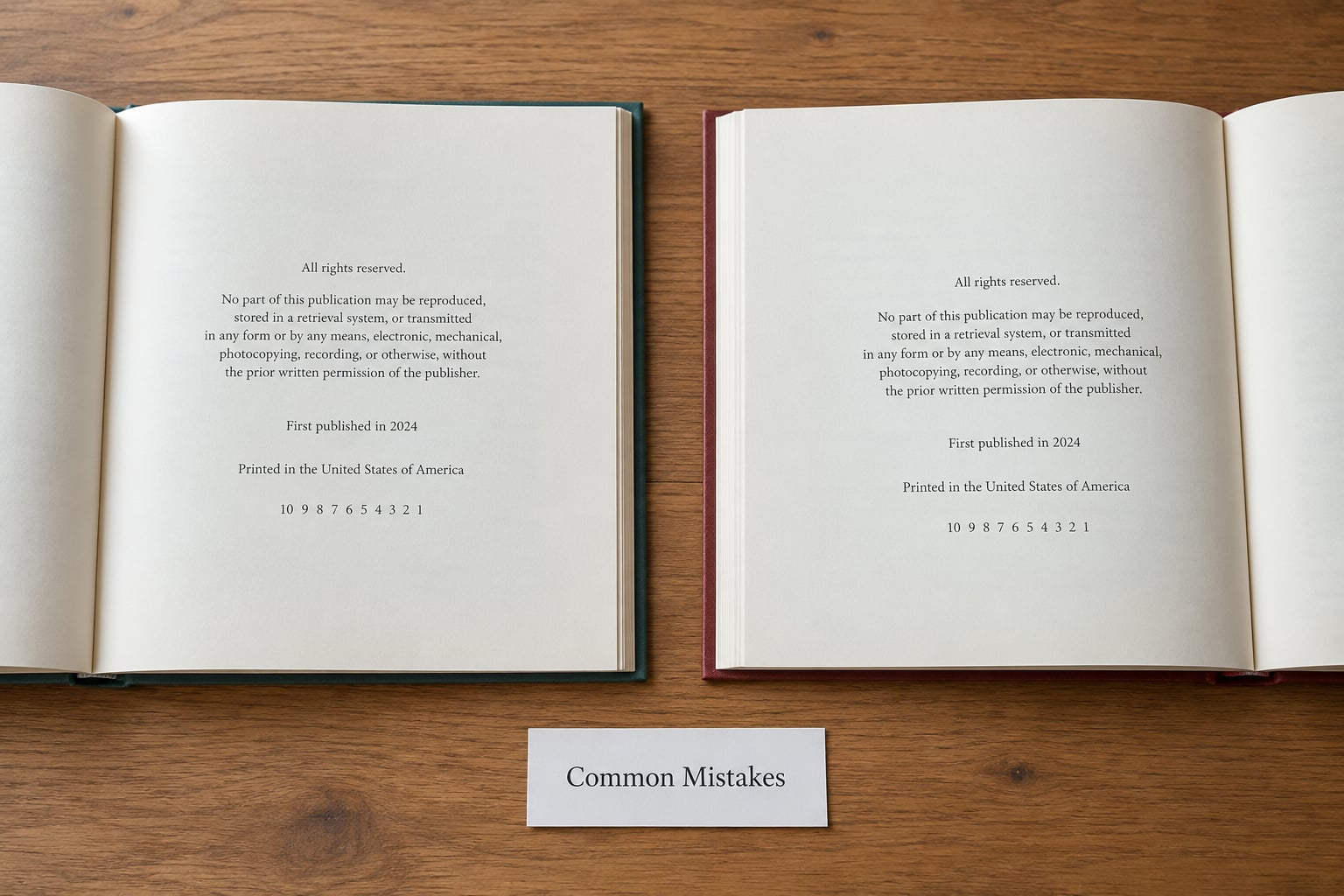
Treating the copyright year as conclusive. A later impression frequently keeps the original publication year and simply adds a reprint date below it. Read the whole year block, not the first line.
Overlooking regional editions. A UK copy and a US copy of the same story are different editions with different identifiers, and the US edition was never published as a hardback first edition. Know which market you are holding before you compare it to anything.
Confusing first edition with first printing. An edition can contain several impressions. The first edition is the whole run of printings made from the same setting; only the first printing within it is the collectible one, and the number line is what tells them apart.
Treating a single issue point as proof. The “1 wand” error has been reported in later printings too, so it is supportive evidence and not a verdict. This is the single most common false positive in the hobby, and it is why the number line comes first.
Counting a deluxe or Collector’s edition as a first edition. Deluxe editions were produced years later, sometimes for a children’s book club, and they say so on the copyright page. They are a separate category from the market, and comparing the two prices is comparing two different things.
Buying from a listing alone. Sellers frequently list late printings as “first edition, first printing” because they read the date line and stopped. Ask for a photograph of the actual copyright page before you commit to anything.
Cleaning the book first. Dust jackets, library labels and old tape are tempting to remove and none of them should be. Leave the book exactly as you found it and let a specialist decide.
Frequently Asked Questions
Does 10 9 8 7 6 5 4 3 2 1 mean first edition?
It means the book came from the first print run, which is the collectible version. Printers work in batches, and the number line counts the batches, so a complete run down to 1 means the first batch. Check it alongside the publisher, the publication year and any printed reprint dates before you treat it as confirmed.
Is 10 9 8 7 6 5 4 3 2 1 a first edition?
A full descending number line ending in 1 is necessary but not sufficient on its own. A genuine copy also needs the right publisher for its market, the original publication year with no added reprint dates, and issue points that belong to the same print run. Later impressions occasionally carry the famous 1 wand error, so the number line narrows the field rather than ending the search.
What does the number after Printed in the U.S.A. mean on a Scholastic Harry Potter?
That number identifies the printing facility that produced that batch, and collectors have traced the codes to specific plants. Mexican printings are labelled Mexico with their own number. It describes where the book was made, not when, so it cannot be used to identify a first printing — use the number line for that.
Is a first American edition different from a UK first edition?
Yes, and they are identified differently. UK copies carry Bloomsbury and often a descending 10 to 1 line, while US copies carry Scholastic and an edition statement such as First American edition, October 1998. A US first printing of Sorcerer’s Stone shows the odd 1 3 5 7 9 10 8 6 4 2 pattern with a year sequence beneath it, and no US hardback first edition exists.
Should I remove library stickers and lending stamps before selling?
No. Library markings affect how a copy is graded, and removing them usually lowers its value rather than raising it. Protective covers, stamps and catalogue numbers are all part of the book’s record. Photograph them for the listing instead, and describe the copy honestly as a library copy.
Is a deluxe edition more valuable than a first edition?
They are separate categories and the prices are not comparable. A deluxe or Collector’s edition was produced years after the original run, often for a children’s book club, and its copyright page says so. If your goal is the first edition, you are looking for a full number line ending in 1, not a special binding.
Conclusion
Start with the copyright page. Read the number line at the bottom of the title verso, and if it does not run down to 1, you are looking at a later impression and nothing else on the page will change that.
If it does, check the publisher, the byline and the year block, then confirm the jacket and the issue points against two independent references. Photograph everything before you clean anything, keep the jacket on, and get a specialist to look at it before you sell. That order takes ten minutes and saves you from the most common collector mistake there is — deciding on a single clue.