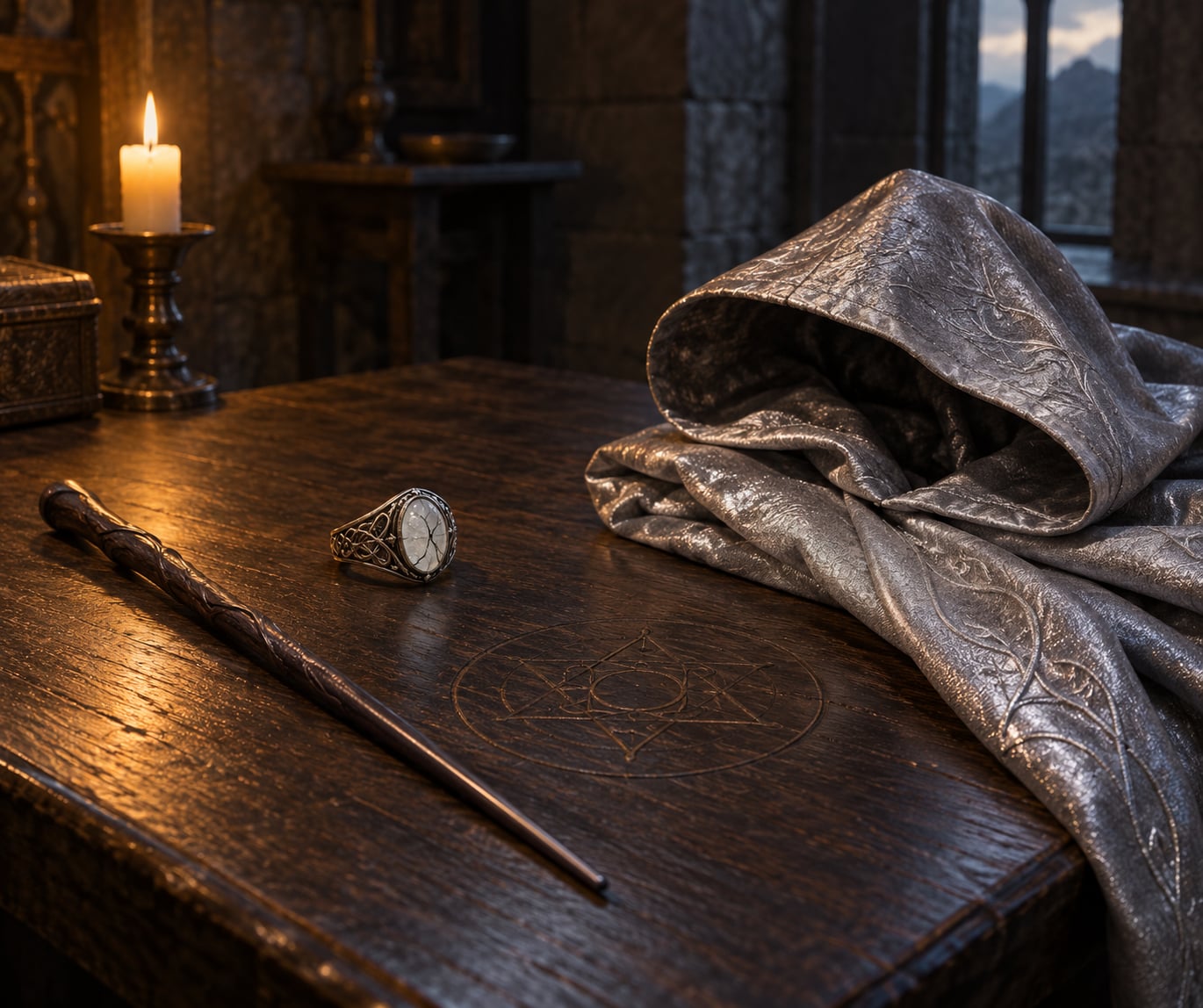
The Deathly Hallows are the Elder Wand, the Resurrection Stone and the Cloak of Invisibility, and they work together by each granting mastery over one part of death: victory in a duel, contact with the dead, and concealment from sight. Together they mark out the uniter of the Deathly Hallows, called the Master of Death.
That is the short answer. The longer truth is that the three objects never combine into a single machine. What unites them is a condition of character, not a ritual, and it explains why Harry Potter ends the war standing over Voldemort’s body while holding two of the three.
Spoiler warning: this covers the plot of Harry Potter and the Deathly Hallows in detail, including Dumbledore’s plan, the Forbidden Forest and the final duel, plus the epilogue.
Table of Contents
- What Are the Three Deathly Hallows?
- What Does Each Hallow Symbolize?
- How the Deathly Hallows Work Together in Harry Potter
- Why Can Only One Person Master Each Hallow?
- How Do the Hallows Help Harry in the Battle of Hogwarts?
- What Does Mastery of Death Really Mean?
- What Is the Difference Between the Hallows and the Horcruxes?
- Frequently Asked Questions
- Do the three Deathly Hallows have to be used together?
- Why was the Elder Wand unable to save Voldemort?
- How did Harry Potter become the master of all three Deathly Hallows?
- Does the Resurrection Stone bring someone back to life?
- Why did the Invisibility Cloak belong to Harry?
- Are the Deathly Hallows the same as Voldemort’s Horcruxes?
- Conclusion
What Are the Three Deathly Hallows?
Three legendary artefacts carry the name: a wand, a stone and a cloak. Each was traced back to one of the three Peverell brothers, and the symbol that joins them is a vertical line inside a circle above a triangle, carved into a ring, hidden in a wand core and embroidered on a hood.
- The Elder Wand passes from master to master and is unbeatable in a duel.
- The Resurrection Stone summons the shades of the recently dead.
- The Cloak of Invisibility hides its wearer from any observer.
The legend behind them is the Tale of the Three Brothers, told in Beedle the Bard’s book and retold by Xenophilius Lovegood. Three brothers die, and Death comes for them in three forms. The first, the wizard, asks for a wand to defeat Death at his own game, and Death makes a wand out of a fallen ash wand and adds a holly core. The second, the idiot, asks to recall his bride, and Death fashions a stone with the power to reopen the line of the dead. The third, the youngest, asks to hide from Death entirely, and Death hides him in a cloak.
The legend and the objects are not quite the same thing. The tale describes Death making the artefacts; the objects Harry handles are physical items that pass through owners, lose allegiance and end up in hiding places. Dumbledore never proves any of it. What he can prove is the wand’s allegiance, and that evidence alone is enough to build his plan around.
It is also worth separating the Cloak from the trio of origin. It is the only one of the three that is simply a powerful object rather than something with an allegiance, and the only one Harry owns outright by the end.
What Does Each Hallow Symbolize?
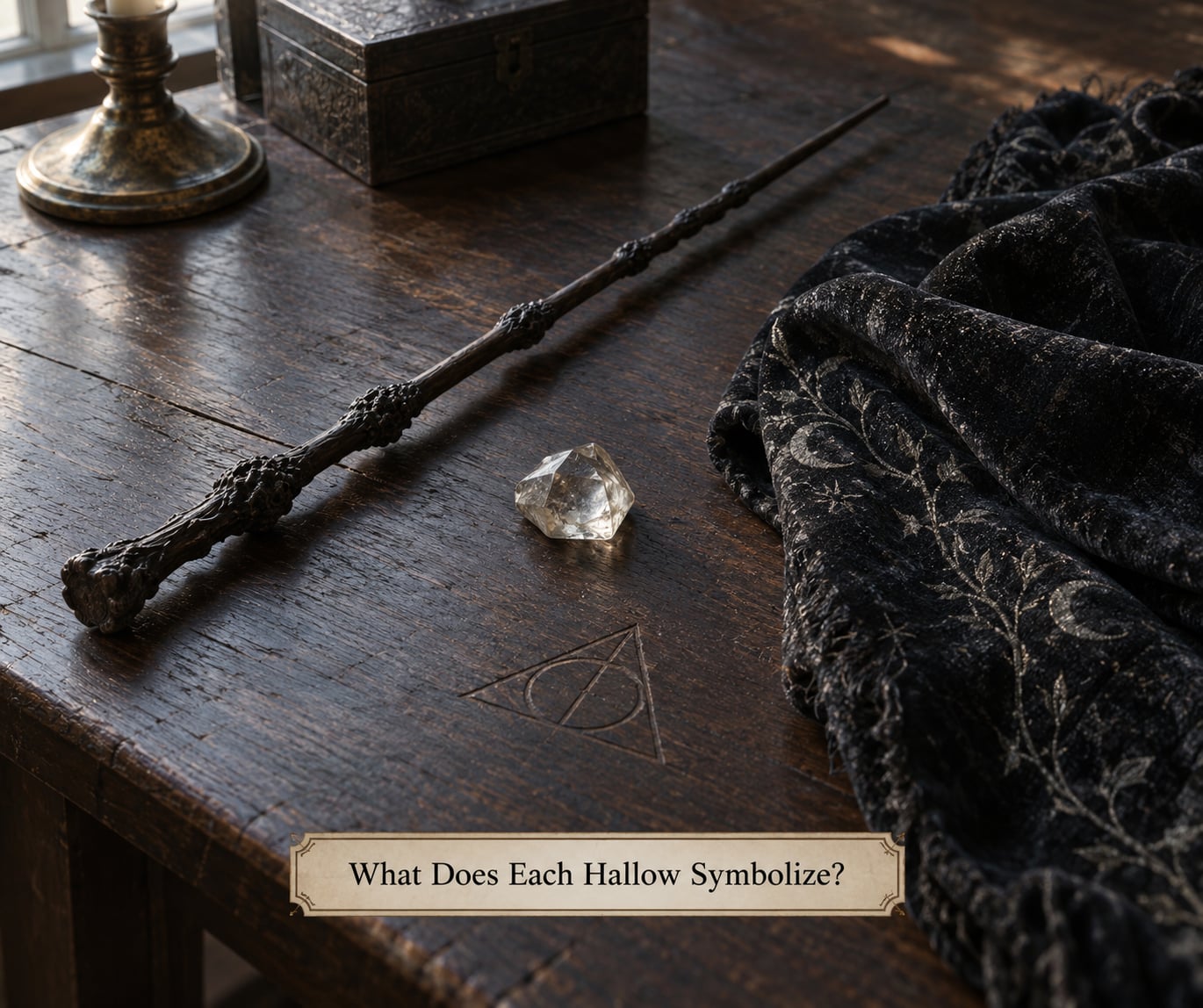
Each Hallow stands for a different human response to dying. The Elder Wand is dominance: the wish to be stronger than whoever comes next. The Resurrection Stone is love refusing to let go, with the acceptance buried inside it that the one you want back cannot truly return. The Cloak of Invisibility is secrecy, the instinct to hide rather than to fight or to mourn.
Put side by side, they spell out the three ways most people bargain with death. Overpower it, reverse it, or hide from it. The symbol itself follows the same logic: the line, circle and triangle are read as the three artifacts, and in Harry’s own hands it reads less like a trophy and more like a diagram of what he refuses to do with any of them.
The symbolism also explains the story’s title. Harry Potter and the Deathly Hallows is about him confronting death rather than acquiring anything to defeat it, and the trio are the shape that confrontation takes.
How the Deathly Hallows Work Together in Harry Potter
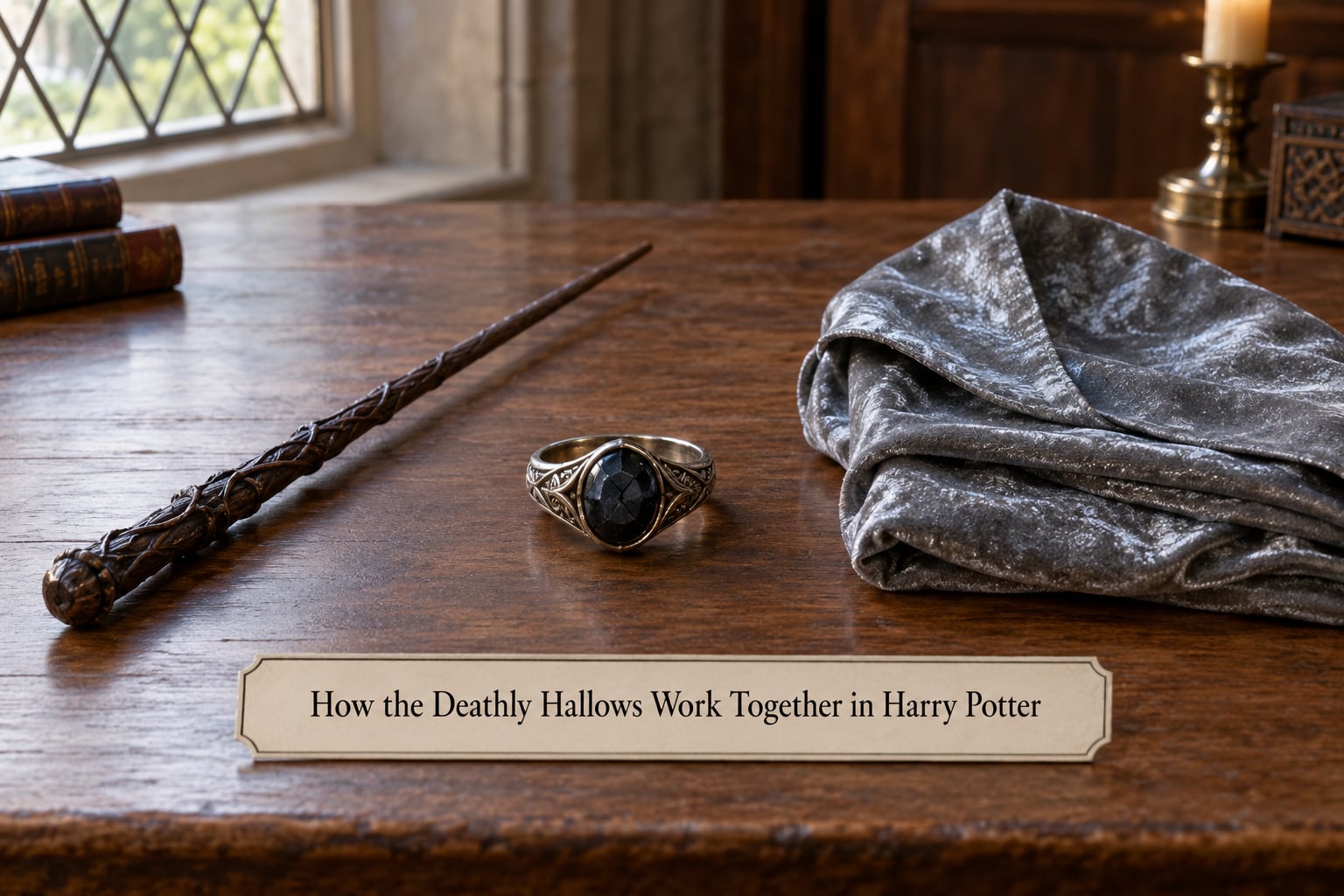
They work together as three separate powers that solve three different problems, and as a single symbolic whole. Nobody in the books ever holds all three at the same moment, and no scene combines them into one combined spell. The unity is a title earned over a lifetime.
So the practical answer to how the Deathly Hallows work together is: each one removes the obstacle that stops Harry at a specific point in the story. The cloak gets him somewhere he cannot be seen. The wand gives him a duel he would otherwise lose. The stone gives him the strength to walk somewhere he has every reason to refuse to walk.
What Power Does the Elder Wand Give Its Master?
The wand’s power is allegiance, not strength. Ollivander tells Harry that a wand chooses its owner and that allegiance can transfer, and the conditions are narrow: the wand passes when its master is disarmed in a duel, and it does not pass when someone simply wins a fight or kills its master. Harry learns the hard way that even a wand of legend can fail a holder who has not earned it.
The other property is stated plainly in the books: the Elder Wand never loses a duel. Voldemort wanted it for that reason, and so did Dumbledore before him, who tracked it with the Elder Wand’s last known owners in mind.
That matters at the end. When Voldemort confronts Harry in the Forbidden Forest, Harry does not overpower him. Voldemort cannot defeat Harry because the wand’s allegiance is already Harry’s, and the Killing Curse rebounds along allegiance instead of travelling outward. A wand that wins duels does Harry no good in that fight, and it is not what kills Voldemort.
How Does the Resurrection Stone Bring Back the Dead?
It does not, exactly. The Stone opens a way back to the shades of those who have died, and what answers is an echo rather than a person who never left. Dumbledore was clear that the Stone does not really bring back the dead, and that its gift is an opportunity to speak to them and say goodbye.
Set into the Snitch, which Harry releases on Dumbledore’s instruction, it carries the inscription “I Open at the Close.” It has no power of its own; it is a passive object. The condition for using it is being close to death, which is why it does nothing for a healthy wizard and everything for a man walking into the forest expecting to die.
In the Forest, Harry turns it three times without speaking a word. He sees his mother, his father, Sirius and Dumbledore, and none of them try to stop him. He walks on and delivers the message Dumbledore gave him, then drops the Stone and never picks it up.
What Does the Invisibility Cloak Make Possible?
The Cloak grants complete and reliable concealment. Unlike a Disillusionment Charm, it does not shimmer or need attention, and it holds up in daylight, at distance and in crowds. Dumbledore claims it works as a shield for anyone under it, not just the wearer, although the books test that claim far less than readers would like.
Harry first meets it in his cupboard under the stairs, where his father left it before he was born. James Potter was given the Cloak by Dumbledore and, as many readers on r/harrypotter have argued, would have had good reason to keep it at home rather than hand it over; the accepted reason is that Dumbledore asked for it and James gave it.
From there it stays with Harry or lies waiting. He wears it to Gringotts vault 713 and the Malfoy Manor, where Hermione uses it to hide him while they steal a Horcrux from Snape’s trunk. At the end he wears it out of the manor and it passes to his son, and readers tend to see that handover as the story confirming what Dumbledore claimed about its real power.
Why Can Only One Person Master Each Hallow?
Possession, use and mastery are three different things in this world, and the confusion causes most of the arguments about the Hallows.
You can pick up any of the three without mastering it. Voldemort wears Marvolo Gaunt’s ring, which holds the Resurrection Stone, and the curse attached to it mutilates him; he does not command it. He takes the Elder Wand from Dumbledore’s tomb and is told outright that it does not answer him, and he is wrong about that too. He never once uses the Stone to bring back anyone, because using it would require accepting a death he has spent his whole life refusing.
The Hallows respond to a person who stops treating death as a problem to be solved. That is the whole requirement, and it is why Harry qualifies. He holds all three at the end, in that order: the ring inside the Snitch in his pocket, the Cloak on his shoulders, the wand in his hand after Voldemort disarms Draco.
Harry is also the only character to hold all three. Dumbledore touched the ring and the wand but never the Stone, and Voldemort collected objects rather than inheriting them. The title goes to the one who accepted the full set of what they mean, not the one who gathered the most.
How Do the Hallows Help Harry in the Battle of Hogwarts?
Four moments matter, and each one uses a different Hallow.
- The Snitch. Voldemort’s mother dies during the battle and Harry hears the memory through the Sorting Hat. Dumbledore’s instructions surface, Harry releases the Snitch, and the Resurrection Stone comes free.
- The walk to the forest. The Stone only works for someone close to death, and Harry goes willingly expecting to die. His loved ones appear and do not stop him, which is what gives him the strength to keep walking.
- The duel. Harry is disarmed, so the Elder Wand passes to him, and Voldemort’s Killing Curse rebounds. Harry survives and carries the wand back to Hogwarts.
- The escape. The Cloak gets Harry, Ron and Hermione through the gates of Malfoy Manor, through the grounds and off the estate, which is where Voldemort’s own household ends up fighting him.
Only one of those uses a Hallow as a weapon. That pattern is deliberate and is the clearest evidence for what the story means by mastery over death.
What Does Mastery of Death Really Mean?
It means acceptance, not immortality. Nobody in the series gets to live forever, and the three who tried most hard ended up dead anyway. Voldemort split himself and died twice. Dumbledore chased the wand to find a third founder’s snake and could never use the wand he found, because he knew it would pass to Voldemort and complete the chain.
Dumbledore’s reasoning, laid out in his office the night before he dies, is that Voldemort made the Hallows his objective because he could not accept death and looked for something that would let him conquer it. Harry refuses that premise. He goes to the forest knowing he will probably die, and comes back anyway.
Whether Dumbledore handed Harry the Stone deliberately to set a trap is the most argued thread on r/harrypotter and r/HarryPotterBooks, and no reader has settled it from the text alone. The defensible reading is that he could not control what Harry did with it, only that he made sure Harry had it. What is not in dispute is the effect: Harry used the Stone for exactly one minute, then let it fall.
Many readers say that minute is the most powerful in the series, and also the cruelest. Both reactions make sense. A gift that only works if you are nearly dead is also a test you can only pass by failing it.
What Is the Difference Between the Hallows and the Horcruxes?
Both sets of objects deal with death, and confusing them is why so much online debate goes in circles.
- Origin. The Hallows come out of the Peverell legend. The Horcruxes are Voldemort’s own work, made by splitting his soul and binding a piece of it to an object.
- Purpose. The Hallows answer a question about death and offer the choice to accept it. The Horcruxes try to refuse death permanently and take other people down with them.
- Cost. The Hallows ask for sacrifice, and Harry pays in people he loves. The Horcruxes ask for murder, and Voldemort pays in his own humanity, one Horcrux at a time.
- Effect on the holder. Mastering the Hallows leaves you more human. Carrying Horcruxes leaves Voldemort unable to love, unable to eat human food, and ultimately unable to remain a person at all.
The practical difference in the plot is that a Horcrux has to be destroyed and a Hallow does not. Harry drops the Stone, gives the Cloak away and buries the wand. The Hallows are not won; they are released.
Frequently Asked Questions
Do the three Deathly Hallows have to be used together?
No. Each one works on its own, and no scene in the books or films combines them. The wand wins duels, the Stone opens a path to the dead and the Cloak hides its wearer. What unites them is the title of Master of Death, which comes from accepting death rather than trying to defeat it. Harry never held all three at the same moment until the end, and even then he used each separately.
Why was the Elder Wand unable to save Voldemort?
Because the wand follows allegiance, not blood. Voldemort took it from Dumbledore’s tomb without ever defeating its true chain of masters, so it never became his. In the Forbidden Forest the wand’s allegiance belonged to Harry, which is why Voldemort’s Killing Curse rebounded off Harry and struck its caster. The wand was never going to protect Voldemort, because he never mastered it.
How did Harry Potter become the master of all three Deathly Hallows?
Harry owned the Cloak after finding it in his parents’ cupboard, received the Stone inside the Snitch on Dumbledore’s instructions, and became the Elder Wand’s master when Voldemort disarmed Draco Malfoy in the Great Hall. He also accepted death when he walked into the Forbidden Forest expecting to die. That acceptance is the condition the title actually requires; holding the objects only confirmed it.
Does the Resurrection Stone bring someone back to life?
Not properly. It lets you speak to the shades of those who have already died, and Dumbledore is explicit that it does not undo death itself. Harry meets his parents, Sirius Black and Dumbledore near the end of the Stone’s usefulness and none of them can stop him leaving. He then drops the Stone and never picks it up again, which is why many readers treat his choice as the point of the whole object.
Why did the Invisibility Cloak belong to Harry?
James Potter owned it after Dumbledore asked him for it, and he left it in the house where Harry was placed with the Dursleys, which is how Harry found it under the stairs at eleven. He wears it for Gringotts, for Malfoy Manor and for the flight from the estate, then passes it to his son in the epilogue. It is the one Hallow he inherits rather than recovers.
Are the Deathly Hallows the same as Voldemort’s Horcruxes?
No, though both are connected to death. The Hallows come from the Peverell legend and offer mastery over death through acceptance. The Horcruxes are Voldemort’s own creations, made by splitting his soul so that destroying his body does not end him. Harry has to destroy the Horcruxes to kill Voldemort, while the Hallows require nothing be destroyed at all. He drops the Stone, gives away the Cloak and buries the wand.
Conclusion
The three Deathly Hallows work together as three separate powers and one symbolic whole. The wand settles duels by allegiance, the Stone opens a door to the dead for anyone willing to stand close to it, and the Cloak moves a person through the world unseen. Together they describe a relationship with death rather than a weapon, and only Harry takes that relationship on seriously.
If you are reading the series for the first time since childhood, start with the Elder Wand, since its allegiance rule is the piece that explains the final duel. If you came for Voldemort’s rise and fall, go back to the ring and what it cost him. And if what draws you to the series is what it does to families, read the Cloak chapters twice, because that is the one Harry simply gives away.