Short answer: for the seven Harry Potter novels, chronological order and publication order are the same list, so you can read them one to seven without rearranging anything. The real decision starts after book seven, where companion texts like Fantastic Beasts, The Tales of Beedle the Bard and The Cursed Child sit in different places on the timeline, or in an entirely separate lane.
That sounds simple until you notice how many reading-order pages out there treat the two concepts as opposites. They are not opposites, and separating them cleanly is the whole trick. Once you know which of the companion books are in-universe documents, which are stories, and which are folklore, the entire Wizarding World shelf sorts itself.
Table of Contents
- What You Need
- Step-by-Step
- How to Read the Wizarding World Books in Chronological Order
- Step 1: Read Harry Potter and the Philosopher’s Stone
- Step 2: Read Harry Potter and the Chamber of Secrets
- Step 3: Read Harry Potter and the Prisoner of Azkaban
- Step 4: Read Harry Potter and the Goblet of Fire
- Step 5: Read Harry Potter and the Order of the Phoenix
- Step 6: Read Harry Potter and the Half-Blood Prince
- Step 7: Read Harry Potter and the Deathly Hallows
- Step 8: Decide Which Optional Wizarding World Books to Read
- Common Mistakes
- Frequently Asked Questions
- What is the chronological order of the Wizarding World books?
- Should I read The Tales of Beedle the Bard before or after Harry Potter and the Deathly Hallows?
- Does The Cursed Child take place before or after the Battle of Hogwarts?
- Do the Fantastic Beasts books and screenplays belong in the Harry Potter timeline?
- Is Hogwarts Mystery part of the Wizarding World timeline?
- Should I read the Harry Potter books in publication order or chronological order?
What You Need
You need the seven main novels and nothing else to finish the story. J.K. Rowling wrote Harry Potter and the Philosopher’s Stone through Harry Potter and the Deathly Hallows as one continuous arc covering seven school years, so the intended reading path and the story timeline never diverge.
Everything past book seven is optional. Some Wizarding World books are textbooks that exist inside the fiction, some are reference books written by characters, and some are genuine stories set in the past or the future. Treating them all as sequels is the most common way readers end up confused about what is canon.
On format, any edition you can get your hands on works, because the novels are the same text in print, ebook and audio. The paperbacks are the easiest to find and cheapest to buy in bulk. For audio, Stephen Fry narrates the original UK titles and Jim Dale narrates the US versions, so pick one and stay with it for all seven rather than switching back and forth.
The illustrated edition from the UK publisher is a different creature entirely: Jonny Duddle’s artwork is beautiful, but it is an abridged retelling rather than a full replacement for the novels. If you want the unabridged story, treat it as a companion, not a substitute.
Set a spoiler boundary before you start. Several of the biggest reveals in the series are planted in the earliest books and only explained much later, so any summary you read about later volumes will cost you more than it gives you.
Step-by-Step
How to Read the Wizarding World Books in Chronological Order
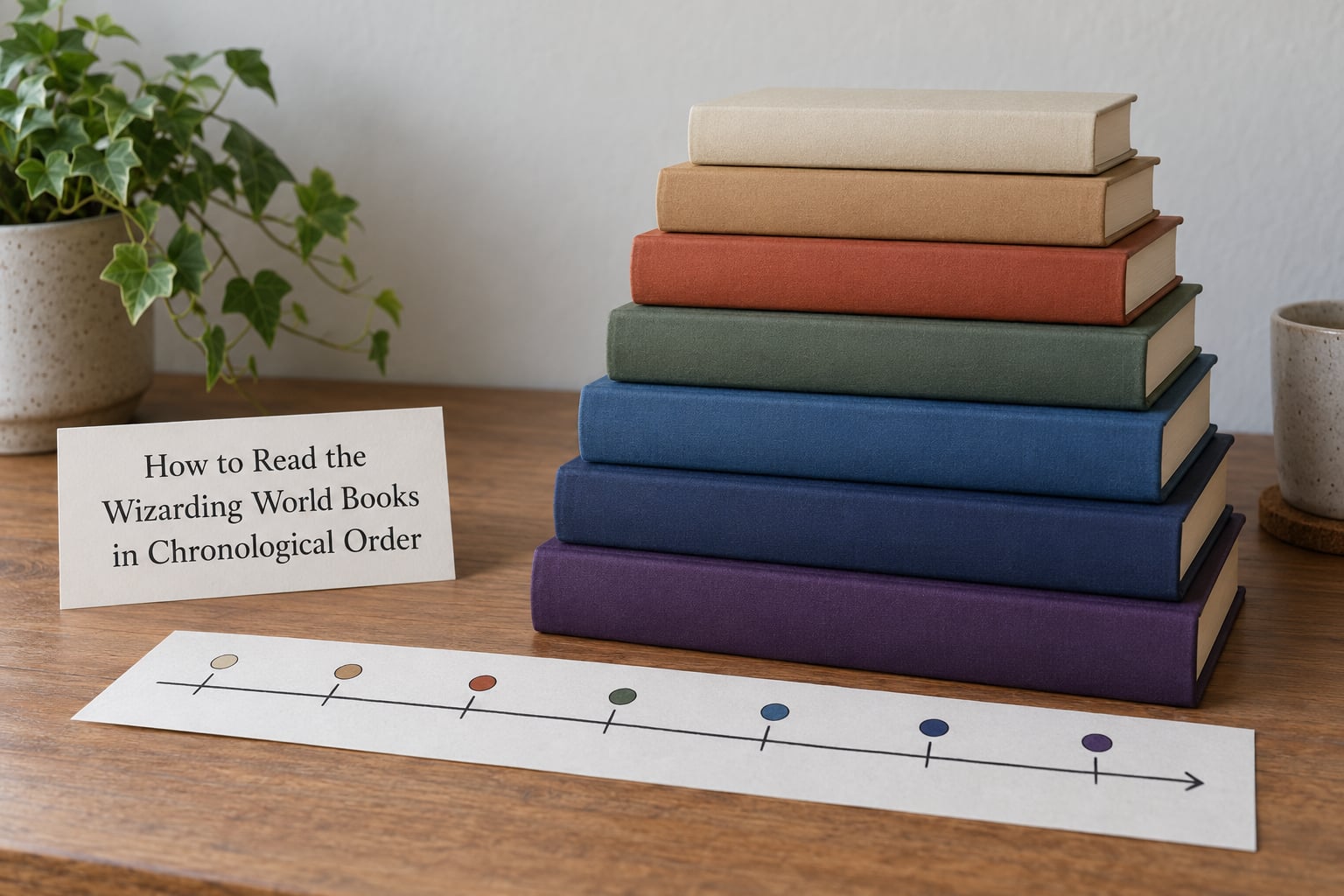
Read the seven novels first, in order, back to back. Then decide how deep into the wider Wizarding World you want to go, and pick companion books by the era they are set in rather than by their publication year. That is how to read the wizarding world books in chronological order without wrecking the main storyline.
Publication order means the year a book was first released. Chronological order means the year the events inside the story take place. For books one through seven those two lists are identical: each novel covers the school year after the one before it, running from 1991 to 1998 in the wizarding world’s own calendar.
Step 1: Read Harry Potter and the Philosopher’s Stone
Cover year: 1991 to 1992. Harry is eleven when he learns he is a wizard, and the novel follows his first year at Hogwarts, the trouble brewing around the Philosopher’s Stone, and the first friendships that carry the rest of the series. Read it as a standalone adventure; almost nothing here requires prior knowledge.
Spoiler boundary: a handful of small clues planted in this book only make sense years later. Resist the urge to look them up.
Step 2: Read Harry Potter and the Chamber of Secrets
Cover year: 1992 to 1993. Harry’s second year brings a writing implement with a personality, a locked chamber somewhere in the castle, a pet that does not fly so much as lurk, and Dobby’s warning that a danger is coming for Harry that he cannot escape. It is the most standalone of the middle books and the easiest place to drop in later.
Step 3: Read Harry Potter and the Prisoner of Azkaban
Cover year: 1993 to 1994. The school year runs through the Quidditch World Cup, the screaming ropes in the third task, and the escape of an Azkaban prisoner whose history reaches back further than Harry’s. Hagrid’s past opens up here, and with it the sense that the adult world and the school year are the same world.
This is where a lot of readers first look up a character or a date, so pick a timeline that labels spoiler status clearly. A good Wizarding World lore reference marks where an entry sits so you do not walk into an answer you were not ready for.
Step 4: Read Harry Potter and the Goblet of Fire
Cover year: 1994 to 1995, and it opens with the Quidditch World Cup in July 1994 before the school year starts. Harry is entered into the Triwizard Tournament without asking, the second task puts him in the lake, and the third task brings back the yule-egg dragons. It is also the longest book of the first half and the tonal turn the series is famous for.
Watch the in-universe year here. A lot of timeline confusion starts with people placing the World Cup in the wrong school year, because the events of book three and the opening scenes of book four run almost wall to wall.
Step 5: Read Harry Potter and the Order of the Phoenix
Cover year: 1995 to 1996. Nobody at the Ministry believes Voldemort is back, the Wizarding World is described as a comfortable lie, and Dumbledore assembles the Order and a resistance group that has to practise in a disused room. This is the slowest book in the series and the one that most needs momentum from the reader.
If you stall here, remember the plot does not stall with you. A reread of book four is often the fix.
Step 6: Read Harry Potter and the Half-Blood Prince
Cover year: 1996 to 1997. Dumbledore’s memories, Snape’s past, a pensieve lesson, the cave, the wedding and a battle at the Burrow all happen in one year. This is where the mechanics of the final book are explained, so it is also the book most people reread immediately afterwards.
Spoiler boundary: horcruxes become explicit in this volume. Any plot summary you read after it will assume you know the mechanism.
Step 7: Read Harry Potter and the Deathly Hallows
Cover year: 1997 to 1998. Harry leaves school, hunts the horcruxes, walks into a forest he does not come out of, and returns for the Battle of Hogwarts. The book ends with a coda about the survivors and their lives nineteen years later, which is exactly the door the next book walks through.
Step 8: Decide Which Optional Wizarding World Books to Read
This is the step most reading-order pages get wrong, so here is the split in plain terms. Fantastic Beasts and Where to Find Them and Quidditch Through the Ages are in-universe textbooks, written by Newt Scamander and by a Quidditch historian, and they cover centuries of material. The Tales of Beedle the Bard is a folklore collection, mostly medieval, framed by a twentieth century antiquarian. Harry Potter: The Prequel is a short story set in the opening pages of book seven.
Harry Potter and the Cursed Child is the only companion that functions as a real book eight, because it is set nineteen years after the Battle of Hogwarts and follows Harry’s son, Albus Severus Potter. Hogwarts: An Incomplete and Unreliable Guide is written by a sixteenth century house-elf and is a joke with footnotes. Short Stories from Hogwarts fills in the gaps between the school years.
Where the screen and game material goes is worth stating plainly. The Fantastic Beasts films and their published screenplays are a different continuity lane that overlaps the 1910s and 1920s, set well before Harry. Hogwarts Legacy is set in the late 1800s, decades before the novels, and its canon status is still argued over on fan forums. Neither belongs in your novel reading path, and neither changes the order of the seven books.
Newer screen projects belong in the same category. Announced television adaptations and further Fantastic Beasts stories are things to read about, not chapters to slot between the novels.
Common Mistakes
Confusing publication order with chronology. Publication order is when J.K. Rowling or her publisher released a book. Chronological order is when the events happen inside the wizarding world. They match for the seven novels and only diverge once you add companion texts, which is why reading one to seven is both the easiest and the correct approach.
Treating The Tales of Beedle the Bard as a normal novel. It is a collection of wizard folklore written by a fictional author, told in a frame story, and a good chunk of it happens centuries before Hogwarts exists. Reading it as book eight or as a straight narrative will frustrate you.
Starting with the companion books. Fantastic Beasts, Quidditch Through the Ages and the other almanacs assume you already know who Harry, Dumbledore and Snape are. Most readers find them dry or confusing before book one and much more interesting afterwards.
Counting screen stories as novel chapters. The Fantastic Beasts films, Hogwarts Legacy and the Hogwarts Mystery mobile game are set before or outside the main storyline. They are not gaps in the timeline, and no book is missing because you skipped them.
Queueing too much before book one. The backlog of guide books, almanacs and screenplays is genuinely large. Stack it up and you may never start. Read seven books, then revisit the list and choose three that interest you.
Reading chronologically for the sake of it. A timeline is a reference tool, not a required reading method. Fans who go back and reread the novels in timeline order usually do so after finishing the series once, because the reveals are built to land in sequence.
Frequently Asked Questions
What is the chronological order of the Wizarding World books?
Chronological order means the order events happen inside the wizarding world, not the order books were published. For the seven Harry Potter novels the two are identical, running from 1991 to 1998 in-universe. Companion texts then split apart by era: Fantastic Beasts covers earlier decades, The Tales of Beedle the Bard reaches back centuries, and The Cursed Child sits nineteen years after the Battle of Hogwarts.
Should I read The Tales of Beedle the Bard before or after Harry Potter and the Deathly Hallows?
Read it after Deathly Hallows. The Tales of Beedle the Bard is a folklore collection by a fictional author, framed by a twentieth century scholar, and it explains where familiar creatures and artifacts entered wizarding tradition. Several of its stories are medieval. Reading it before the novels spoils nothing, but it makes far more sense once the main series has established why those tales mattered.
Does The Cursed Child take place before or after the Battle of Hogwarts?
After, by nineteen years. Harry Potter and The Cursed Child is the only companion novel that works as a genuine book eight, opening with the same coda timeline as the end of Deathly Hallows and following Harry’s son, Albus Severus Potter, into his first year at Hogwarts. It also introduces the new generation of teachers and students, including a headmaster who is not Dumbledore.
Do the Fantastic Beasts books and screenplays belong in the Harry Potter timeline?
The Fantastic Beasts and Where to Find Them is an in-universe textbook, so it can sit anywhere in the timeline, though it was published after book five and covers earlier decades. The Fantastic Beasts films and their published screenplays form a separate lane set in the 1910s and 1920s. They are prequels to the wider world rather than chapters in Harry’s story.
Is Hogwarts Mystery part of the Wizarding World timeline?
It is optional and loosely set. Hogwarts Mystery is a mobile game story about a student investigating a mystery at Hogwarts in an era before the novels, and its exact place relative to the school years is not fixed by the books. Readers who enjoy the companion lore often enjoy it, but skipping it costs you nothing in the main storyline.
Should I read the Harry Potter books in publication order or chronological order?
Read them in publication order, which is also their chronological order. Books one through seven each cover one school year, starting in 1991, so nothing needs rearranging. Chronological order only becomes a separate question when you add companion books, and those work best as a follow-up read after the novels are finished.
Start with Harry Potter and the Philosopher’s Stone and read straight through to book seven without stopping to look anything up. That is the correct chronological order for the Wizarding World books, and the only place the debate about ordering actually matters. Build the companion list afterwards, read Cursed Child first if you want a story, and save the textbooks for when you are ready to enjoy the footnotes.