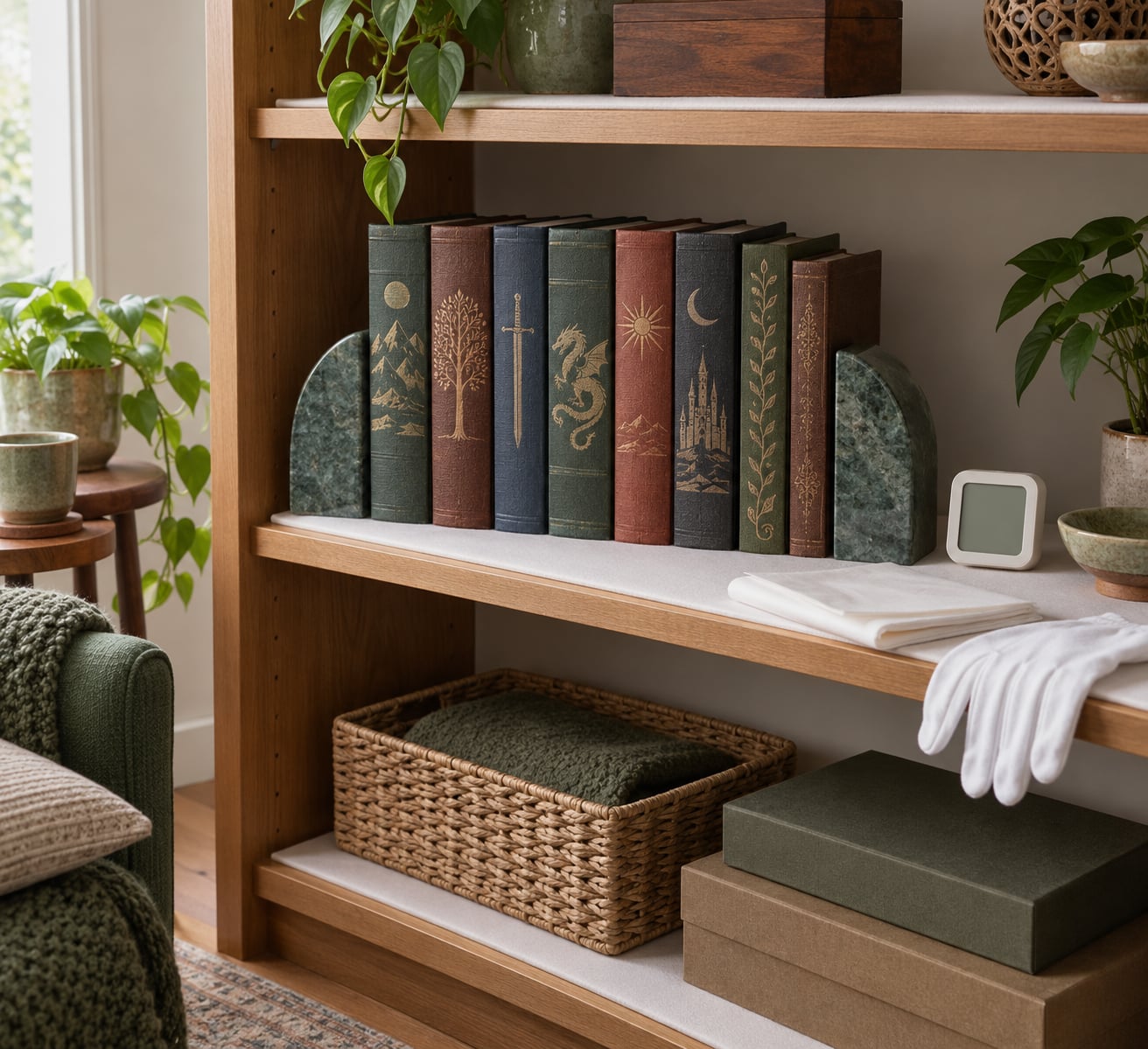
Knowing how to store and protect collectible books at home comes down to four things: a stable room, archival materials, shelving that supports the weight, and hands that pick books up correctly. Most damage to a collection happens slowly and quietly, and by the time you notice foxing on a page or a faded spine, the cause has been sitting in the room for years.
The good news is that none of this requires a climate-controlled vault. A spare bedroom with a working hygrometer, a set of bookends, and a roll of acid-free tissue will protect the vast majority of a home collection for decades.
Table of Contents
- What You Need
- Step-by-Step
- Common Mistakes
- Frequently Asked Questions
- Should rare and collectible books be stored in plastic bins?
- What is the best humidity level for a home book collection?
- How should I store oversized Harry Potter books?
- Are cotton gloves better than clean hands for handling books?
- How do I remove mold or musty odors from old books safely?
- When should a valuable book be taken to a conservator?
- Conclusion
What You Need
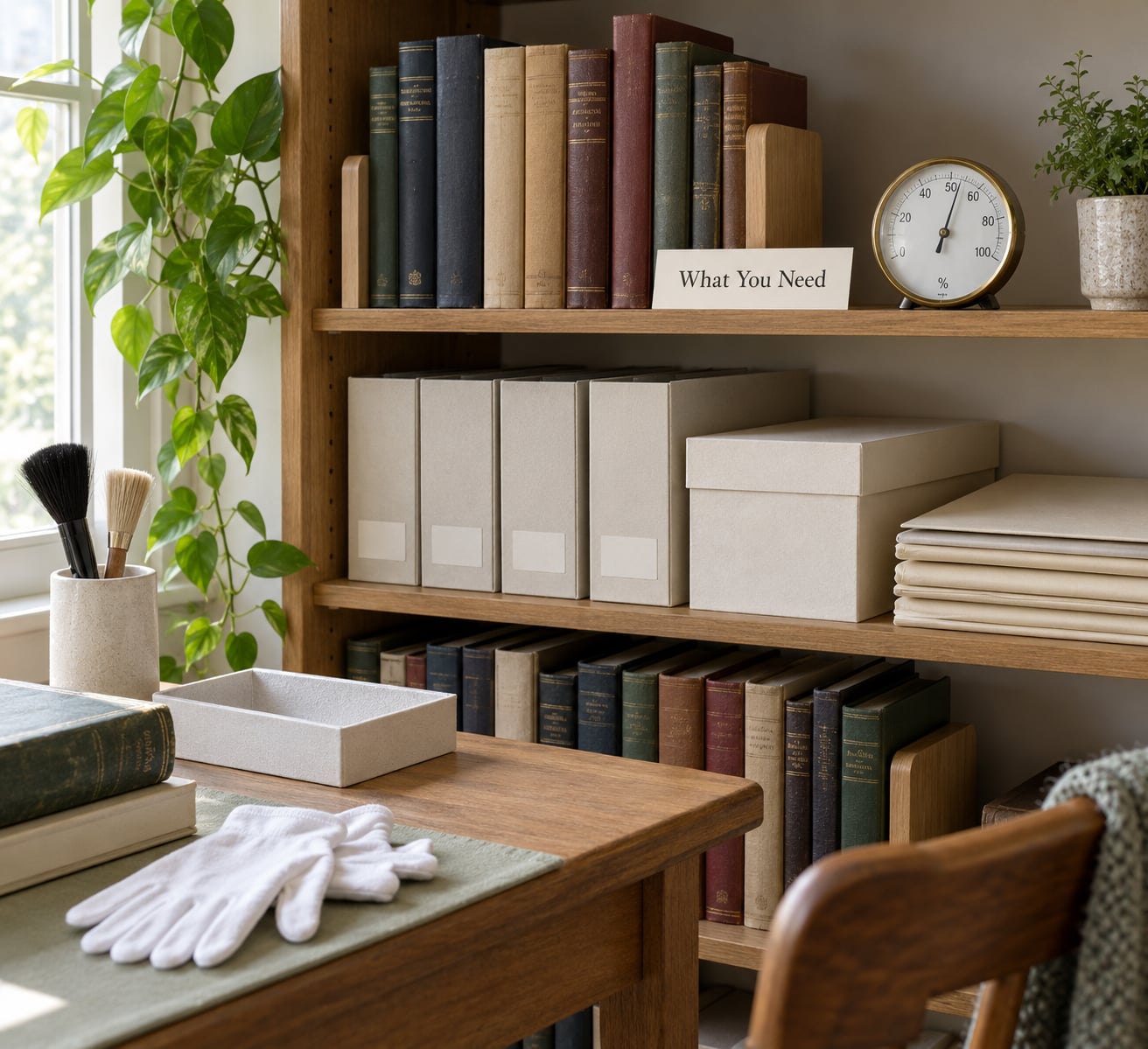
Before you move a single book, gather the tools. Rushing this part is how collectors end up with a reorganised shelf and a fresh crop of bent spines.
- Shelving you can trust — solid, level, deep enough for the book, and lined with acid-free board or buffered paper along the back and sides.
- Bookends that fit — L-shaped or adjustable, not the decorative wire kind that lets tall books slump. Heavy books need a foot under the bookend.
- Archival tissue and folders — acid-free, buffered interleaving paper for fragile or floppy books, and acid-free folders if you are grouping by series.
- Archival boxes — clamshell or metal-edge boxes for the most valuable volumes and for anything that has to survive a move.
- A hygrometer — a cheap digital one is fine. This is the single most useful tool in the room.
- Soft cleaning kit — a clean soft-bristled brush, a microfibre cloth, and soft cotton gloves for the genuinely fragile items.
- Cloth book sleeves — padded, non-abrasive sleeves for the books you actually read and carry around.
- A good storage room — interior, upstairs, no exterior wall on the outside, no window, no bathroom or kitchen nearby.
Step-by-Step
How to Store and Protect Collectible Books at Home in Acid-Free Shelving
Start by sorting the collection into three piles: fragile, solid, and boxed. Fragile means cracked headcaps, loose or missing joints, flaking cloth, or pages that sound brittle when you shuffle them. Those get the closest attention.
Clear each shelf with a dry soft brush first. Work from the top of the spine downward and away from the joint so you are not driving grit into the hinge. Vacuuming is a bad idea at this stage; the suction and the beater brush will chew a soft spine.
Then interleave. Slip a sheet of acid-free tissue between a book whose boards are touching a neighbour’s cloth, or between two paperbacks that have started to curl. Where a book leans or has lost its shape, wrap it in tissue before it goes back on the shelf.
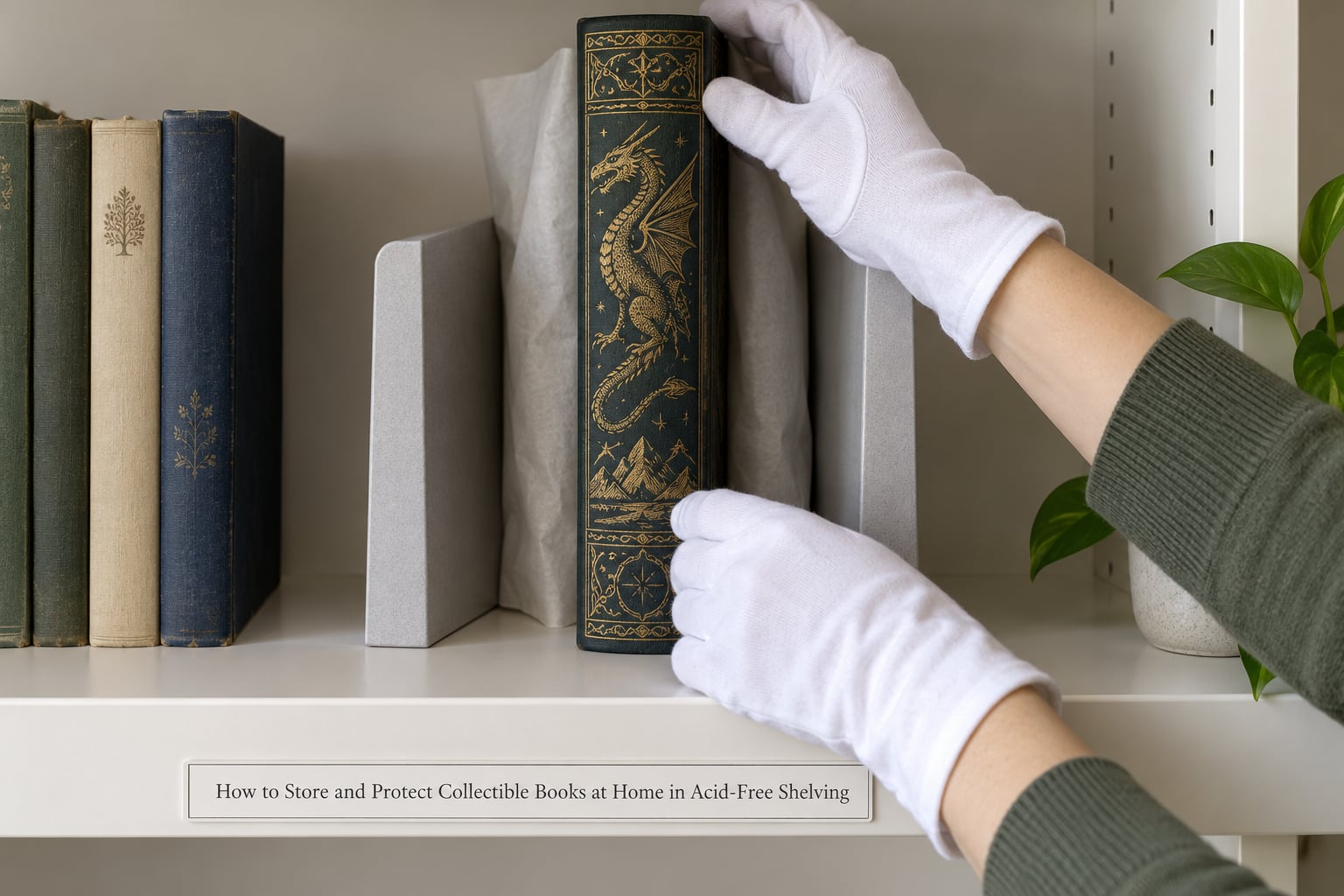
Stand books upright on the archival lining and snug a bookend against the last one on each side. Leave about a finger’s width behind the books so air can move; a gap of two to three centimetres is the standard advice from library preservation staff. Paper goes back after the books, never underneath them.
Control Temperature, Humidity, and Light
Paper is hygroscopic, which is a polite way of saying it constantly absorbs and releases moisture from the air. Aim for 60-70°F and 45-55% relative humidity, and treat stability as more important than hitting a perfect number. A room that sits at a steady 52% is better for books than one that swings from 35% to 70% across a week.
Put the hygrometer on the middle shelf, not near a window or a radiator, and check it in the morning and the evening during your first month so you can see the pattern. A dehumidifier helps in genuinely humid regions, and collectors in places like Florida often run one continuously rather than seasonally.
Watch for the warning signs of too much moisture: a musty smell in the room, cockling or rippling pages, a spine that feels soft, or dark speckling that was not there last year. Those are all reasons to fix the environment first, before touching the books.
Light is the other half. Ultraviolet radiation breaks down lignin, the structural component in paper, and it fades cloth, dyes and gilt lettering irreversibly. Keep books off the wall that faces a window, close blinds during the brightest hours, and consider UV-filtering film on any glass that looks directly onto a shelf. Replace fluorescent and halogen desk lamps with LED if you read at the shelf.
Use Shelving That Supports Every Volume
Upright is the right default for most hardcovers. Flat storage suits nothing except a small number of very wide, very tall, or intrinsically fragile books, and newspapers, which stay flat on their own. A heavy hardback leaning at an angle puts its own spine under continuous sideways stress, and that is the exact mechanism that turns a straight spine into a broken one.
Get the fit right. A shelf should be a couple of inches deeper than the book so the back edge rests fully, with no overhang. Adjustable shelves beat fixed ones because you can bring heavy paperbacks down to a lower level instead of letting them sit at head height where they are awkward to handle. Leave an inch of clearance above the tallest book on the shelf so nothing is crushed by whatever sits above.
Book type changes the answer. A slim signed paperback wants an archival sleeve and a tight bookend. A leather- or vellum-bound volume wants support and darkness, because leather stiffens and cracks in dry air and vellum reacts badly to swings in either direction. An oversized illustrated edition or a heavy omnibus is the one case where lying flat on a shelf padded with acid-free board is kinder than standing.
Create a Handling and Cleaning Routine
Clean, dry hands beat cotton gloves on almost every book. Gloves reduce grip, and a book that slips out of your fingers gets damaged. Reserve cotton gloves for leather bindings, flaking cloth, gilt, and photographs, where the surface is the fragile part.
Lift with two hands: one under the text block near the bottom, one on the spine, with your thumb on the same side as your fingers. Never pull a book out by the top of the spine, the headcap, and never tug at a stuck volume. Tilt the whole group back slightly, slide the one you want upward, and let the rest settle.
Open a book no wider than about 90 degrees on a flat surface, and support the covers with a book cradle or clean cloth wedges if you read it that way often. To clean, brush gently away from the spine with a soft brush, and use a barely damp microfibre cloth on cloth boards, testing an inconspicuous spot first. Skip sprays, solvents and wipes entirely.
Paperclips, rubber bands and receipts are the enemies here. A rubber band left on a spine for years will leave a stain, and metal hardware rusts and bleeds onto boards. Use an archival bookmark instead.
Some jobs are not for a home. Detached boards, torn hinges, a broken spine, torn text block, or anything with real monetary value should go to a professional conservator. A bad DIY repair on a first edition can cost more than the original problem did.
Document and Monitor the Collection
Cataloguing is the step almost every collector skips and every collector later wishes they had done. A spreadsheet is enough. One row per book, with columns for title, edition, publisher, year, format, condition, shelf location, purchase price, date and estimated value.
Photograph the collection shelf by shelf. That one afternoon of photos saves hours when you need to prove what you owned after a leak, a fire appraisal, or a theft.
Set a calendar reminder: monthly for a humidity glance and a quick dust check, twice a year for a proper inspection, and once a year for a full condition review with photos. During those inspections look for silverfish (small, silvery, quick-moving insects and their irregular surface feeding marks) and booklice (tiny pale insects that thrive in damp, mouldy conditions and do no real damage on their own). Look for mustiness, tide lines from water, warped boards, faded spines, and any book where the shelf above is bending it.
Prepare for Leaks, Storms, and Other Disasters
Storage and protection includes the bad days. Know where your main shutoff valve is, keep a list of emergency numbers by the phone, and keep the highest-value books in boxes rather than loose on open shelves if you live somewhere that floods.
Prioritise before you ever need to. Tier one is anything irreplaceable: first editions, signed copies, inherited family bibles, anything you could not buy again. Those go into sealed or vented archival boxes that you can lift quickly and carry. Tier two is the rest of the collectible shelves, boxed in small batches you can actually manage. Tier three is ordinary reading books, which will survive.
For a planned move, pack each box with books packed upright and snug, or flat if they are very heavy, never with the spines sticking out and never overfilled. Tape nothing directly to a book. If the forecast says serious flooding, get tier one off the lower shelves first — water climbs, and a shelf a foot off the floor is often the difference between a soaked and a dry collection.
Common Mistakes
Badly stored collections all share a short list of habits. Each one is cheap to fix and expensive to undo.
- Attics and basements. Both have swings in temperature and humidity that no amount of acid-free paper can fix. Move the books upstairs into a conditioned room.
- Ordinary cardboard boxes long term. Standard moving boxes and their corrugate are acidic and will brown the paper edges over a few years. Use archival boxes if a book is staying in a box.
- Overpacked shelves. Books squeezed in without breathing room trap moisture and encourage mould. Leave a hand’s width behind them.
- Sunlight on display. A shelf that looks lovely in a sunlit room is fading the cloth every day. Rotate display books or move them out of the beam.
- Gloves on everything. Cotton gloves reduce your grip on smooth modern hardcovers and lead to drops. Clean dry hands for sturdy books, gloves for fragile surfaces.
- DIY repairs. Household tape, superglue and gaff-taped spines cause more long-term harm than the tear you were fixing. Archival tape such as Filmoplast is for spine-label repairs on modern books only.
- Stretchy bands and hardware. Rubber bands, paperclips and metal fasteners stain and rust over time.
- Ignoring musty smells. That smell is a moisture problem, and it will become mould if the humidity does not come down.
Quick Protection Tips
If you remember five things, remember these. Keep the temperature and humidity steady, because swings hurt more than a slightly imperfect number. Handle books by lifting them, never by pulling the top of the spine. Never force a swollen or stuck page block open, because the tear it causes is permanent. Send high-value or genuinely fragile books to a conservator instead of attempting a repair. And inspect the storage area at least twice a year, every year, not just when something looks wrong.
Frequently Asked Questions
Should rare and collectible books be stored in plastic bins?
Only for moving, and even then only loosely. Plastic bins trap condensation and any moisture already inside, which is how mould starts. Getting how to store and protect collectible books at home right starts with ruling them out as permanent homes. For long-term storage, use acid-free archival cardboard or a clamshell box and keep it somewhere with stable humidity. Collectors do sometimes leave collectible books in unsealed polyethylene bags, which let the paper breathe while blocking dust, but bags are a short-term measure rather than a home for a first edition.
What is the best humidity level for a home book collection?
Around 45-55% relative humidity, held steady. Paper is hygroscopic, so it swells when damp and shrinks when dry, and repeated movement warps boards, cracks joints and makes pages cockle. Read a hygrometer on the shelf itself rather than trusting a weather app. If you cannot hold the number, consistency beats precision: a steady 50% protects books far better than a room swinging between 35% and 70%.
How should I store oversized Harry Potter books?
Upright, supported on both sides, on a shelf deep enough that the book does not overhang the front edge. Leave a hand’s width of air behind them and an inch of clearance above. Illustrated deluxe editions and heavy omnibuses are the exception: laid flat on a shelf padded with acid-free board, they last longer than standing. Slip a cloth sleeve or an acid-free folder over the dust jacket, and never lean them against a wall.
Are cotton gloves better than clean hands for handling books?
No, not for most books. Gloves reduce grip, so you are more likely to drop a volume, and the oils on clean dry hands actually help paper. Cotton gloves earn their place on leather bindings, flaking cloth, gilt lettering, photographs and anything with a fragile surface, where the outer material is what is deteriorating. Wash and dry your hands before handling, and skip lotion, which transfers to paper and attracts dust.
How do I remove mold or musty odors from old books safely?
First fix the source. Lower the humidity, improve airflow and clear debris from the shelf, because mould returns the moment the room is damp again. Then isolate the affected books on a covered surface and brush the dry spores off outdoors with a soft brush, wearing a mask. Wipe or brush a humidified book dry, fan it in a ventilated room, and interleave with unbuffered acid-free tissue. Serious or spreading growth means a conservator, not a home clean.
When should a valuable book be taken to a conservator?
Take it in when the damage is structural rather than cosmetic: detached or cracked boards, a broken spine, hinges pulling away, a torn text block, or missing leaves. Also bring anything you cannot clean without risking further loss, and anything significant enough that a mistake would be expensive. A conservator will also assess papers that have turned brittle or sticky and jackets that have faded or flaked. Your local library can usually point you to a reputable one.
Conclusion
Start small. Pull out the three or four volumes that are either irreplaceable or already fragile, find an interior room that holds a steady temperature, and buy the small set of things that matter most: a hygrometer, a couple of solid bookends, acid-free tissue and archival board. Knowing how to store and protect collectible books at home is mostly this sequence done once, in the right order. Move those books onto supported shelves first, then work through the rest of the collection at a pace you can keep up.
Nearly all of the damage that collectors regret was preventable with those five purchases and a little attention twice a year.