The time-turner rules in Prisoner of Azkaban come down to four things: one turn of the hourglass sends you one hour into the past, a Ministry-issued time-turner will not carry you more than five hours back in a single trip, it only ever moves backward, and you reappear in the past version of the exact spot where you were standing. Everything else people argue about follows from those four.
Full spoilers for the whole third book, including who is in prison and how he gets out.
One framing note before we start. The book gives you the device, the five-hour ceiling and the secrecy oath. The explanation of why those limits exist, and what happens when the rules are broken, arrived years later through Rowling’s writing on Pottermore, quoted by Muggle scholars in the books. I will keep those separate from what the novel itself states, and I will flag the sequel-canon material from The Cursed Child so you know which shelf a fact sits on.
Table of Contents
- What are the time-turner rules in Prisoner of Azkaban?
- How does the time-turner move someone through time?
- How far back does the time-turner turn in Prisoner of Azkaban?
- Why did Dumbledore give Hermione Granger a time-turner?
- What can the time-turner change, and what can’t it change?
- Can the time-turner bring someone back to life?
- Why does the time-turner cause problems in Prisoner of Azkaban?
- How does the time-turner rule set up the Dementor surprise?
- What do the books say that the films leave out?
- Frequently Asked Questions
- Can the time-turner turn time forward?
- How many hours can the Prisoner of Azkaban time-turner go back?
- Who gave Hermione the time-turner in the books?
- Can the time-turner save Sirius Black without changing history?
- Why couldn’t Harry Potter simply use the time-turner to stop Voldemort?
- Is the time-turner’s behavior in the films different from the books?
- The Short Version
What are the time-turner rules in Prisoner of Azkaban?
A time-turner is a Ministry-issued device that takes its user back into the past. It works like this:
- One turn, one hour. Each revolution of the enchanted hourglass moves the user back exactly one hour. Hermione counts the turns out loud when she uses it.
- Five hours maximum. A Ministry time-turner will not take you more than five hours into the past in one trip. This ceiling is stated in Harry Potter and the Order of the Phoenix, not in Prisoner of Azkaban.
- Backward only. There is no forward travel. The charm reverses time; it does not skip it ahead.
- Physical contact carries others. Anyone touching the user travels with them. This is how a second person gets pulled along.
- You return to the place you were. Not the building, not the town. The past version of the exact spot where you stood when you turned the glass.
- It is a controlled Ministry object. Possession is illegal without permission, and using one is illegal without permission. A licensed user has signed an oath of secrecy.
- Nobody is supposed to know. The user must not tell anyone about the object, which is exactly why Hermione’s friends find out by accident.
Here is the same set in a form you can check against the text.
| Rule | Limit | Canon source |
|---|---|---|
| One turn equals one hour back | 1 hour per revolution | Prisoner of Azkaban |
| Maximum distance back | 5 hours per trip | Order of the Phoenix |
| Direction | Backward only, never forward | Order of the Phoenix |
| Who travels | The user plus anyone touching them | Prisoner of Azkaban |
| Arrival point | The exact spot you were standing | Prisoner of Azkaban |
| Permits | Special permission from the Ministry of Magic | Prisoner of Azkaban |
| Disclosure | Oath of secrecy, must not tell anyone | Prisoner of Azkaban |
| Failure mode | Unstable magic, temporal anomalies, physical harm | Order of the Phoenix, Pottermore |
That last rule is the one that matters most for the plot. Hermione tells Harry and Ron that the Ministry collapses time-turners in case of misuse, and that hers was destroyed when she stopped using it. The threat is not theoretical, it is the reason the device disappears from the series.
How does the time-turner move someone through time?
The mechanism is a stable Hour-Reversal Charm sealed inside a small glass hourglass in a metal frame, worn on a silver chain around the user’s neck. Hermione’s has an inscription on the base. When the holder winds the glass, the charm pulls the person back. The inscription is the closest thing the books give to a manual, and it reads like a warning rather than an instruction.
Two different things are moving, and readers often merge them. The hourglass is the object that passes backward through time. The person wearing it is the traveller, and their body goes with the glass even though the glass itself stays in their hand. Nobody has to hand them a second device in the past.
The second mechanic is touch. A person holding the traveller’s arm or hand comes along, which is why Hagrid can drag Harry and Hermione through an hour backward without his own permission, and why the trio can pull Ron along. The device does not distinguish between the user and the company the user is keeping.
Then there is the arrival. Turn the glass and you are not dropped somewhere vaguely near where you were. You are standing where you were standing, one or more hours ago, with whatever was going on there already going on. In the book this is the detail that makes the whole rescue plan possible, because the trio arrange to be in the right place at the right hour before the plan starts.
How far back does the time-turner turn in Prisoner of Azkaban?
Two jumps matter in this book, and they are different sizes.
Hermione’s school-year schedule. From late September onward, Hermione goes back to the start of each school day and repeats it. By the time Harry notices, she is attending far more classes than the timetable allows. When Harry, Ron and Hermione recount the count in the Shrieking Shack, it comes to several hundred classes across a term, hour by hour, which is a lot of turning for one object.
The rescue jump. The night Harry learns the truth about his godfather, he uses her time-turner with her permission and drags Ron along on his way up to her. They go back far enough to be in position hours before Hagrid arrives with Sirius. Buckbeak’s execution has to be imminent, which is the real reason the plan has no slack in it.
Now the honest part. Prisoner of Azkaban never prints a number of hours for that second jump, and the five-hour ceiling is not mentioned in the novel. What the book establishes is the mechanism and the direction. The ceiling comes later, from Order of the Phoenix and from Rowling’s own explanations, and plenty of readers have noticed that a rescue requiring hours of careful positioning is hard to square with a device that stops at five. Treat five as the published limit and the rescue as the story’s loosest fit with it.
So if you were looking for a single number, there isn’t one in the book. There is a per-hour rate, a later-published cap, and a plot that needs more room than the cap allows.
Why did Dumbledore give Hermione Granger a time-turner?
He did not, strictly speaking. Hermione applied, and her application was approved.
At the end of her second year, Professor McGonagall writes to the Ministry of Magic on her behalf and lays out the case. Hermione is the brightest student the school has seen in a century, the schedule she wants to build cannot be done inside the existing timetables, and she has already proved she will not abuse the access. The Ministry grants special permission, and Hermione signs an oath promising never to tell anyone about the object.
Three things make this an exception rather than a student privilege. It required a written case from a professor. It required the Ministry’s sign-off, and the Ministry treats time-turners as controlled objects with destruction built into the law. And it came with a gag, which is why two friends find out about the most powerful thing in the school by bumping into her in a corridor.
Dumbledore is in the background of that decision, and that is where a fair question starts. He owned a time-turner himself. He could have gone back further than anyone, further than a Ministry device allows, and he spent a year looking at a death he knew was coming. Whether that counts as a contradiction in the rules or as a choice about a different kind of problem is a fair thing to think about, and reasonable readers land on both sides.
What can the time-turner change, and what can’t it change?
Short version: it changes the traveller’s own path, and it does not hand anyone else a new history.
The clearest example in the book is Buckbeak. The trio go back to save a hippogriff from execution, and they succeed. That is a real change to the world, and it holds after they leave. So the device is not useless for saving people.
What it will not do is hand you someone else’s happy ending. Sirius Black is released from the tower, and the trio watch him walk toward the tunnel. The Dementors arrive before he is through the veil. Nobody gets to rewind that and try a second plan, because by then the hourglass is in Hermione’s pocket along the tunnel wall and the moment has passed.
Cedric Diggory is the other test case, and the reason fans ask why the trio did not go back further. In the third book there is no window. They learn what happened to Cedric only after the fact, and the device cannot be used to look forward. That is also the practical reason the trio stop using it entirely. Hermione returns hers once she no longer needs it, every time-turner the Ministry holds is destroyed, and after Order of the Phoenix the option simply does not exist for them.
One more limit worth naming. During Hermione’s month of double attendance, nobody is supposed to notice, and nobody does. The secrecy rule is a rule about other people finding out, not about a traveller being invisible. People can absolutely see you in the past. The danger is that they will ask.
Can the time-turner bring someone back to life?
No, and the books are clear enough about the direction of the magic. A time-turner moves you into the past. It does not fetch anyone out of it, and it does not restore what has already happened.
That is why it is useless against Voldemort in the way fans sometimes wish it weren’t. By the time Harry has the device in his possession, the attack at Godric’s Hollow has happened. Going back five hours from his third-year life does not reach that night, and going back does not undo it in any case. The horror of the series is that the one terrible event cannot be edited out.
The Ministry keeps a record of what happens when someone pushes past the device’s limits, and the record is not encouraging. Muggle-born witches and wizards have been found with their minds damaged, some unable to move properly, one apparently turned inside out. These are the consequences the books attach to unstable time-related magic, and the sound of that list is the reason the five-hour ceiling is a safety rule rather than a technicality.
Everything in this section comes from the novels. The Cursed Child contains time-turners of a different kind, credited to Theodore Nott, and games and films add material of their own. Those belong to a different continuity and they do not add rules to the third book.
Why does the time-turner cause problems in Prisoner of Azkaban?
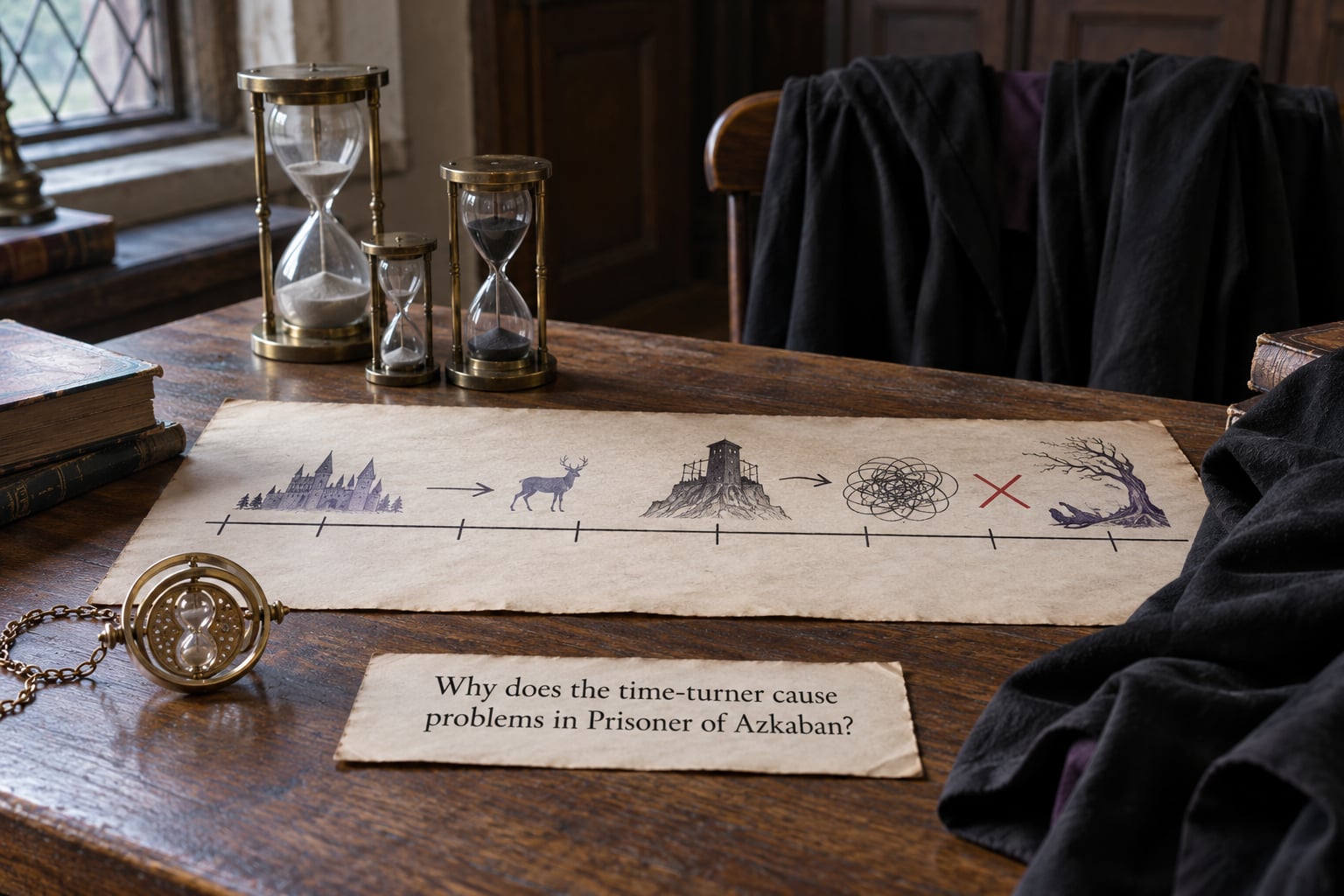
Because it puts three people in the past with no way to check the result.
Every extra person in the past is extra exposure. Hagrid has to move a second grown wizard and a sleeping child through an hour of darkness, unseen, on a path where a single stumble undoes the plan. Nobody can see how the evening will turn out. They are working from the version of events that already happened, which means they know the ending and nothing about the middle.
Their advantage is also the trap. They know Sirius is wrongly imprisoned, they know Buckbeak is innocent, they know Hagrid is coming. That knowledge is the only reason the plan works, and it is exactly the kind of certainty that breaks when something arrives out of order.
And there is the one nobody planned. The Dementors that should be inside Azkaban are on the lake. The trio did not cause that, and no amount of prior knowledge prepared them for it. The time-turner is the most powerful object any of them owns and it does nothing at all about a change in someone else’s schedule.
How does the time-turner rule set up the Dementor surprise?
The sequence runs in stages, and the surprise only works if you follow the order.
- The trio rescue Sirius from the tower and go back far enough to arrive early.
- Sirius is revealed as an Animagus, the Horklump appears, and the confusion is resolved. Buckbeak flies free, which also resolves Hagrid’s character problem for the Ministry.
- They walk out through the tunnel toward the Forbidden Forest.
- The Dementors are waiting, which they should not have left the prison.
- Harry steps forward to protect the others. He has no memory of casting anything, but he sees the silver shape flying over the lake and a huge, transparent figure standing on top of it.
The figure is his own Patronus, cast by the Harry who lived this hour already. It saved a worse version of him. No one in the book is more disturbed by a piece of magic than Harry is by this, because the only version of him with the skill to do it is a version that has already suffered what he is in the middle of suffering.
What the scene demonstrates is not that the device failed. The device worked exactly as advertised. It is a demonstration of the cost of standing inside an event that is bigger than you, which is a different kind of rule from the mechanical ones, and a much more expensive one.
What do the books say that the films leave out?
The 2004 film keeps the core beats and drops several of the mechanics, which changes how the scene plays for anyone who watched it first.
Hermione’s double attendance is compressed into a few lines, so the sheer scale of the schedule, hours upon hours of turning, is much harder to picture on screen. McGonagall’s letter to the Ministry largely disappears, which removes the on-page reason Hermione was allowed one. The oath of secrecy still exists, and the film plays it for comedy when she finally shows Ron and Harry the necklace.
The biggest difference is who turns the glass. In the book, Hagrid winds the hourglass and hands it back; in the film, Hagrid does it more casually and the secrecy of the moment is softened. On where the traveller reappears, the book and the film also behave differently at the worst possible moment. Hermione goes back alone to the tower to save Sirius, and in the film she is shown arriving inside the tower corridor and being seen, which sits badly against a rule that has just been established.
The Dementor attack is also staged differently. The film cuts between Harry alone in the tunnel and the trio on the lakeshore, so the Dementors arrive off screen. The book’s version puts the reader in the dark with the characters, which is why the scene lands harder on the page.
One spoiler about the film only: the door Harry walks through in the third movie is an addition that has nothing to do with the time-turner rules and a lot to do with the fourth book’s plot.
Frequently Asked Questions
Can the time-turner turn time forward?
No. The charm inside a Ministry time-turner is a Hour-Reversal Charm, so it only ever moves the user backward. Rowling confirmed this in the Order of the Phoenix writing, where she describes a Ministry time-turner as a device that sends the user back into the past. That single fact explains most of the frustration fans have with the device: you cannot skip ahead to see how a plan turns out, so a rescue has to be built entirely on knowledge of what already happened.
How many hours can the Prisoner of Azkaban time-turner go back?
Five hours in a single trip, and that number comes from Order of the Phoenix rather than Prisoner of Azkaban itself. The novel gives you the rate of one turn per hour but never states a ceiling. Rowling later wrote that Ministry time-turners had a five-hour maximum, and the wizarding community treats that as canon. It sits awkwardly with the rescue in the third book, which needs several hours of preparation and repositioning.
Who gave Hermione the time-turner in the books?
Nobody gave it to her outright. At the end of her second year, Professor McGonagall writes to the Ministry of Magic on Hermione’s behalf and argues that her academic record makes extra study time fair. The Ministry grants special permission and Hermione signs an oath of secrecy. Dumbledore supports the case but does not hand over the device himself, which matters, because the point is that Hermione earned legal access to a controlled object rather than receiving a favour.
Can the time-turner save Sirius Black without changing history?
In the novel, yes, and the way it works is what readers argue about. Buckbeak goes free and stays free, so the trio do change things. The trick is that the change lines up with what was always going to happen, which is why Buckbeak’s trial ends without execution. Sirius is not so lucky. He is released, walks toward the tunnel, and meets the Dementors before he reaches the veil, so nothing the trio do can carry him out that night.
Why couldn’t Harry Potter simply use the time-turner to stop Voldemort?
For three reasons, and they are all in the books rather than in fan theory. The device only goes backward, and by the time Harry has it the attack has already happened. It is capped at five hours, so he cannot reach the night itself. And the Ministry destroys time-turners after Order of the Phoenix, so even a saved copy would eventually be gone. A time-turner cannot undo history; it can only put a person in a past they already lived through.
Is the time-turner’s behavior in the films different from the books?
Somewhat. The 2004 film compresses Hermione’s double attendance, drops most of McGonagall’s letter to the Ministry, and shows Hagrid handling the hourglass more casually than the book does. The clearest continuity change is the return to the tower to save Sirius, which the film stages in a way that plays against the secrecy rule. The Dementor attack also moves off screen in the film, so the on-page version keeps the reader as blind as the characters.
The Short Version
If you are re-reading the third book and the time travel is what is muddling it, go back to the four mechanics and hold them: one turn per hour, backward only, everyone touching the user comes along, and you land exactly where you stood. The rescue then reads as what it is, a plan built on knowledge that never quite fits the room it is in. For everything the novel leaves out, the Order of the Phoenix material and Rowling’s own published writing are where the missing limits live.