Goblin magic is a form of wandless magic that goblins are born with rather than learn, and it powers the deepest part of Gringotts: the vault doors that no wizard can open. Gringotts security works in layers, from identification at the marble counter down to a conditioned dragon, and almost every layer can be tied back to something goblins actually built or run. This guide walks through both, and marks where the books stop and the films and fan theories take over.
It is worth saying up front that Rowling never wrote a technical manual for goblin magic. There is no spell list, no wand-core theory, no exam syllabus. What we have is a set of demonstrated examples, a 1631 Ministry decree and a lot of confident fan inference. I will keep those two things apart.
Table of Contents
- How Does Goblin Magic Differ from Wizard Magic?
- What Kinds of Magic Do Goblins Practice?
- Why Did the Goblins Build and Run Gringotts?
- How Does Gringotts Security Work?
- What Protects the Deepest Gringotts Vaults?
- How Do Vault Keys, Passwords, and Blood Checks Work Together?
- Which Gringotts Defenses Are Magical, Physical, or Administrative?
- Why Is Gringotts Considered Neutral Ground?
- What Are the Limits of Gringotts Security?
- What Do We Know and What Are We Guessing About Goblin Magic?
- Frequently Asked Questions
- Conclusion
How Does Goblin Magic Differ from Wizard Magic?
The short answer is that wizard magic is taught and instrumented, while goblin magic is innate and worked by hand. Wizards learn spells from books and teachers, and cast them through wands that are made, sold and registered. Goblins cast without a wand at all.
The regulation that defines this gap dates to 1631, when the Ministry of Magic enforced Clause Three of the Code of Wand Use. The clause had always applied only to goblins, and enforcing it meant confiscating their wands. It is the reason goblins appear throughout the series as creatures who work without an obvious implement.
Two examples do most of the explaining. When Griphook opens the Lestrange vault, he does not wave a wand at a mechanism; he presses his hand against the metal and the door simply is not there anymore. In the earlier books, goblin-made silver is treated as a category of its own, valued precisely because it was forged under magical control rather than struck by a hammer alone.
Goblin magic is also described as capable of being channelled through a wand, which is exactly what the 1631 clampdown was aimed at. Some goblins have refused to be stopped. Ragnuk, the Goblin King of the 17th century, is credited with working a curse of his own; Polyus, the goblin Polyjuice turns into in Prisoner of Azkaban, knows the vault business from the inside and helps Harry, Ron and Hermione plan the theft of a Horcrux.
What Kinds of Magic Do Goblins Practice?
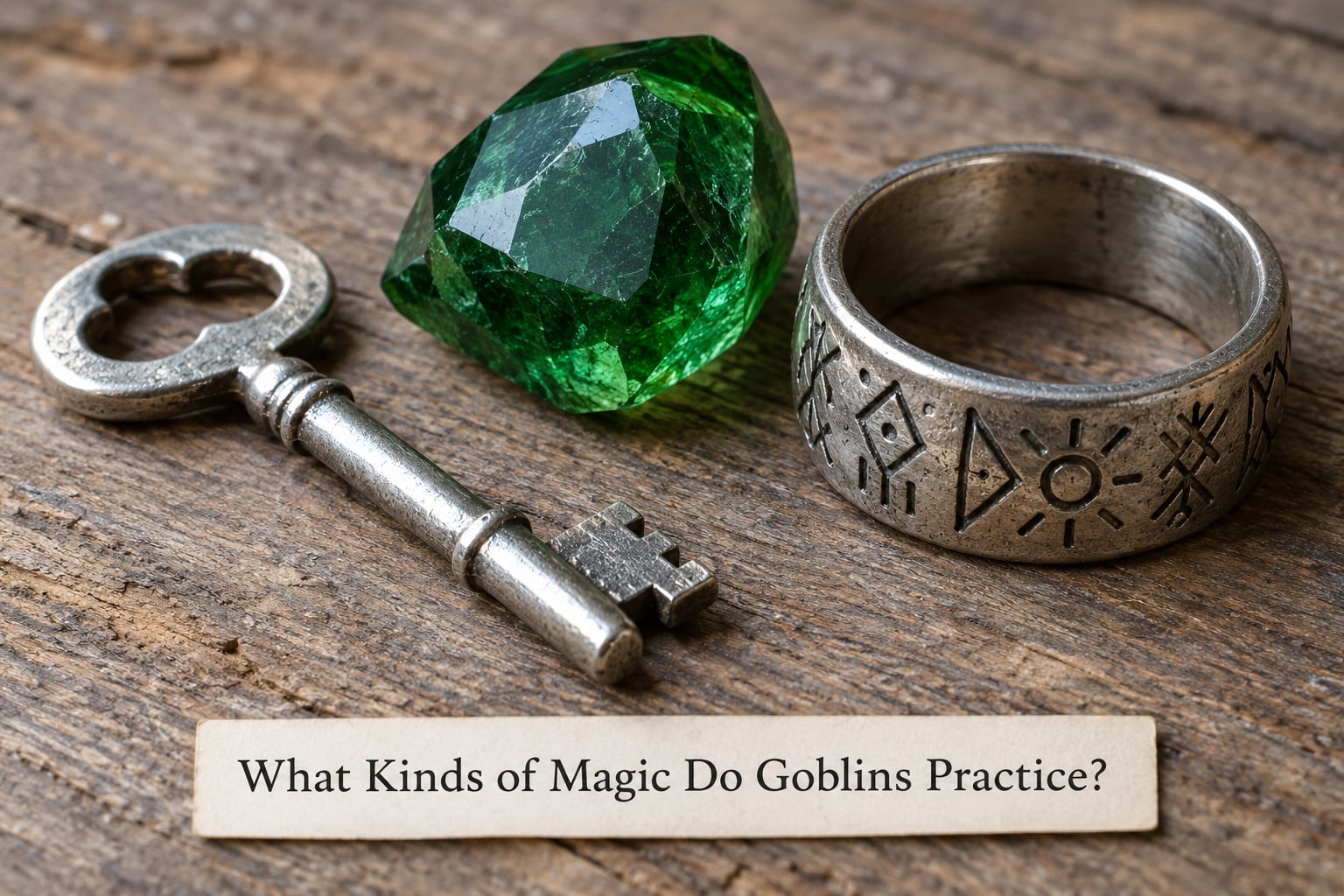
Strip away the legend and the confirmed list is short. Enchantments on objects, protective charms, metalwork, gemstone knowledge, and the practical business of running a vault. Everything else fans attach to goblins sits somewhere between those five things and pure guesswork.
Enchanted objects are the safest category. Griphook can open doors that answer to no spell Harry or Hermione knows, and goblin-made objects turn up across the series as armour, blades, coin and bank furniture. That is established in the text. What sits underneath those objects, the exact working of the enchantment, is not.
Runic work is the part readers argue about most, and the books help less than people hope. Ancient magic in the series is associated with methods described as runic in shape, and goblins are plausibly connected to those traditions. But no passage in the seven novels sets out a goblin runic alphabet, and no character writes one on screen. If you build a system on that, you are building it yourself.
Gem and metal work is the one skill you can watch a goblin demonstrate. Griphook inspects and appraises the vaults; goblins mint Galleons, Sickles and Knuts. That minting function is doing a lot of quiet work, because a currency issuer has an obvious reason to want the bank stable.
The broader craft of magical banking is best read as goblin-led rather than goblin-magical. Gringotts vaults are maintained, inventoried and defended by goblin staff. The magic is real; the role is professional.
Why Did the Goblins Build and Run Gringotts?
The bank was founded in the 13th century by Gringott the First, and the arrangement that makes it work was settled during centuries of conflict between goblins and wizards. Goblins were overrun, displaced and driven underground, and wizards held the surface. Control of a bank is one of the few things a besieged minority can bargain with, because a settlement nobody trusts with money has no settlement.
That is the practical version of the origin story. In the politics of the series, the bank’s authority comes from an old compact, which is why Gringotts operates under wizard jurisdiction in a human city while remaining effectively answerable to neither side.
It is easy to slide from this into “goblins are neutral because they are good at money.” They are not uniformly good at anything. The vaults were breached in the 17th and 18th centuries during goblin rebellions, Voldemort took over security under his Ministry in 1997, and after the 1998 break-in the bank retaliated hard, relocating to new offices with new protections and refusing any element of that agreement that let it operate without goblins.
The better explanation for trust is self-interest plus professional pride. A bank that loses its deposits has nothing left, and a bank that fails to honour its contracts loses the one asset it cannot replace.
How Does Gringotts Security Work?
Walk the route from the street to the deepest vault and the layering becomes obvious. Each step assumes the previous one has already failed, and each one belongs to a different category of defender.
At the front door
The entrance is guarded, and in the books the bank is treated as a place where identification is the first gate rather than the last one. Gringotts is also protected as a site where the wizarding government has no routine authority to place wards. That detail matters, because it means a Ministry can pass a law about the bank and still be unable to install something inside it.
Getting underground
Down means mine carts. Visitors ride in under goblin supervision, and the anti-apparition protections on the bank mean the shortcut is closed. This is the first real answer to the question readers ask most: nobody walks in from Diagon Alley, and nobody drops in from above.
Once underground, the water starts. A spell usually described as the Thief’s Downfall pours down over anyone moving through the vault passages and strips magical concealment. Disguises, concealment charms and colour-changing magic come off, and the person underneath is identified by sight.
Past the creatures
Security is layered with living defences. A troll works the bank on a loose arrangement that the books play for laughs in one famous heist, and deeper vaults are associated with far more dangerous creatures. Vault 713 is the one to remember as a case: it held the Philosopher’s Stone in 1991 and was described as so secure that the Stone had to be moved on Hagrid’s advice, because Hagrid had a protective charm on it that no vault could improve on.
The forced password of Fortius Quo Fidelius, applied to open objects, comes from this same world of procedure. A bank that can make an object refuse anyone but its owner is not really guarding items so much as removing the possibility of a stranger being present at all.
The door itself
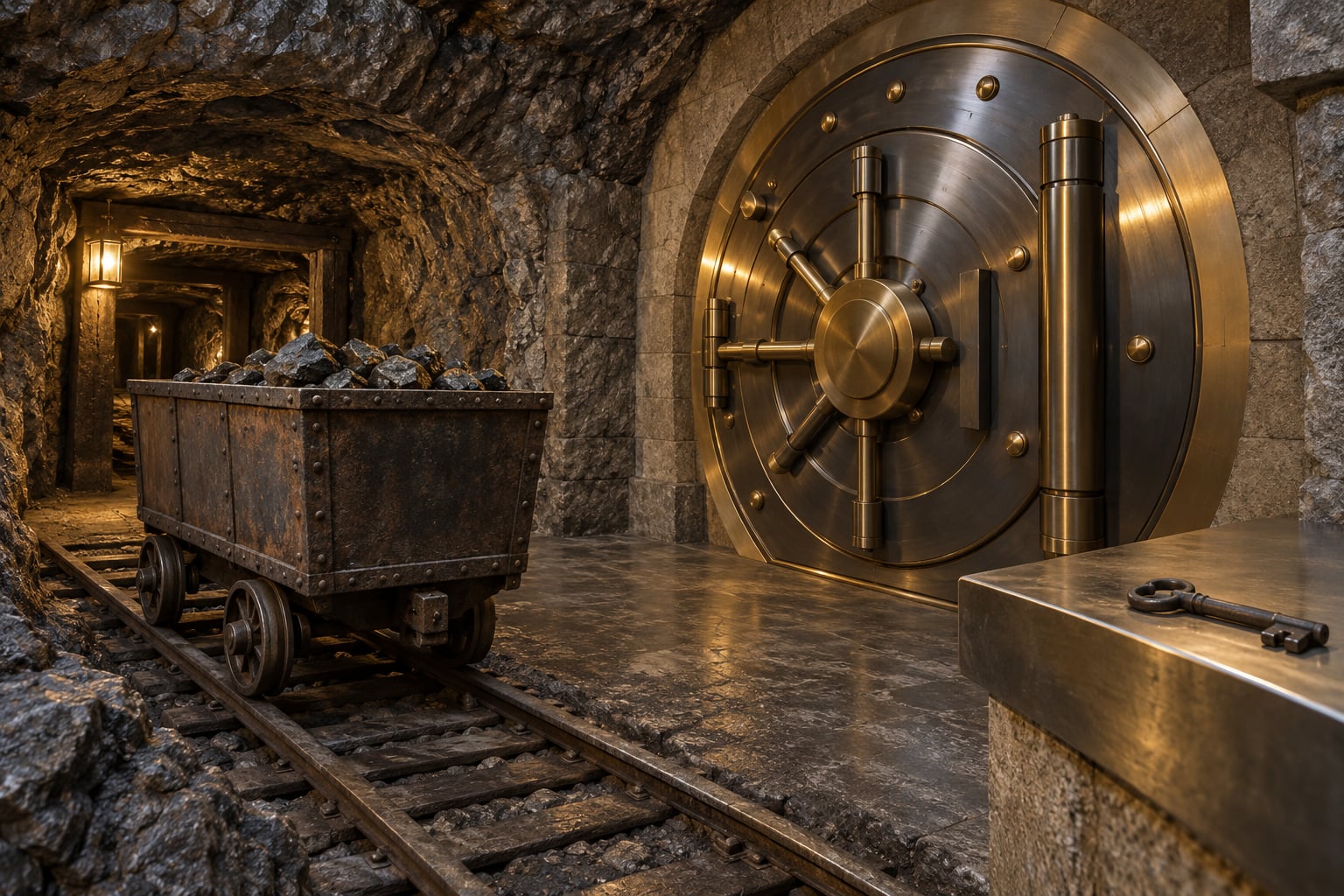
And then there is the mechanism people actually came to ask about. Lower vaults open with a key. Deeper ones do not, because no wizard can open them at all. A goblin presses a bare hand to the metal and the surface melts away, and if the hand is not a goblin’s, the mechanism pulls it in.
So when you ask how goblin magic and Gringotts security work, the honest answer is that they are the same system. The bank’s most valuable locks are not locked in a way a spell can override. They are locked in a way that only the bank’s own workforce can open, which makes the doors a staffing decision as much as a security device.
What Protects the Deepest Gringotts Vaults?
The Lestrange vault is the clearest example, and the only one Harry ever sees opened from the inside. It sat so far down that reaching it took a cart pushed through tunnels in the dark, and Harry, Ron and Hermione came out of it badly burned by dragonfire, having already passed every checkpoint above.
Its protection was not mainly a lock. It was that almost nobody knew it existed, nobody outside a small circle knew what was inside, and anyone who did know was either dead, imprisoned or unwilling to talk. Gripping, Polyus and Griphook are the only people in the books who could open it, and one of them had to be bribed with the goblin-made Helga Hufflepuff cup that Harry carried for two years.
Across the series, dragons are attached to the deepest holdings. Hermione works out during the flight from Gringotts that the dragon is conditioned to respond to Clankers and not to people, which is why nobody was eaten in the vault itself.
The post-war change is worth noting too. The bank’s new offices, reported in the aftermath of the war, are protected by sphinxes instead, and the dragons do not appear in that later account. Whether that was an upgrade or simply a different way of saying the same thing is not something the books settle.
How Do Vault Keys, Passwords, and Blood Checks Work Together?
Bank access in the series runs on identification and permission, not on possession. The key introduced in Philosopher’s Stone looks like the whole mechanism, and then it almost disappears from the story. Later access is granted by staff who decide you are who you say you are, and by the standing terms of your account.
Three ideas explain nearly every example in the books:
- Identification. How the bank knows the person in front of it. It can involve a key, a written authorisation, a familiar face recognised by a clerk who has worked there for decades, or an account in standing that authorises someone to act on the holder’s behalf.
- Permission. Whether the person identified is allowed into that specific vault today. Some accounts hold authority to visit and withdraw at any time. Others require a named person to be present.
- The mechanism. The key, or the goblin’s hand, which opens the door once the first two are satisfied.
This is why key-based access looks inconsistent. Sirius Black buys a broom in Prisoner of Azkaban using Harry’s name and pays from Harry’s vault, and Molly Weasley retrieves gold from Harry’s vault with no key at all. Nobody is cheating. The bank is applying its rules correctly to an authorisation it accepts.
Named vaults follow the same logic. Vault 687, the Potter family vault, was emptied before the finale and held nothing the books bother describing. Vault 711, the Black family vault, had its contents cleared out and later looted during the break-in. Vault 713, the Hufflepuff vault, held the Philosopher’s Stone before it was moved to the Room of Requirement.
Hermione’s plan in Prisoner of Azkaban is the cleanest illustration of identification versus possession. A Polyjuice Potion gives her the face of someone who already has the access she wants, and Polyus the goblin tells her exactly what the bank needs: identification and permission. She gets both without owning anything. Thief’s Downfall and Probity Probe measures, used by the Ministry in this period, are the sorts of things that complicate that trick, not the goblin doors.
The one thing no one has managed is to open a deep vault with a wand and an argument. Griphook asks for the cup before he asks for payment, and nobody in the books outbargains him.
Which Gringotts Defenses Are Magical, Physical, or Administrative?
Sorting the defences by type makes the whole system easier to picture, and it shows which ones a clever burglar could argue with.
| Defence | Type | What it does | Source |
|---|---|---|---|
| Guarded, ward-protected entrance | Physical and administrative | Blocks unauthorised entry at the door and keeps the Ministry out of the bank’s own wards | Books |
| Identification at the counter | Administrative | Confirms the person is who they claim to be and may act on the account | Books |
| Anti-apparition charms | Magical | Closes the easy way in, so travel underground is the only route | Books |
| Mine cart descent | Physical | Controls who goes down, when, and how deep | Books and films |
| Thief’s Downfall | Magical | Strips concealment and appearance-altering magic from anyone moving through the vaults | Books |
| Fortius Quo Fidelius | Magical | Makes an object refuse to be opened by anyone but its owner | Books |
| Goblin-made doors | Physical and magical | Key for shallow vaults; a goblin’s hand melts the metal away for deep ones | Books |
| Goblin staff and the code of silence | Administrative | Turns the workforce into the lock: nothing is described to strangers | Books and forum consensus |
| Creature defences, including the dragon | Physical and magical | Deterrent and, in the worst case, lethal; conditioned to Clankers rather than people | Books |
| Secrecy about depth and contents | Administrative | Makes an unknown vault impossible to rob before it is found | Books |
| Probity Probes | Magical | Detects concealment and deception; used under Voldemort’s Ministry | Books, 1997 context |
Read top to bottom, the pattern is clear. The bank spends most of its protection on identification and secrecy rather than on hard magic, which is also why one determined crew with a goblin on the payroll could do as much damage as they did.
Why Is Gringotts Considered Neutral Ground?
Gringotts serves wizard and goblin customers in the same building, holds both families’ wealth, and survives changes of government. It gets that position from a legal arrangement rather than from goodwill: a settlement reached when goblins had something the wizards wanted and the wizards had something the goblins needed to stop fighting.
That has three practical consequences. The bank has no public owner to be nationalised by a new Minister. It has customers on both sides, so seizing it would be theft from the wrong half of the population. And it operates inside wizard jurisdiction while holding protections the wizard government cannot casually add or remove.
Neutrality here is a political status, not a moral claim. The bank’s record includes banking for people on both sides of every conflict and expanding into new offices after the war with goblins effectively running them. It is also the institution that refused to bend after the 1998 break-in, when Harry returned a Horcrux to keep the arrangement intact.
What Are the Limits of Gringotts Security?
No system in the books is invulnerable, and Gringotts is the rare case where the weaknesses are demonstrated rather than guessed at.
The largest one is insider access. The 1998 break-in worked because Griphook had spent his life inside the system and knew where every door was. No amount of hardening fixes a bank whose own employees can open the deepest vaults, because that is the product being sold.
Second, the layered design does not stop a determined intruder from getting in. Harry, Ron and Hermione passed identification, rode the carts down, went through the water, and reached the vault. The layers slowed them and shaped the route, but the route was completed.
Third, secrecy does the heavy lifting and secrecy is fragile. An unknown vault cannot be robbed before it is found, which is excellent until someone tells a stranger about it. The bank’s exposure scales with how widely its contents are discussed.
Fourth, magical theft is outside what doors can solve. A Polyjuice Potion plus a friendly goblin beat the warding. There is no counter described for an insider who is willing to trade loyalty for a cup.
And fifth, the bank is vulnerable to political capture, which is what Voldemort attempted through the Ministry’s control of magical policy. That is a different attack from a burglary, and it is the one the series treats as the long-term danger.
What Do We Know and What Are We Guessing About Goblin Magic?
Confirmed in the books: goblins cast without wands; the 1631 Wand Ban and Clause Three of the Code of Wand Use; goblin-made objects including silver, coin and the Helga Hufflepuff cup; goblin-run Gringotts; goblin doors that open only to a goblin’s hand and are dangerous to anyone else; and goblin knowledge as the access requirement for the deepest vaults. Griphook and Polyus are the two characters who demonstrate that knowledge directly.
Reasonable interpretation: that goblin magic is partly innate rather than taught, that enchanted objects are part of the crafting tradition rather than separate from it, and that goblin recognition of customers is the real gate on access.
Not established: any runic system, magical biology, inheritance rules, a special way goblins communicate, a technical explanation for why a goblin’s hand opens a vault that resists everything else, or any spell formula of their own. Books, films, Hogwarts Legacy and Hogwarts Mystery all add different details, and the games add the most that the novels never established. If a claim sounds precise and has no book behind it, treat it as decoration.
Frequently Asked Questions
Is goblin magic based on runes?
The books associate ancient runic methods with goblins, and goblins are consistently tied to enchanted objects. But no novel sets out a goblin alphabet, shows a rune being written, or explains a runic spell system. Treating goblin magic as a rune-based tradition is a reasonable reading, not a stated fact. Some of the strongest material on this comes from fan wikis rather than Rowling’s text.
Are goblins inherently more powerful than wizards?
Not in the way most people mean it. Goblins cast without wands, which matters because wands are the usual bottleneck, and they run the deepest part of the bank’s security. What that shows is competence and institutional control, not raw power. Goblins are not described as stronger or more magically potent than wizards, and they lost their own underground territory to wizards in the historical conflicts described in the series.
Why can’t wizards simply apparate at Gringotts?
Because the bank is protected against it. Gringotts is treated as a site where the wizarding government cannot impose its own wards, and anti-apparition charms close the shortcut once you are inside the perimeter. The only route the books describe is the front door, then mine carts down. Anyone who tries to skip the sequence is caught by a layer that was built specifically to catch them.
Why can’t the Ministry simply take control of Gringotts?
Ownership and control are separated there. The bank operates under a settlement reached centuries ago between goblins and wizards, it holds the wealth of both communities, and the wizard government cannot install its own protections inside it. A Minister can pass laws about wizarding finance, but seizing the vaults would mean seizing the savings of the wizard population too. That shared customer base is what makes it politically untouchable.
How did Harry, Ron and Hermione get into the Lestrange vault?
With Griphook, who knew the way and agreed to help in exchange for the goblin-made Helga Hufflepuff cup. They used Polyjuice Potion to pass identification, rode the mine carts to the deepest level, got past the water and the dragon, and came out burned by dragonfire. Griphook had handled the Horcrux alone while they waited outside, then disappeared with it. The security worked as designed; the insider was the failure point.
Can dragons or monsters break into Gringotts?
There is no account of any creature breaking in, and the dragon in the books does not attack people, because it is conditioned to respond to Clankers rather than humans. Creatures function as defences rather than as threats the bank has to guard against. The one recorded breach of the deepest vaults came from three people and one goblin employee, which suggests insider knowledge matters more to this bank than anything roaming the tunnels.
Conclusion
Gringotts is a layered system rather than a single strong lock. Goblin expertise supplies the mechanism, legal neutrality keeps the bank outside ordinary political reach, physical depth buys time, restricted access limits who travels underground, magical authentication strips disguises, and information control keeps the most valuable vaults unknown.
If you remember one thing, make it this: no single lock or spell accounts for the bank’s security. The wards, the creatures and the depth all matter, and the thing that actually broke the deepest vault was a goblin who had spent his life inside the system.