House elf magic is non-human magic that elves cast without a wand and without speaking an incantation. An elf simply directs force of will at an intent, often with a snap of the fingers, and the effect simply happens. That is why an elf can hover a pudding, disarm a witch at close range, and Apparate inside Hogwarts when a trained wizard cannot go near those places. Short version: elf magic is innate and will-driven, and the obedience compulsion attached to it decides where that power is allowed to point.
Most confusion about house elves comes from mixing up two separate things. There is what an elf can do, which is considerable, and why an elf does it, which is decided by a binding older and more powerful than any spell. Separate those two and the whole system makes sense, which is what this guide does.
Table of Contents
- What Is House Elf Magic?
- How Does House Elf Magic Work?
- What Is the Difference Between a Spell and House Elf Magic?
- Does House Elf Magic Require a Wand?
- How Does Magical Compulsion Control House Elves?
- Can House Elves Refuse Their Masters?
- What Powers Can House Elves Use?
- Why Do House Elves Serve Households?
- What Are the Limits of House Elf Magic?
- How Do Dobby, Kreacher, and Other House Elves Show Exceptions?
- How Does House Elf Magic Reflect Wizarding-World Power?
- Frequently Asked Questions
- Conclusion: The Simple Rule Behind House Elf Magic
What Is House Elf Magic?
House elf magic is a form of magic native to house elves, the small, long-eared magical creatures bound into wizard households. It is not a spell that some elf learned at Hogwarts or invented with a wand. It is part of what an elf is, in the same way that a centaur’s understanding of astrology or a goblin’s instincts for metalwork are part of what they are.
Three traits show up every time the books demonstrate it. First, it is powerful. Elves perform magic that would take an advanced witch or wizard years to master. Second, it is silent and unchanneled, which is why you never hear an elf intoning a charm. Third, it is tied to service, which is the subject of a compulsion rather than a choice.
Hermione Granger puts the frame most clearly in Harry Potter and the Goblet of Fire (GF) chapter 9, during the World Cup final. House elves had done a “job” that wizards would consider impossible, and she recognises the magic involved even while calling it horrifying. The scene is important because she does not get it wrong. The magic is real; the employment conditions are what she objects to.
How Does House Elf Magic Work?
The mechanism is short. An elf forms a clear intent, exerts will on it, and the effect resolves. No wand is drawn. No incantation is spoken. Often a snap of the fingers marks the moment, as when Dobby hovers a cake over the heads of the Malfoys at their Christmas party in Harry Potter and the Chamber of Secrets (CS) chapter 18.
That will-and-intent model explains nearly every documented feat. It explains why elves need no wand. It explains why Disapparition at the right moment is enough to leave a room. And it explains the puzzle that drives half the fan discussion online: elf magic operates differently enough from wizard magic to shrug off an anti-apparition ward, yet not so differently that it escapes the Trace, the Ministry enchantment that registers unlawful magical activity.
There is a second mechanism layered on top, and it is not magic in the same sense. The compulsion binds an elf to a designated household and to whoever holds authority in it. When people describe house elf magic as slavery, they are usually describing this layer, not the casting. Those are separate systems, and the books treat them separately.
What Is the Difference Between a Spell and House Elf Magic?
Wizard spells are learned, taught, and channelled through a wand. Levitation Charm is an instruction set that takes years of practice and a suitable focus. House elf magic is innate and unchannelled, which is why the question “can an elf cast Levitation Charm” is a bit of a category error, the same as asking whether a bird can cast a spell because it can fly.
The comparison comes out cleaner as a table.
| Feature | House-elf magic | Wizard magic |
|---|---|---|
| Source | Innate to the species | Learned and taught |
| Wand needed | No | Yes, for nearly everything |
| Incantation | None | Usually required |
| Anti-apparition wards | Elves are not stopped by them | Wizards cannot Apparate through them |
| The Trace | Does not evade it | Does not evade it |
| Obedience constraint | Bound to a household or master | None |
| Upper ceiling | Gamp’s Law of Elemental Transfiguration | Gamp’s Law as well |
The wands column is the one readers query most, and the answer is a flat no. The rows underneath it are where the interesting contradictions live.
Does House Elf Magic Require a Wand?
No. Not for levitation, not for Disapparition, not for disarming an opponent at close range. Across every scene the books give us, elf magic operates with no channel at all, and the wand ban is a legal fact rather than a magical necessity.
Wizarding law prohibits house elves from owning wands, and the prohibition dates back centuries. The Harry Potter Lexicon essay on the species connects the law to fear rather than utility: elves already perform magic at an advanced level without one, so arming them was never about closing a gap.
In practice almost no elf argues for the right. The one who had the chance to live free, Dobby, wanted clothes and a wage rather than a wand, and he paid for it with his life. Whatever the ban was designed to prevent, the elves themselves have not organised around reversing it.
How Does Magical Compulsion Control House Elves?
The compulsion is the control layer. An elf is bound to a home, and within that home the owner holds authority that carries real magical weight. When Hermione argues in Harry Potter and the Order of the Phoenix (OP) chapters 23 and 27 about freeing the Hogwarts elves, nobody claims the elves could simply leave. Dobby’s own account is the clearest statement of it: his magic works, and it works where his family says it works.
It is worth resisting the idea that this is mind control in the crudest sense. Elves keep personalities, loyalties, humor, and preferences. Dobby is loyal and sarcastic. Kreacher is loyal and miserable. Winky is proud and wounded. Compulsion shapes what an elf will do, not everything an elf feels.
That gap between feeling and action is the most interesting feature of the system, and it is where the loophole rules live.
Can House Elves Refuse Their Masters?
Not directly, and not safely. But elves are extraordinarily literal readers, and the books use that to their advantage in ways that often serve the elves. Sirius Black testing whether Dobby has truly been freed produces the order “get out,” which releases Dobby rather than confining him, because Dobby reads freedom as permission. Kreacher regaining his own orders after Regulus Black’s death reverses years of enforced servitude. Harry’s pointed instruction to Draco Malfoy about his task in Harry Potter and the Half-Blood Prince (HBP) chapter 9 shows how a master can be argued out of a command.
Disobedience that nobody reads as an order has consequences. Elves punish themselves, and the text treats that as both a horror and a convenient way for a master to dispose of an inconvenient servant. It is also why resistance usually looks indirect: misreading an order, stalling, or choosing who to warn about a danger rather than delivering an obvious message.
What Powers Can House Elves Use?
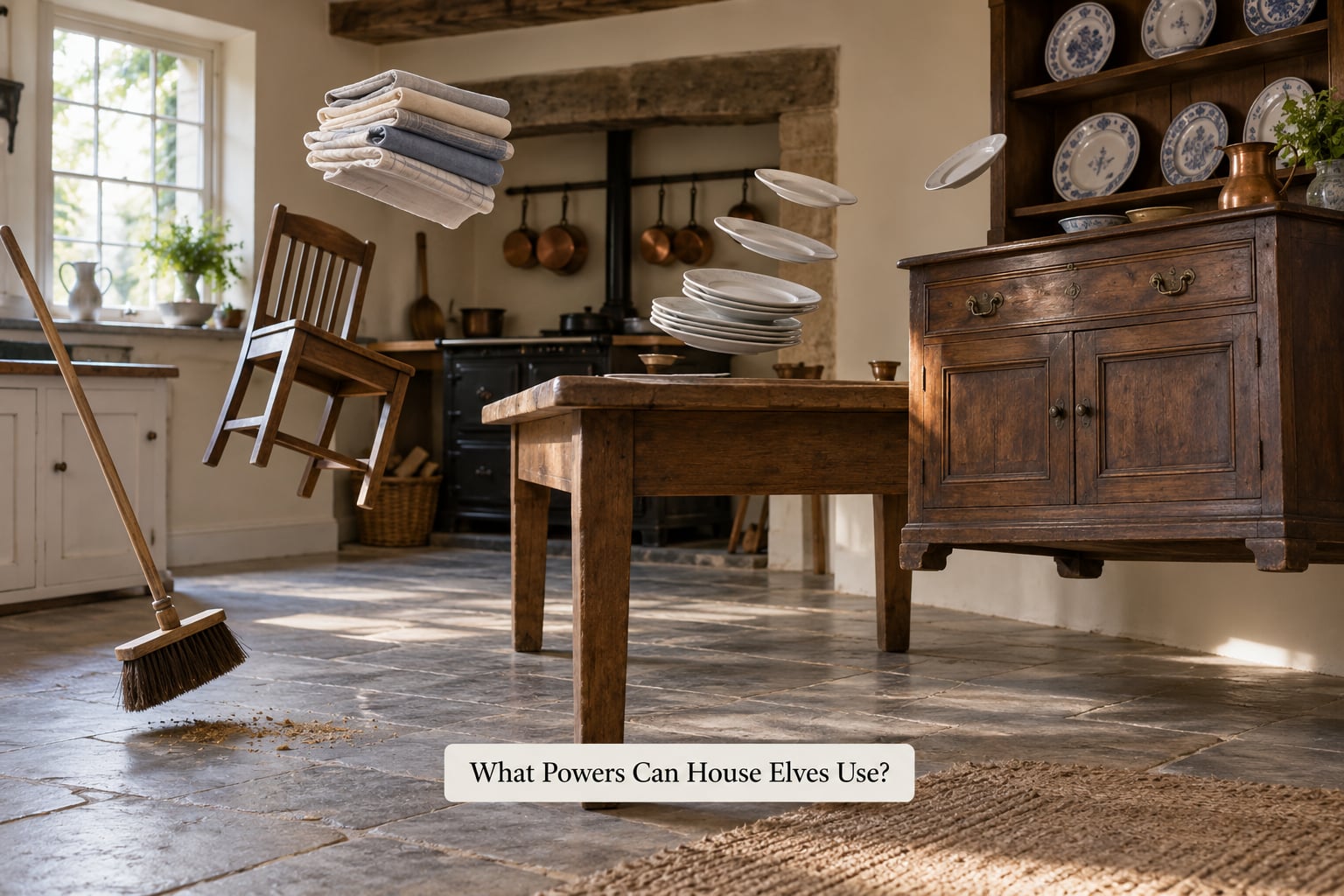
Here is what the books actually demonstrate, with the sources attached, because almost every argument online runs on which chapter someone can cite.
| Feat | Who | Source | What it shows |
|---|---|---|---|
| Hovers a cake over diners | Dobby | CS ch. 18 | Levitation with no wand and no incantation |
| Strikes Lucius Malfoy across the face | Dobby | CS ch. 18 | Forceful magic used offensively without command |
| Disarms Narcissa Malfoy mid-duel | Dobby | DH ch. 12 | Reacts at wizard speed against a trained duellist |
| Appears and vanishes inside Hogwarts | Dobby | OP ch. 23 | Ignores anti-apparition wards |
| Leaves Malfoy Manor under a spell | Dobby | DH ch. 12 | Can impose a lasting condition as an escape |
| Escapes the locket cave on command | Kreacher | DH ch. 10 | Beats wards laid by a Horcrux’s owner |
| Wages the closing fight of the battle | Hogwarts elves | DH ch. 36 | Combat magic used freely when the binding allows |
Anti-apparition charms block the method, not the intent. That is why the wards do nothing here, and why the explanation used most often on Reddit, that elves are pulled toward their assigned home, holds up against the locket cave case better than ward-based theories do.
Why Do House Elves Serve Households?
The books give the arrangement as tradition rather than history. Nobody explains the origin. Elves serve in households, in institutions such as the hospital wing at St Mungo’s, in wizarding businesses, and in the kitchens and halls of Hogwarts, and they have done so for long enough that the assumption goes unquestioned.
The Hogwarts case shows the range. House elves handle cooking, cleaning, and the invisible labour that keeps a castle functioning, and they do it out of sight. The elves who fight at the end of Harry Potter and the Deathly Hallows (DH) are not rebels who have discovered freedom; they are servants whose household has been attacked, acting exactly as bound.
Which raises the question every reader eventually asks. If the power is that large, why does nobody try to leave?
What Are the Limits of House Elf Magic?
Elf magic has a hard ceiling, and it is the same ceiling wizard magic has: Gamp’s Law of Elemental Transfiguration, which prevents humans from turning into other animals. The wizarding world’s own figures accept it as a limit on all transfiguration, and there is no text suggesting elves are exempt.
Other limits are practical rather than cosmic. Elf magic does not evade the Trace, so the Ministry’s enchantment still registers a breach of the laws of magic when an elf breaks them. Elf magic cannot simply overpower the compulsion an elf serves under. And it does not give an elf authority over wizards or over the wider magical world, which is the answer to the question of why such powerful creatures are held in servant positions at all.
Some questions stay open, and pretending otherwise helps nobody. The books never explain where elf magic comes from, how the original binding was made, whether an elf could be transferred to a new household without ceremony, or how far an elf’s reach extends. Treat those as open, not as answered.
How Do Dobby, Kreacher, and Other House Elves Show Exceptions?
Dobby is the exception that proves the system’s edges. Freed by Harry in Harry Potter and the Chamber of Secrets chapter 15, he insists he will work for a family if they will have him. He wants clothes, money, and work, which is a small request and the one thing the arrangement cannot give him. His death in DH chapter 35 is the cost of his freedom, and the books treat it as the limit of what a freed elf can survive.
Kreacher is the other side of the coin. Bound to the Black family, he is punished with the worst tasks, falls silent for half a century, and is released only when Regulus Black’s dying order reverses the binding. Harry’s own commentary in DH chapter 10 is that elves are not the free workers Hermione imagined. They are trapped, they know it, and they go on serving.
Winky adds the case of a loyal elf who watches her master lose his post and then loses her place for defending him. None of these three overturns the compulsion. They show what it costs, and how much room there is inside it for loyalty, shame, and stubbornness.
How Does House Elf Magic Reflect Wizarding-World Power?
House elf magic is the wizarding world’s clearest case of power that means nothing on its own. The abilities are real and considerable. The legal status is close to slavery, enforced by magic rather than by law alone, and it has been normal for so long that the household it serves does not usually think about it.
That is the pattern worth carrying away from the books. Magical strength is not the same thing as freedom, and a binding can be old enough that everyone treats it as natural. The elves who matter most in the series, Dobby and Kreacher, are the ones who make that visible by breaking or nearly breaking the pattern.
Recall it as a formula: innate magical ability, assigned household service, magical compulsion. Each term is doing separate work, and most arguments about elf magic fail only because two of the three get merged.
Frequently Asked Questions
Why are house-elves slaves if they are so powerful?
Because the compulsion is stronger than the ability. An elf’s magic is powerful enough to hover a cake, disarm a witch, or Apparate inside Hogwarts, but it is pointed by a binding to a household and its owner. Strength here does not translate into freedom, because the power was never the thing that was controlled. The slaves are not kept by their magic being too useful; they are kept by who is allowed to direct it.
How strong is house-elf magic?
Strong enough to match advanced wizardry without a wand. Documented feats include hovering a cake (CS ch. 18), striking Lucius Malfoy (CS ch. 18), disarming Narcissa mid-duel (DH ch. 12), appearing inside Hogwarts despite anti-apparition wards (OP ch. 23), and escaping the locket cave on command (DH ch. 10). Even so, elves could not free themselves without a loophole or a master who agreed.
What are house-elves in Harry Potter?
House-elves are small, long-eared magical creatures bound into wizard households to serve as servants. They possess innate magic that needs no wand and no spoken incantation, and they can be freed if a master formally gives them clothing, which they treat as a sign of ownership. Dobby, Kreacher and Winky are the best-known examples, and they appear throughout the series from the second book onward.
Why can’t wizards apparate where house elves can?
Anti-apparition charms block the wandless method wizards use, but they do not block elf magic, which is will-driven rather than channelled. Dobby moves freely through Hogwarts while Harry and Hermione cannot, and Kreacher escapes the locket cave through wards a wizard could never pass. Elf magic is not undetectable, though: it still registers with the Trace, so an elf’s movement is invisible to wards without being invisible to the Ministry.
What is the lifespan of a house-elf?
The books do not give a firm figure. What they show is that elves age very slowly, since Winky is described as nearly two hundred years old and still serving, and that they are extremely durable. Nothing in the series states an average life expectancy or a maximum, so any specific number is inference rather than canon. The realistic answer is that elves live long enough that generations of a family pass during one elf’s service.
Why did Dobby die at the end of the Deathly Hallows?
Dobby died in Harry Potter and the Deathly Hallows chapter 35 because he had been freed. Freed elves are rare, and the one Harry freed could not find a household willing to employ him, so he made his own way into a home he did not belong to and was killed for it. His death shows the clearest limit of elf magic: he could defend himself against almost anything, and he still could not simply choose to live as a free elf.
Conclusion: The Simple Rule Behind House Elf Magic
House elf magic is innate, will-driven, and cast without a wand or an incantation, and everything it touches is shaped by the compulsion that points it at a household. Start by separating what an elf can do from why an elf is made to do it, because everything else in the series follows from that split.
Innate magical ability, assigned household service, magical compulsion. Three parts, and the third is the one that decides where the first gets used.