Short version: the prophecy does not name Harry. Sybill Trelawney’s 1980 prediction describes a set of conditions, and two babies born at the end of July 1980 met all of them. Understanding how the prophecy about Harry and Voldemort works comes down to one uncomfortable idea — Voldemort heard half of it, reacted to what he heard, and his reaction created the rest.
That is why so many readers argue about it. One group says the prophecy was always about Harry. The other says Neville Longbottom fits every line just as well. Both groups are reading the same words, because the prophecy is written in conditions rather than names.
The whole reveal sits in one conversation: Dumbledore finally reads the prophecy out loud in Harry Potter and the Order of the Phoenix, in the chapter called “The Lost Prophecy.” Everything before that chapter is Dumbledore editing the story on purpose. Everything after it is Voldemort reacting to a version he was never given.
Table of Contents
- What Does the Prophecy About Harry and Voldemort Actually Say?
- How Does the Prophecy Choose Its Candidates?
- What Does the Prophecy About Harry and Voldemort Leave Unclear?
- How the Prophecy and Voldemort’s Choices Interact
- Why Does the Prophecy Fulfill at the End of Harry Potter?
- Frequently Asked Questions
- Did the prophecy name Harry Potter or Neville Longbottom?
- What exactly did Trelawney’s prophecy say?
- What is the power the Dark Lord knows not?
- Was it Snape who told Voldemort about the prophecy?
- Did Voldemort torture the Longbottoms because Neville was the chosen one?
- Is Trelawney’s prophecy the same as Grindelwald’s prophecy?
- Conclusion
What Does the Prophecy About Harry and Voldemort Actually Say?
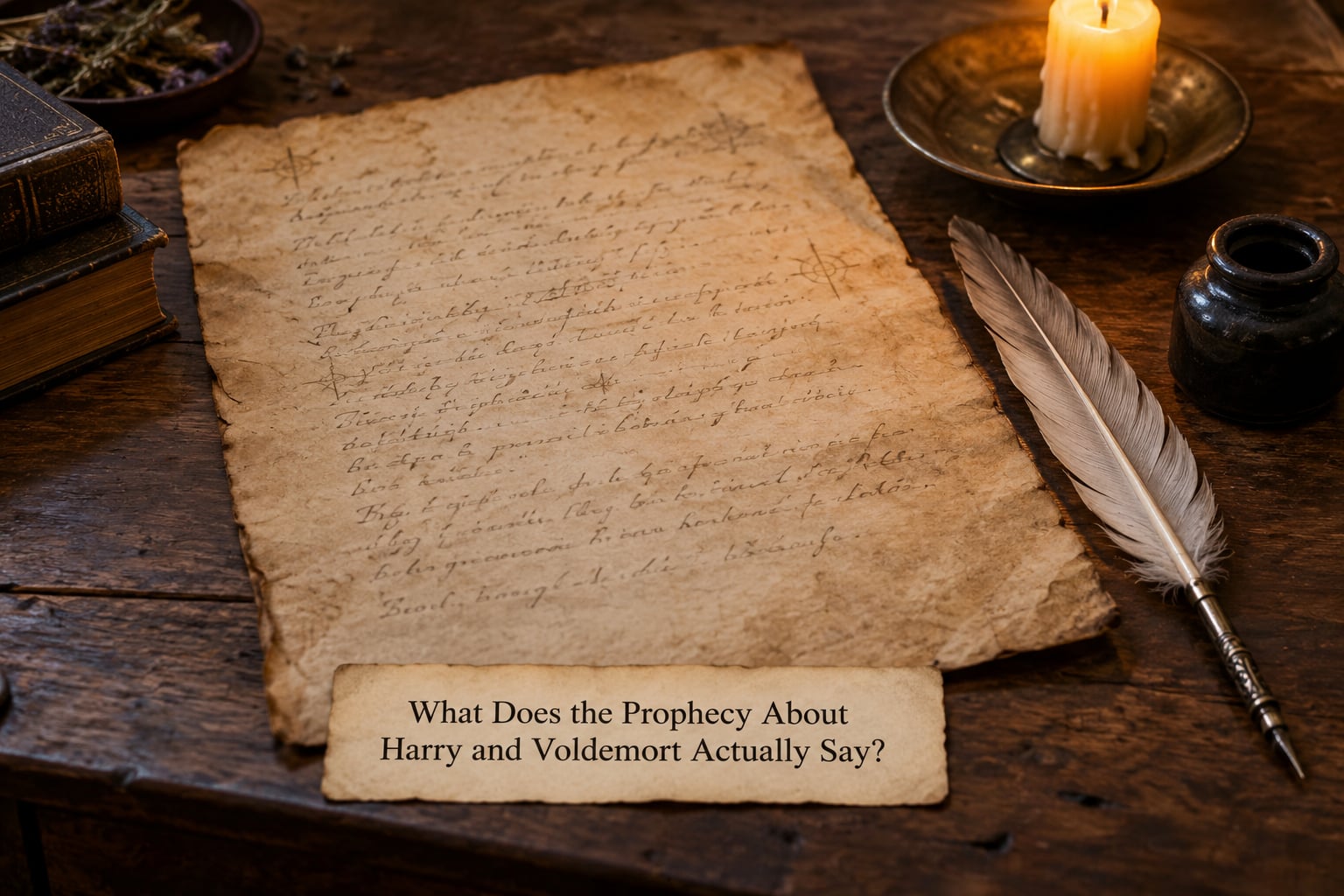
The full canon text, as Dumbledore reads it, runs like this.
“Tonight, the seventh month dies… a boy will be born, born as the seventh month dies… and the Dark Lord will mark him as his equal, but he will have power the Dark Lord knows not… and either must die at the hand of the other, and either can live while the other dies… the one with the power to vanquish the Dark Lord approaches.”
Five conditions hide inside that, and not one of them is a name. The boy is born as the seventh month dies. His parents have thrice defied the Dark Lord. The Dark Lord marks him as his equal. He has a power the Dark Lord does not know. One of the two must die at the hand of the other.
Trelawney made the prophecy in 1980 at the Hog’s Head, in a bar in a back street, while Dumbledore interviewed her for the Divination teaching post. She had been answering every question wrong for months. Then she went into a trance and delivered this, and Harry’s surname came out correctly, which is how Dumbledore realised it was genuine.
Her real name is Sybill Patricia Trelawney, and she is a true Seer who spent twenty years being dismissed as a fraud because Dumbledore wanted a buffer between her and anyone curious enough to ask why her predictions kept coming true. She survives Umbridge’s attack on her in Order of the Phoenix, and she is with Dumbledore at the end of Half-Blood Prince. She made a second genuine prophecy about Harry in Cursed Child.
How Does the Prophecy Choose Its Candidates?
It does not choose a person. It describes a slot, and the slot has two occupants.
Harry Potter was born on 31 July 1980. Neville Longbottom was born on 30 July 1980, roughly nine hours apart. Both boys are children of parents who defied Voldemort three times: James and Lily Potter refused to join him and helped manufacture Polyjuice, while Frank and Jugulus Longbottom joined the resistance and ended up at Azkaban.
| Condition | Harry Potter | Neville Longbottom | Who created it |
|---|---|---|---|
| Born as the seventh month dies | 31 July 1980 | 30 July 1980 | Chance |
| Born to those who have thrice defied him | James and Lily | Frank and Jugulus | The parents, before either child was born |
| The Dark Lord will mark him as his equal | Rebounded Killing Curse, lightning-bolt scar | Voldemort treated the family as a threat and tortured them | Voldemort’s decision |
| Power the Dark Lord knows not | Protection from a sacrifice Lily made for him | His own nerve, after his parents are broken | Harry: Lily. Neville: Voldemort |
| Either must die at the hand of the other | Possible | Possible | Nobody. It stays open |
Look at the third row. The condition says the Dark Lord will mark the boy as his equal, and in Harry’s case Voldemort did it personally — he walked into Godric’s Hollow to kill a half-blood baby and left a scar on a toddler’s face. For Neville, Voldemort created the equivalent condition from the other direction, hunting the family instead of the child and breaking them open with Cruciatus to get at the wording.
Dumbledore says outright that the last condition is the sharpest one, because it is a live wire rather than a fact. Two boys, one prophecy, no stated winner.
Snape worked this out in year five. He went to Dumbledore for confirmation, half hoping the prophecy had stopped meaning what he feared, and Dumbledore only said, “I have no idea what it means.” In the following months Snape began timing Harry’s proximity to Voldemort, and by the end of that year he had concluded Harry was not simply a victim but a Horcrux.
What Does the Prophecy About Harry and Voldemort Leave Unclear?
Nearly everything that matters. Four phrases carry the whole argument.
“The power to vanquish.” This is a statement about capacity, not outcome. The prophecy says the boy has the power to defeat Voldemort. It never says he will, and it never says he must. Dumbledore reads destiny as character rather than as a plot outline, and he says so out loud to Harry: a prophecy that is fulfilled matters less to him than the person who faces the choice.
“The power the Dark Lord knows not.” Snape reports this clause to Voldemort, and Voldemort assumes the Dark Lord does not know it. He never realises the prophecy means himself — the Dark Lord did not know about Lily’s sacrifice, because the sacrifice was an act of free will rather than a spell he performed or could perceive. At Godric’s Hollow Voldemort shields himself from the Killing Curse instead of sacrificing himself, and that is the entire difference between his protection and Harry’s.
“Chosen.” The word is a fan shorthand, not a word from the prophecy. Harry is never told he is special in that way. Snape treats the label as a slur, and Dumbledore refuses it outright.
“Defeated.” Vanquishing can mean a lot of things. The prophecy is satisfied by Voldemort being stopped, whatever route gets him there.
The conditional structure shows up in the strange corners of canon too. Harry Potter and the Cursed Child runs an alternate timeline in which Voldemort kills Harry at the end of Philosopher’s Stone and Neville ends up facing him in the graveyard. That branch only exists in the play’s frame, not in Rowling’s books, but it is a useful demonstration of what a prophecy does and does not guarantee.
One more confusion to clear up. Grindelwald also made a prophecy about a child, a boy he said must die, and Voldemort treated it seriously enough to help him take over the ministry. That is a different prophecy from Trelawney’s, from a different speaker, in a different source. Mixing the two is the reason a lot of online arguments cannot be won.
How the Prophecy and Voldemort’s Choices Interact
The prophecy describes a possible future. It does not push events toward it, and Voldemort is the engine that turns it into one.
At the end of Philosopher’s Stone, Severus Snape uses Legilimency near the Hog’s Head and overhears the tail end of the interview — the seventh month, a boy, the two must die. He reports it to Voldemort as a complete prophecy, because he is trying to save an already-committed Dark Lord from making the same choice again. Voldemort tells Snape to go back and read Dumbledore’s face, and when Snape cannot find Dumbledore he simply reports certainty, which is what Voldemort wants to hear.
Voldemort had already decided Harry was the subject of the prophecy. Reddit’s Harry Potter readers argue about this endlessly, and the fair reading of the books supports them: both boys matched, and Voldemort picked the one he wanted to be true. Harry was a half-blood with a father he despised and a mother he wanted to kill. Neville was a pure-blood with no particular use. Voldemort chose his own mirror, and r/harrypotter has been calling that the most ironic structural detail in the series ever since.
That choice starts a five-step chain.
- The attack. Voldemort goes to Godric’s Hollow in October 1981 to kill the child he believes the prophecy names.
- The mark. Lily’s protection throws the Killing Curse back. Harry is marked with a scar and survives, which satisfies “the Dark Lord will mark him as his equal” and gives Voldemort a way to monitor him for the next thirteen years.
- The confirmation. Voldemort treats the survival as proof the prophecy is active. His surveillance gives Harry a childhood full of danger that reinforces his own sense of exceptionalism, and Voldemort is the reason that sense exists.
- The obsession. Decades of tracking a prophecy he has only half heard is why Voldemort fixates on Harry as the chosen one, and why the books treat him as reacting to a story rather than running his own.
- The confrontation. Voldemort spends thirteen years making sure the boy he chose is present at Hogwarts, where the final duel happens. The arena he built is the arena he loses in.
Voldemort also wanted the original text, which sat in a spun-glass sphere in the Hall of Prophecy in the Department of Mysteries, labelled S.P.T. to A.P.W.B.D. Those initials name both Trelawney and Albus Percival Waddledore Dumbledore, who was present when she made it. The label quietly places Dumbledore inside the prophecy rather than outside it as a reader, which reframes a lot of what he does afterwards. Harry’s raid on that sphere in Order of the Phoenix destroys the record and confirms that the prophecy will never be checked.
Dumbledore kept the real story from Harry for sixteen years, then told him in the cave at the end of that school year, and warned him that knowing about a prophecy is itself dangerous. Naming it out loud, he argues, hands a person a script. He says plainly that the prophecy does not require Harry to do anything, and his closing line on the subject is that it is our choices that show what we truly are, far more than our abilities.
Why Does the Prophecy Fulfill at the End of Harry Potter?
Because the conditions are met through a chain of actions, and Voldemort holds most of the links.
The last duel works because Harry has three things at once: the sword of Gryffindor recovered from the Snatch, the sacrificial protection laid down by Lily in 1981, and Voldemort’s own Horcruxes already destroyed. Ron stabs the basilisk fang through the diary, Harry destroys the locket, McGonagall, Ron and Hermione break the cup, and Neville breaks the diadem that Voldemort put on his own head. The ring and the locket go in the fire, the Nagini goes down with a basilisk fang through its roof, and Harry walks to the graveyard with one Horcrux left.
He gets there because Voldemort was obsessed with the prophecy. He is spared on the train because Dumbledore’s plan puts Harry under the protection of the one sacrifice Voldemort could never understand. And he wins because Voldemort casts the Killing Curse at him, so the protection rebounds a second time and Voldemort’s own attack destroys him.
So does the prophecy make Harry the chosen one, or does it hand the story to him? The conditions create the possibility and Voldemort manufactures the pressure. Harry still has to walk into the graveyard, and the man walking in is described as someone who was the one truly protected, whose parents loved him enough to die for him and whose own decisions put him there. Neville could have matched the wording. He did not have the circumstances.
That is how the prophecy about Harry and Voldemort works. It never says his name. It says that a person capable of ending Voldemort’s reign would be born, and it says Voldemort would create the conditions himself.
Frequently Asked Questions
Did the prophecy name Harry Potter or Neville Longbottom?
It named neither. Trelawney described conditions — born as the seventh month dies, parents who thrice defied the Dark Lord, marked as his equal, a power he does not know, one must die at the hand of the other — and both boys met all five. Neville was born on 30 July 1980, Harry on 31 July, and Frank and Jugulus Longbottom defied Voldemort just as the Potters did. Voldemort chose Harry on his own reasoning, not on the prophecy’s.
What exactly did Trelawney’s prophecy say?
The canon text, read aloud by Dumbledore in Order of the Phoenix, runs: tonight, the seventh month dies, a boy will be born, born as the seventh month dies, and the Dark Lord will mark him as his equal, but he will have power the Dark Lord knows not, and either must die at the hand of the other, and either can live while the other dies, the one with the power to vanquish the Dark Lord approaches. No names appear anywhere in it.
What is the power the Dark Lord knows not?
Protection created by sacrifice. Lily Potter chose to stand in front of her son and die rather than let Voldemort reach him, and that willingness generated magic Voldemort could not perform and could not perceive. In Dumbledore’s reading the clause also refers to Voldemort not knowing it because it is the Dark Lord himself, which is why he shields himself from the curse at Godric’s Hollow instead of sacrificing himself as Lily did.
Was it Snape who told Voldemort about the prophecy?
Yes. Snape used Legilimency to overhear the tail of Trelawney’s interview at the Hog’s Head and reported it to Voldemort as though it were complete. He deliberately omitted that the Dark Lord did not know the boy’s power, trying to keep Voldemort from repeating the choice he made in 1981. Snape never heard the whole prophecy either, which is why his later fear about Harry comes from his own deductions.
Did Voldemort torture the Longbottoms because Neville was the chosen one?
Voldemort tortured them because he believed Neville was the child in the prophecy and wanted the exact wording. Frank Longbottom was left permanently damaged and lost his mind; his wife Jugulus kept her sanity only by knowing the information was already out. It was an interrogation that failed, since Snape had reported the prophecy as finished and Voldemort had no reason to think details were missing.
Is Trelawney’s prophecy the same as Grindelwald’s prophecy?
No, and mixing them causes most of the confusion. Trelawney’s 1980 prophecy is the one about the seventh month and the boy who can vanquish the Dark Lord. Grindelwald made a separate prophecy about a child who must die, recounted in Harry Potter and the Cursed Child. Different speaker, different wording, different outcome, and only Trelawney’s version concerns Harry and Voldemort directly.
Conclusion
The prophecy about Harry and Voldemort works as a description, not a script. It names nobody, it matches two boys, and it says only that one of them has the power to end Voldemort. What turns that possibility into an event is Voldemort’s decision to believe the half he heard and to attack a house in Godric’s Hollow on Halloween 1981.
If you keep one thing from the whole story, keep this: the prophecy supplies the conditions, Voldemort supplies the motive, and Harry supplies the choices. The scar, the protection and the graveyard all exist because the Dark Lord reacted to a sentence he never finished hearing.