Because the wizarding world has no confirmed way to overwrite history, and because every Ministry Time-Turner was destroyed in the Department of Mysteries battle in Order of the Phoenix. Underneath that single practical answer sit three deeper layers: the rule that time-travelers fulfil events rather than change them, a set of limits Rowling added afterwards, and her own admission that the invention caused as many problems as it solved. That is why time travel was never used again after Prisoner of Azkaban, and why the question still splits readers twenty years later.
I have read the books twice, argued this one out with friends more than once, and gone back through the Order of the Phoenix fight chapter by chapter looking for the sentence that settles it. There isn’t one clean sentence. What there is, is a set of answers that sit at different levels of the story, and the trick is working out which level each one belongs to.
Table of Contents
- Why Time Travel Stopped After Prisoner of Azkaban
- What Happened in the Prisoner of Azkaban time loop?
- Why time travel was never used again after Prisoner of Azkaban: the three explanations
- What does the Harry Potter canon establish about time travel?
- Was Harry responsible for breaking the time-turning loop?
- Why did the Ministry of Magic restrict time travel?
- How does the book explanation differ from the Prisoner of Azkaban films?
- Why was the Pensieve more practical than turning time backward?
- Could another wizard have gone back to help Harry?
- Frequently Asked Questions
- Did the Ministry of Wizardry ban time travel after Prisoner of Azkaban?
- Why did Hermione say time travel always backfires?
- Did Dumbledore create the whole Prisoner of Azkaban time loop?
- Can Harry change the past by traveling through time?
- Is the Time-Turner in the Prisoner of Azkaban films the same as Deathly Hallows?
- Could time travel have been used to save Sirius Black?
- Conclusion
Why Time Travel Stopped After Prisoner of Azkaban
Time travel stopped after Prisoner of Azkaban because the past turns out to be fixed, and because the devices that allowed it were destroyed. No wizard in the books ever announces a ban on time travel, and no law is quoted to us. What we get instead is a habit, a fear and an accident.
Think of the answer as three layers sitting on top of each other.
- The rule layer: going back does not change what happened, so there is nothing to gain from doing it again. Dumbledore is quietly removed from the story, and with him goes the person most likely to have tested the rule.
- The risk layer: the Ministry destroyed every Time-Turner it could find in the Department of Mysteries battle in Order of the Phoenix, and Rowling later described time travel as catastrophic past a handful of hours.
- The oversight layer: out of the story, Rowling has said the invention created as many problems as it solved, which is the closest thing to a canonical confession that Azkaban needed a patch.
The uncomfortable part is the third one. The rule layer is the answer fans quote most often and it does hold up well against the plot of a single book. It does not, on its own, explain why the Ministry spent an entire battle breaking glass rather than simply confiscating the things.
So the honest summary is this: time travel was not forgotten, it was retired. What retired it was a combination of a magical limit nobody fully understands, a political decision made under fire, and an author who recognised the invention was doing more damage than good.
What Happened in the Prisoner of Azkaban time loop?
Harry and Hermione travel back three times, and each trip repeats something the reader has already watched. The repetition is not a trick of editing. It is the mechanism of the plot.
The three journeys
First, Hermione turns the hourglass back one hour and drags Buckbeak out of his cell before the Committee for the Disposal of Magical Creatures can execute him. Second, she goes back two hours to pull Harry out of the lake, where he had fallen unconscious in his second year. Third, she goes back three hours to save Sirius Black from the top of the astronomy tower.
Each trip has a cost. Harry turns the hourglass on the second and third journey, and Hermione is the one who has to be pulled out of a river of her own making. She is noticeably sick afterwards, which is the detail that stays with readers.
Original loop versus deliberate change
The first pass through these scenes is not a fixed event. Harry is the one who saves Sirius on the roof, on instinct, and the loop is then unmade because a second version of Harry travels back and makes a different choice.
That difference matters more than it first appears. The Marauders, Snape and Voldemort all move at the original hour without any interference, and what changes is Harry’s decision to let Sirius go. The consequences spread outward from there: Sirius survives, Horklump survives, Hagrid is cleared, the Azkaban file is exposed, and Dumbledore gets the information he needs.
Sirius’s survival is the only real edit. Almost everything else in Azkaban happens anyway, which is why some readers argue the trip was never about changing the past at all. They read the loop as a trap Harry and Hermione fall into, and a warning delivered by the story rather than by a character.
That reading has a problem of its own, though. If the past were entirely fixed, Dumbledore’s plan would fail before it began, since it depends on Harry arriving at exactly the right moment with exactly the right information. A story that needs your choices to matter while insisting your choices changed nothing is a fair thing to object to.
Why time travel was never used again after Prisoner of Azkaban: the three explanations
The books offer three layers of explanation, and they answer the question at completely different levels. Only the first is really in-universe law. The second is a retroactive limit, and the third is an author talking outside the story.
One: the law, the fabric of time, and the return problem
Dumbledore’s position, stated in conversation in Order of the Phoenix, is that time-turners did catastrophic damage and that the Ministry responded by destroying them. He knows what was being smashed in the Department of Mysteries and chooses not to warn Harry, which tells you how much trouble the objects are in. Destroying your own government property during an active Death Eater attack is not a measure anyone takes over a scheduling inconvenience.
The wider magical logic is the same. Time travel in the wizarding world is a spell, and like every spell it runs on rules. A held breath has a limit, an Occlumency shield has a limit, apparating needs a licence. It would be strange for the one device that rewinds the world to be the one thing in the universe with no edge at all.
Two: the limits Rowling added afterwards
After the books, Rowling wrote material published on the Wizarding World website that functions as an official rulebook. Professor Saul Croaker’s writings describe time-turners as a danger rather than a convenience, and tell the story of Eloise Mintumble, a witch who turned back roughly five hundred years and returned to a world five centuries older, leaving behind twenty-five descendants who were never born.
Whether that is in-universe canon depends on how strictly you treat post-book website writing. Most readers treat it as soft canon: reliable about intent, less binding than the novels. What it does is supply the number the books never gave, which is that the useful range of a Time-Turner is small and going past it is not a clever shortcut.
Three: the author admitting the invention was a problem
In a 2007 interview, Rowling said the Time-Turner was a very difficult invention for her because it created as many problems as it solved. That is the most direct statement anyone in the franchise has made about the device, and it is not spoken by any character.
It reframes the whole question. Azkaban is not a story about a magic object that other characters then decline to use. It is a story about a door that was opened too wide, and the rest of the series is the sound of it being shut.
What does the Harry Potter canon establish about time travel?
Canon establishes far less about time travel than fans assume, and most of what gets quoted as rule is inference built on a single working example.
Confirmed by the text
A Time-Turner holds the Hour-Reversal Charm, which is described as unstable on its own, in an hourglass worn on a necklace. Each turn of the glass sends its wearer back an hour.
Hermione’s was a Ministry loan arranged by McGonagall, originally so she could attend extra classes in her third year, and she uses it for six hours across three trips. The devices are physically breakable, and the Ministry treats them as dangerous property rather than equipment.
What we also know from the page is that a time-traveler keeps their memory of the original timeline. Harry knows exactly what Sirius is about to do on the roof because he has already watched him fail. That continuity is the load-bearing element of the entire plot.
Established by later material
The Cursed Child shows a working Time-Turner years after the Ministry supposedly wiped them out, built by Theodore Nott from knowledge he gathered in the Room of Requirement. Albus Severus Potter and Scorpius Malfoy use it, and Scorpius is turned into an Action Figure in the process.
That contradiction is real. Rowling co-wrote the stage play and has never walked it back, so the most defensible position is that the Ministry destroyed what it knew about, while Nott had built his own from different knowledge.
Inference, not law
Most of what circulates as time travel law is really the closed time loop reading, which is a plausible interpretation rather than a stated rule. The books never say a closed loop happened, and they never say the past is immutable. They show one loop working in one direction and leave the mechanism unexplained.
The people nobody counts
The Unspeakables, the Department of Mysteries staff who handle the objects the Ministry does not admit to owning, are the fandom’s favourite candidate for continued time travel. It is a theory rather than a fact. The books give them a mandate to study death and a mandate not to discuss it, which is exactly the sort of mandate a quiet time programme would hide behind.
Was Harry responsible for breaking the time-turning loop?
Harry did not create the loop, but he ended it, and the ending is the only real change of consequence in the book.
The loop exists because three people are trapped in a situation none of them can escape by ordinary means. Sirius is about to fall off the astronomy tower, Buckbeak is about to be executed, Harry is drowning. Hermione’s Time-Turner is the only tool that touches any of it, and she is using it within limits.
Harry’s contribution is one decision, made in the dark with no plan: he explains who Sirius is and why Voldemort is not listening, and then he tells Sirius to run. Everything downstream of that comes from Hermione, Dumbledore and the Ministry reacting to information that only exists because Harry freed it.
So the fairest answer to the fan complaint that Harry did not simply go back further and fix Sirius is that going back further was never on the table. Hermione’s excursion is measured in hours, and Azkaban is a story about a boy with no information being handed one precious hour by a device he did not know existed.
Why did the Ministry of Magic restrict time travel?
Because a Time-Turner turns a private grievance into a public crisis. The logic runs from paperwork straight to catastrophe.
You cannot run a bureaucracy on retroactivity. Records, evidence, wills and custody orders all assume a linear past. A Ministry that lets citizens return and undo decisions would be legally impossible within a single generation, and Fudge would have lost his job in the first week.
You also cannot police intent. A licensed Time-Turner used for extra chemistry lessons is indistinguishable from the same device used to undo a murder.
And harm compounds in one direction only. Nobody in the books attempts to undo a dead parent, a lost relationship or a ruined reputation, which suggests the rule exists precisely because nobody has found a way to undo the good things either.
The secrecy angle is the one fans push hardest, and it is the most speculative. If the entire subject were under something like a Fidelius Charm, that would explain the near-total silence about Time-Turners after Azkaban and the way Ministry records are mysteriously incomplete. It is a good theory, and it should be labelled as one rather than smuggled in as canon.
How does the book explanation differ from the Prisoner of Azkaban films?
The books hand you the loop as narration, and the film hands you the same loop as physical repetition. The effect on the audience is very different.
Repeated scenes versus retold scenes
Alfonso Cuaron’s film shows you the Buckbeak rescue, the lake and the tower twice, from two angles, so you watch the second pass unfold over footage you have already seen. Harry asks about the time-turner out loud, which the book does not need him to do. The film has to work harder to make the audience accept a repeat, and it uses recognition as its engine.
The book gets the effect almost for free. It narrates the first pass once, then tells you plainly that they did it again, and it trusts the reader to feel the ground shift.
Who goes down the well
In the film, Neville pursues Bellatrix into the Department of Mysteries and tumbles down the well, the same well Harry and Hermione fall into in the novel. The film also puts the destruction of a device on screen as a shattering on the corridor floor, while the book leaves the smashing off the page and lets you learn the outcome from Dumbledore afterwards. One gives you the moment, the other gives you the aftermath.
What each version leaves unresolved
Neither adaptation explains the rule. Neither shows a Minister of Magic stating a law. Both end the loop in the same place and both go quiet on it for the remaining four books and five films.
If you only watch the films, the plot hole is louder, because the repetition is dramatised so heavily that the rules should feel visible. If you read the books, the plot hole is quieter and stranger, because the narration treats the mechanism as ordinary while the stakes around it are enormous.
Why was the Pensieve more practical than turning time backward?
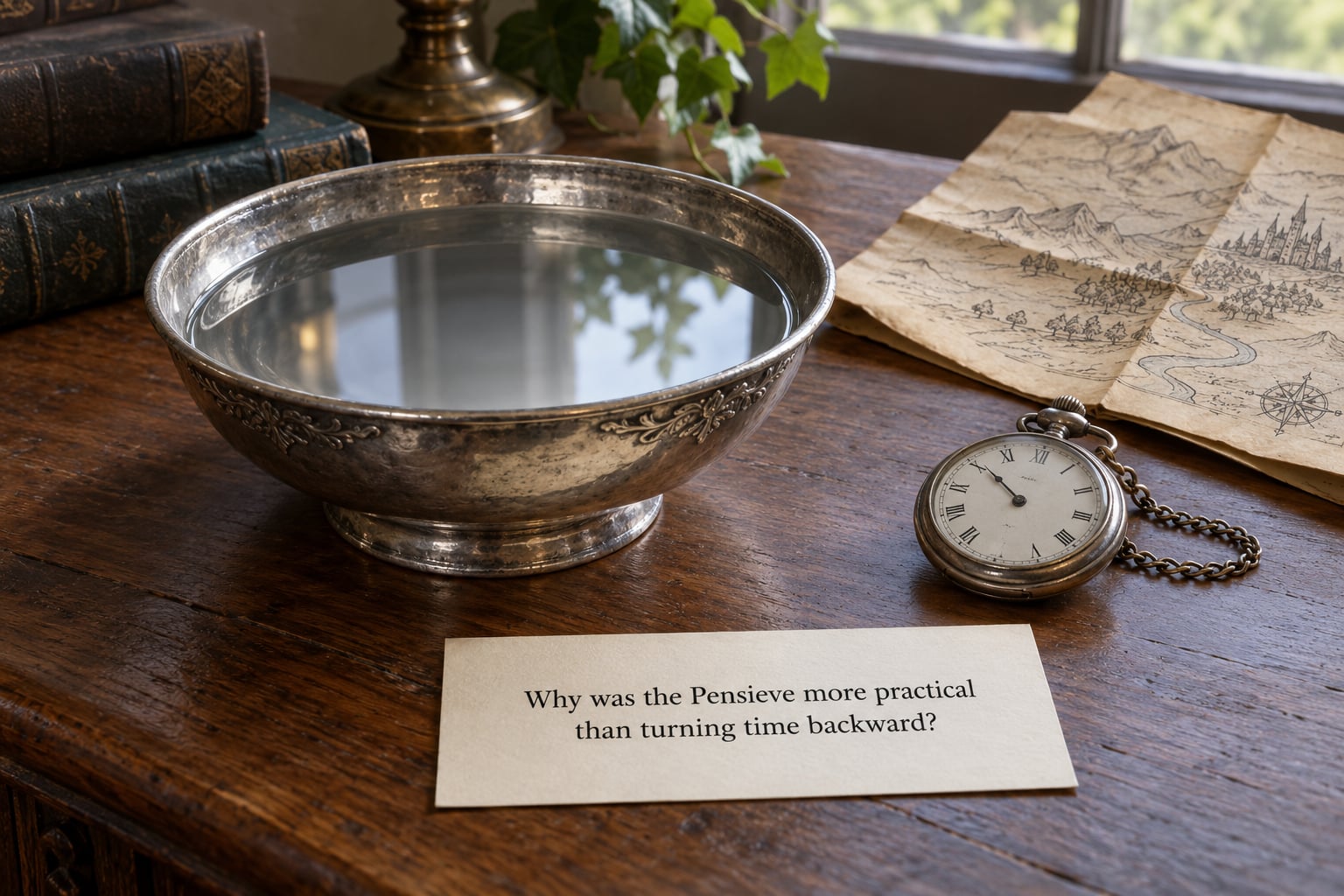
A Pensieve lets you watch a memory again without adding anything to it. That is the difference, and it is why the wizarding world preferred it whenever it had the choice.
Whatever else it is, the Pensieve is repeatable in a way that time travel is not. Turn a memory back and you get the same minute again at the same resolution, with no new information and no second version of anybody standing in the room. Dumbledore relies on this with Snape’s memory in Order of the Phoenix, and the whole scene works because watching is reversible in a way that being there is not.
Turn time backward and you get a second past. That one carries risk, and it drags you and everyone near you into it. Hermione is sick after Azkaban, and she is sick because the version of her who lived through it remembers having lived through it twice.
The Pensieve has sharp limits of its own. A memory is only ever as honest as the person who holds it, which is precisely why Dumbledore cannot simply sit down and watch what Harry missed, and why Snape’s snarling recollection is the only version of that night available to anyone. Turning time backward at least guarantees that something happened. Memory only guarantees that someone remembers it that way.
Could another wizard have gone back to help Harry?
Only within a few hours, only if they already knew what was wrong, and only into moments where the past would have permitted it. For the large tragedies the fandom asks about, the answer is no.
The graveyard in the first book
Hermione reaches for a Time-Turner here and Ron stops her, and the novel never says she was wrong. Voldemort is holding her at wand-point, the wand movement does not match a spell, and a wandless witch from a school where she is known would have had a hard time surviving the encounter and explaining it afterwards. The scene is a near miss on grounds of risk, not grounds of physics.
Saving James and Lily
This is the fandom’s number one question, and it deserves a straight answer. The loop that surrounds Harry’s parents runs the other way: their deaths are the fixed point the entire series pivots on. Voldemort goes to Godric’s Hollow because a tip from Snape has just removed his greatest obstacle, and if a wizard had been in that kitchen in 1981 the prophecy would never have been set in motion at all.
The counter-argument is fair and I think it wins: if you save the Potters, Voldemort lives, Harry never becomes the chosen one, and the world he would have grown up in is not one the story promises to be safe. The Tragic Captain backstory only works because it happened.
The Gringotts break-in and the prophecy
Going back to grab the prophecy earlier simply means Harry walks in, takes it, and leaves. Nobody stops him, because nobody knows a teenage boy with no wandless skills and a growling Horcrux is in the vault.
The prophecy is the clearest test case in the series for the fixed-point reading, since Voldemort arrives at the exact hour he always does and overhears exactly what he overhears. Fudge blames the break-in on the Death Eaters, and nobody checks.
The Triwizard Tournament and Cedric
Harry and Hermione could have gone back from the graveyard portkey to the moment Harry saw the third task. Instead they lose Cedric, and it stays that way for three books, which is the strongest evidence that saving people from a fixed past is not something the rules permit.
The Battle of Hogwarts
Everyone who could have done something was already doing it, and most of the deaths in that battle happen in the first hour, before anyone is in a position to try. Going back to warn anyone would require knowing the outcome first, which only ever happened to Harry in Azkaban, once, on a device he was handed on a school visit.
Frequently Asked Questions
Did the Ministry of Wizardry ban time travel after Prisoner of Azkaban?
No law is ever quoted in the books. What the Ministry did was destroy the devices: every Time-Turner it could find was destroyed in the Department of Mysteries battle in Order of the Phoenix, which Dumbledore confirms afterwards. In practice the ban is total, but it arrives as a wartime decision about dangerous property rather than as legislation.
Why did Hermione say time travel always backfires?
She says it to Harry and Ron as an explanation of why she will not spend hours reattending classes, and it reflects her experience: she gets physically sick after six hours of use. Later writing published by Rowling adds that turning back further than a few hours brings catastrophic harm, illustrated by the witch Eloise Mintumble, who returned five centuries later.
Did Dumbledore create the whole Prisoner of Azkaban time loop?
He arranged for Harry to save Sirius from Pettigrew, and he knew exactly when it would happen. What he did not engineer is Harry’s second visit or his decision to let Sirius run. The loop closes itself because Sirius comes to the roof at the same hour every time, and Dumbledore’s plan depends on that clock rather than on controlling it.
Can Harry change the past by traveling through time?
Not in any way the series shows. Sirius surviving is the only lasting change, and it happens because Harry makes a different choice on the second pass, not because the past is rewritten. The books never state the rule directly, so this is the closed time loop reading: travellers fulfil events rather than replace them.
Is the Time-Turner in the Prisoner of Azkaban films the same as Deathly Hallows?
They are the same object in the same continuity, not two devices. The film shows the destruction of a time-turner in the Department of Mysteries, while the book leaves the smashing off the page and lets Dumbledore report the outcome later. Deathly Hallows contains no time-turner on the page at all, which is a large part of why the question keeps resurfacing.
Could time travel have been used to save Sirius Black?
Harry saved him with the only trip that worked: one hour back on the roof, made under conditions Harry could not control. Going further back would mean arriving before Voldemort arrived, which no one knew was possible. Going back further still is blocked by the practical limit of the device, which works in hours and punishes anyone who stretches it.
Conclusion
The cleanest way to hold all of this together is to stop asking whether the past can be changed and start asking who would be allowed to change it. On that reading the plot hole shrinks considerably: a device this powerful, in the hands of a Ministry that cannot decide whether magic should be legal, is one you confiscate during a firefight and never mention again.
What survives the scrutiny is the closed time loop. Sirius, Buckbeak, the astronomy tower, Voldemort leaving Godric’s Hollow and arriving at Godric’s Hollow, Voldemort overhearing the prophecy at the same minute in the same cellar. A device that can only move you inside a scene that is already happening is not an escape from the plot, it is a feature of it.
And the layer underneath that one is the author admitting it out loud. A very difficult invention, she said, because it created as many problems as it solved. Take that at face value and Prisoner of Azkaban stops being a story about a magic object and becomes a story about a narrative problem that had to be shut down quickly.
The forthcoming screen adaptation retells Azkaban, so expect the argument to run again. The interesting part is not whether the new version fixes it. It is whether a story can invent a device this good, enjoy it for three hundred pages, and then spend six books explaining why nobody else gets to use it.