House elves cannot be freed easily because the magic that binds them is keyed to a specific master’s act of giving, and because fear and conditioning make most elves refuse the gift even when it is offered. There is no spell a third party can cast, no potion and no wand trick that unties the bond. In the books, exactly one known release exists: a master presents the elf with clothing, freely given, and the servitude ends. Dobby, freed by a sock, is the exception that proves how narrow the whole rule is.
That narrowness is the point. Reading elf lore as a list of fun facts misses why the question is asked so often. The difficulty sits in three places at once, and this guide takes them one at a time.
Table of Contents
- Why Are House Elves Bound to Their Masters?
- Why House Elves Cannot Be Freed Easily in Harry Potter
- What Happens When a House Elf’s Master Dies?
- How Does Dobby’s Freedom Challenge the Rule?
- Can a House Elf Be Freed by a Command From a Wizard?
- Why Does Fear Make Liberation Even Harder?
- Does Being Treated Kindly Automatically Free a House Elf?
- What Can a Patron Actually Do to Help an Elf?
- Does Hogwarts Create a Special Exception?
- Are There Any Ways to Free Every House Elf at Once?
- Frequently Asked Questions
- Conclusion
Why Are House Elves Bound to Their Masters?
A house-elf is a small magical being, two to three feet tall, with large bat-like ears, a bald head and eyes bulging slightly sideways, dressed in a grubby pillowcase or a tea towel stamped with a household crest. Wands, they serve a witch or wizard, or an institution, in exchange for food and a roof.
The bind itself is not employment. A servant can resign, argue, or be dismissed. A bound elf cannot, because the compulsion runs through the same magic that makes them good at the work. Dobby tells Harry plainly in Chamber of Secrets that elves are bound by a magic that is “stronger than you can imagine”, and that the household exists to serve its master. That bond outranks the elf’s own preference, which is why the freeing condition is a legal act rather than a conversation.
Two details from the books make it clear this is not a metaphor. Elves are punished by their own magic when they fail, and they cannot speak abusively about their masters. Hermione notices the second one in Goblet of Fire while she is interviewing kitchen staff, and it is a good clue that the binding reaches speech, not just labour.
Why House Elves Cannot Be Freed Easily in Harry Potter
Here is the short version, in four barriers:
- Only the master can act. The magic listens to the person the elf is bound to, so an outsider cannot trigger it. An elf cannot free itself either, which is the part readers find hardest to accept.
- The gift has to be an act of release. Clothing does the work, but handing over laundry is not the same thing as giving something to wear. The intention is the mechanism.
- Most elves are conditioned to refuse. Kreacher wanted to die rather than be free. Winky, freed by her master, was reported as miserable in a way the other elves found embarrassing.
- The world treats it as normal. Hogwarts employs over a hundred elves, refuses them sick leave, and holds no pension fund. Hermione’s SPEW campaign failed because the institution had no reason to change.
Those four stack up. Even when a kind master is willing, the elf may say no, and the wider world will not help.
What Happens When a House Elf’s Master Dies?
When a master dies, the household the elf serves simply ends, and the elf goes with it. In Order of the Phoenix, the house-elves in Harry’s inherited houses simply disappear once the Dursleys move out, along with most of the furniture.
But the disappearance is not a rescue. It leaves the elf with no master and no household, which is why Kreacher and Dobby end up adrift. The bond was never released, it was broken, and the two outcomes are not the same. An elf whose master has died is not free; it is unplaced.
What about elves whose family passes ownership on? Elves travel with households, so a transfer to a son or a cousin carries the binding along with it. Hermione in Prisoner of Azkaban has to work out the paperwork around her inheritance before she can even think about elves in the house, and the books never explain what happens to an elf if a household line dies out entirely.
How Does Dobby’s Freedom Challenge the Rule?
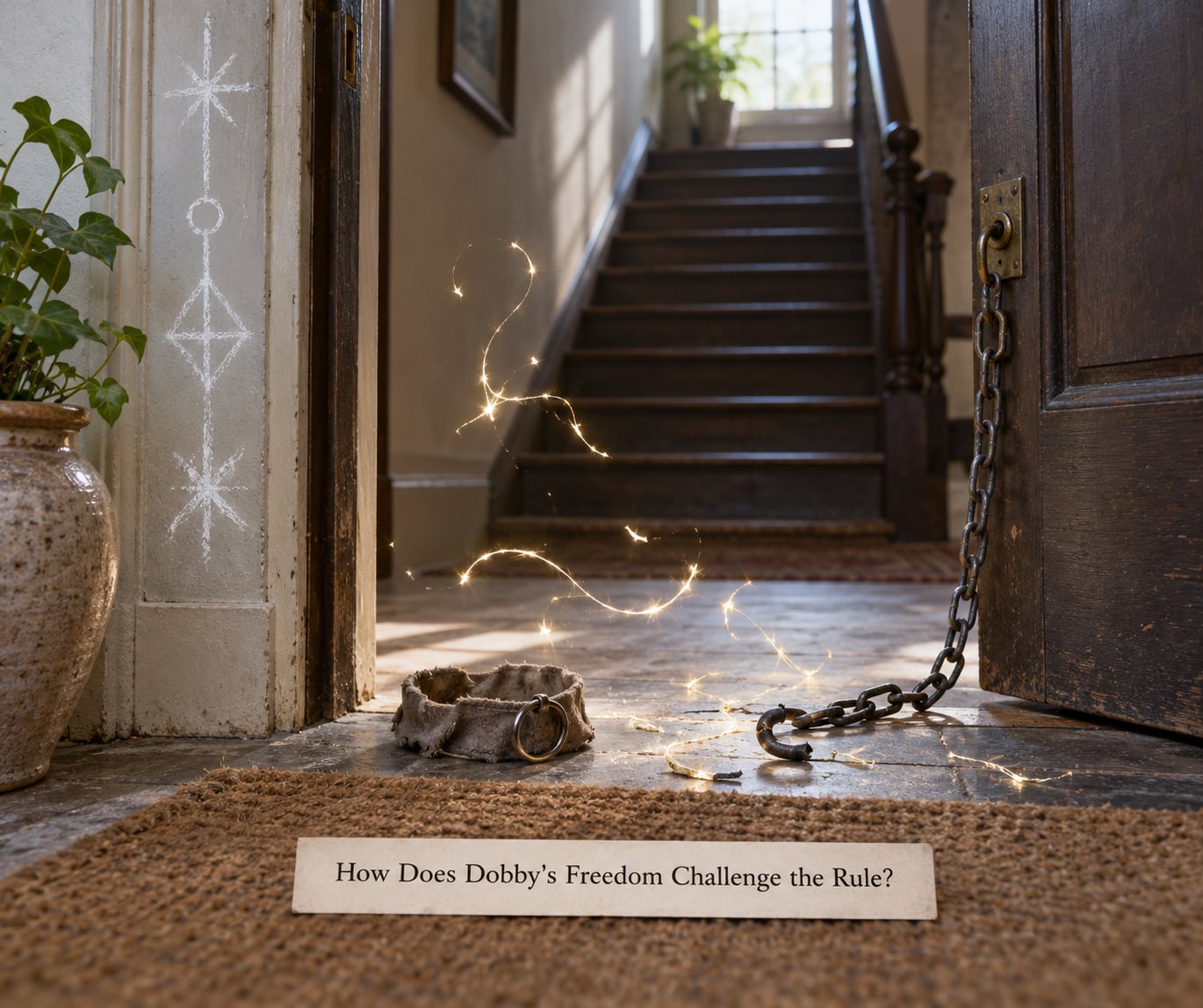
Dobby was freed by accident. Lucius Malfoy caught a sock, idly waved it at his house-elf and said out loud that it was a Christmas present. The elf was gone before he knew what had happened, and Dobby spent the rest of his life explaining that he had received a master, not been given freedom.
That is a useful correction to the popular version of the story. Dobby did not escape his binding, he was released from it, and Lucius later admitted he had no idea he done it. Every deliberate example in the books works the same way: the master gives the item, and gives it meaning.
What Dobby demonstrates is that the rule is complete, not that it is easy. His case needed a master, a moment of inattention and an item that happened to be to hand. Dobby says he prayed for freedom every night for years and nothing came. Once he had it, he was so disoriented he had to be taught what a sock was for.
Can a House Elf Be Freed by a Command From a Wizard?
A good wizard saying “you are free” does not do it. The books give no example of a spoken order working, and there is a good reason. An order is a request the elf can fail to hear, deflect, or quietly disregard, while the gift is a physical act the magic registers on its own.
The distinction matters because the two look identical from the outside. A master saying “here, put this on” while handing over a shirt is doing something the magic recognises. A stranger saying the same words with no shirt in their hands is doing nothing at all. A master can also speak at length, explain that the elf deserves better, and hand over nothing, and the bond stays exactly where it was.
This is also why nobody can shortcut the process from outside. Harry cannot free Dobby’s binding, Hermione cannot free the Hogwarts elves by wanting them free, and Dumbledore, who has more authority over that school than almost anyone in the wizarding world, does not do it either.
Why Does Fear Make Liberation Even Harder?
Fear is the part the mechanics do not cover, and it is the part that decides most cases. Elves whose masters are cruel are not reliably the ones who get freed, because a cruel master is unlikely to give anything away and the elf is afraid to ask.
The books show the punishment side of this. Elves inflict injuries on themselves when they fail, and Dobby describes the family punishments he grew up with before the Malfoys. An elf in that position faces a real calculation: refuse the gift and risk the household’s retaliation, or accept it and lose the only identity they have been given.
Kreacher’s reaction after Regulus’s death is the clearest example of what fear and grief do to a freed elf. He went looking for a master to die with, and the loss of the household he served seemed to damage him more than the loss of the person.
Does Being Treated Kindly Automatically Free a House Elf?
No. Kind masters and close relationships are common in the books without producing free elves. The Malfoys treat Dobby reasonably well, and the elves in the kitchens at Hogwarts are described as cheerful. Neither household has an incentive to change anything.
The kind-master defence also runs into a practical problem. A kind master who wanted to release an elf would find that the elf might refuse, might not understand the offer, or might refuse again after accepting. Kreacher needed a year of Harry telling him he was a free elf before he would accept the fact at all. The magic does the unbinding in a moment. The person inside it takes much longer.
Kindness also does not stretch to cover wages. The Hogwarts elves work for room and board, the Potter elves accept the same, and the reader is told outright that elves are not paid. That arrangement survives because a good employer is not an employer giving compensation.
What Can a Patron Actually Do to Help an Elf?
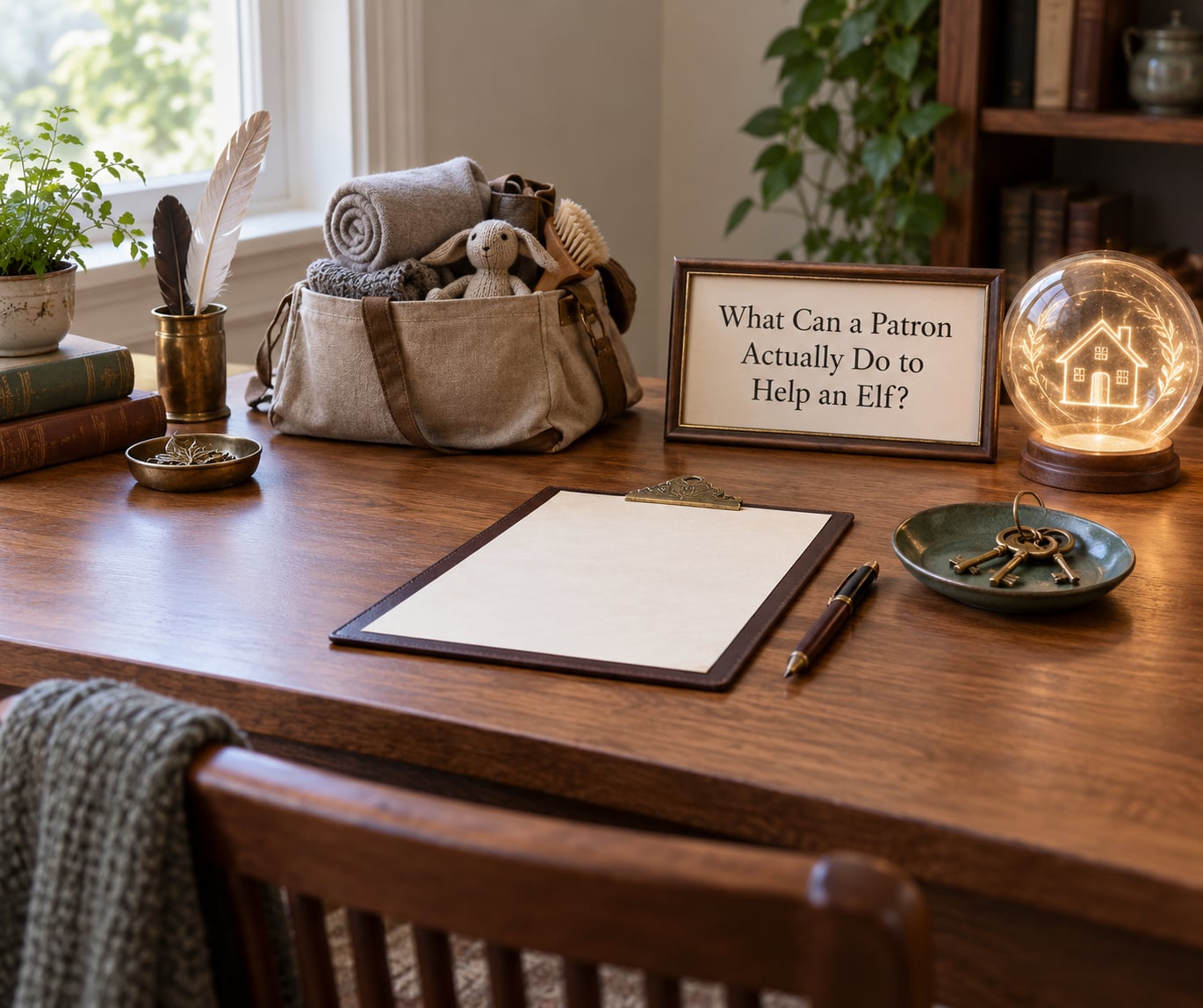
Help does not have to mean magic. In practical terms, a patron can do a few things that matter, and they work in a sensible order.
Offer paid, arranged work
A job with a wage, a named employer and hours removes the reason the binding existed, which is the strongest argument a wizard has for taking on an elf as a servant by choice. This is what Hermione would have to build.
Give the elf a person to appeal to
Fear is what keeps the gift from being accepted. An elf who knows someone outside the household will hear about a bad offer has room to refuse it. A patron who takes reports seriously removes part of the calculation that makes refusal feel like the safer choice.
Offer housing outside the household
Masterless elves are described as going to pieces, so somewhere to stay matters as much as a wage. Without a roof waiting, accepting freedom can feel like accepting a fall.
Buy the garment, then hand it over
If a patron is paying for an elf’s clothes rather than issuing them, the gift comes with a different weight. The books never test this, so treat it as inference rather than a rule.
Does Hogwarts Create a Special Exception?
Hogwarts is the largest employer of house-elves in the books, with over a hundred working in the kitchens alone. The school is not run by a single wizard, which raises the question of who can free them at all, and the books leave it open.
What the books do establish is that the arrangement suits everyone who benefits from it. Dobby is a Hogwarts elf who will not leave the school he is abused in, because being Hogwarts is the closest thing he has to a self. His loyalty outlasts his treatment, and it is the reason he keeps saying he cannot leave.
The institutional scale is what makes this a system rather than a handful of sad households. Elves are underpaid, overworked, and not counted. A policy of emancipation would cost the school its entire kitchen and cleaning operation, which is exactly the kind of arithmetic that keeps a practice in place for centuries.
Are There Any Ways to Free Every House Elf at Once?
No mass release exists in the books, and readers should be careful about pages that claim otherwise. Much of what circulates about elf origins, magical dependence and elf employment contracts comes from fan wikis and fan fiction rather than from Rowling, and the two are usually presented side by side as if equally solid.
What Hermione attempted is the canon example: SPEW, the Society for the Promotion of Elfish Welfare, arguing in the wizarding world that elves should be paid and freed. It failed. The other elves think she is mad for it, the Ministry takes no interest, and the political problem is that the benefit goes to the enslaved and the cost goes to the households that employ them.
There is one structural change the books hint at, and it is not a spell. Change who counts as a magical creature, and the category that permits unfree labour comes under review. The Ministry department that regulates magical creatures already handles elves, which is the closest the canon gets to a door.
Frequently Asked Questions
Can a wizard simply command a house elf to leave?
No. A spoken order is not the mechanism in the books. The binding responds to a master presenting an item of clothing with the intent to set the elf free, and nothing in canon shows a verbal release working. Harry, Hermione and Dumbledore all want house-elves freed and none of them manages it, which is the clearest evidence that a command is not enough.
Is Dobby the only house elf who has ever been free?
Not the only one, though he is the best known. Winky was freed by her master, Padfoot, and Kreacher was freed by Regulus Black, though Kreacher refused to accept it for a long time. The pattern is consistent across all three: the elf is released, and then has to work out what freedom is.
Why can’t house elves use ordinary wands or magical devices?
Elves do magic, and they do plenty of it without wands, including household magic of the kind they are famous for. What the books show is a limit on the magic they can take for themselves, not an inability to cast spells. A freed elf like Dobby is still capable of powerful magic, so the restriction reads more like the limits of the bond than a limit on elves as creatures.
Can house elves own money or make purchases on their own?
Not while they are bound. The books are explicit that house-elves are unpaid, and Hermione’s SPEW campaign exists because elves are given room and board instead of wages. That is part of why they cannot be freed in practice: an elf who receives nothing has no independent position to step into when the bond ends.
Would helping a house elf break the bond between it and its master?
Not on its own. Kindness, better working conditions and a warm household do not touch the magic, and a well-treated elf can stay bound for life. Only a deliberate gift of clothing from the master releases an elf, so a patron outside the household can improve conditions and prepare an exit, but cannot do the unbinding themselves.
Conclusion
House elves cannot be freed easily because the release is one person’s decision, and that person usually has no reason to make it. The magic needs a master, the gift needs intent, and the elf needs to be able to accept what is being offered without fearing the household that owns them.
Start with those three together rather than the clothing rule alone. Dobby is the precedent worth studying, because he is the rare case where all three lined up, and even then it took an accident and left him so disoriented he could not recognise a sock. The rest of the elves in the books are still waiting on a household that sees them as worth releasing.