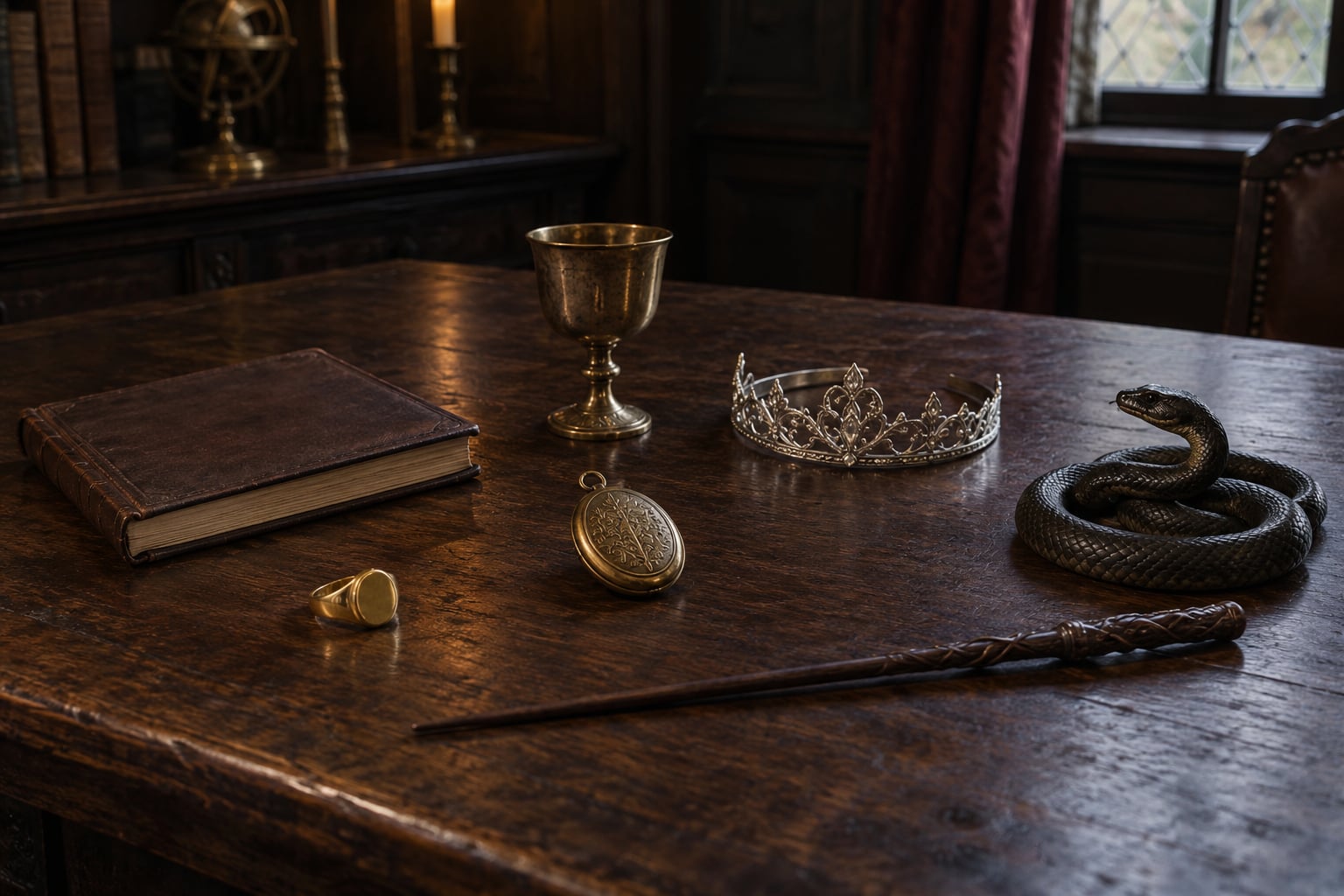
Short answer: Voldemort made six Horcruxes on purpose — Tom Riddle’s diary, Marvolo Gaunt’s ring, Salazar Slytherin’s locket, Helga Hufflepuff’s cup, Rowena Ravenclaw’s diadem and Nagini. Harry Potter became the seventh by accident in 1981, and Voldemort’s murder of Nagini that same night split his soul again, so the number people argue about is really six deliberate, seven holders, eight soul fragments.
The seven-versus-eight argument trips up almost every reader, including people who have finished the series more than once. The confusion is not really a plot hole. It comes from three separate questions being compressed into one: how many objects did he make on purpose, how many containers held his soul at the end, and how many pieces his soul was split into.
What follows covers all three, with the object-by-object table first so you can check the facts against your own memory.
Table of Contents
- How Many Horcruxes Did Voldemort Make and What Were They?
- Why the Answer Is Six Intentional, Seven Objects or Eight Fragments
- Voldemort’s Horcruxes, One by One
- Was Voldemort’s Wand the Seventh Horcrux?
- Why Nagini Was Both the Sixth and the Eighth Horcrux
- How the Horcruxes Were Destroyed
- Frequently Asked Questions
- Conclusion
How Many Horcruxes Did Voldemort Make and What Were They?
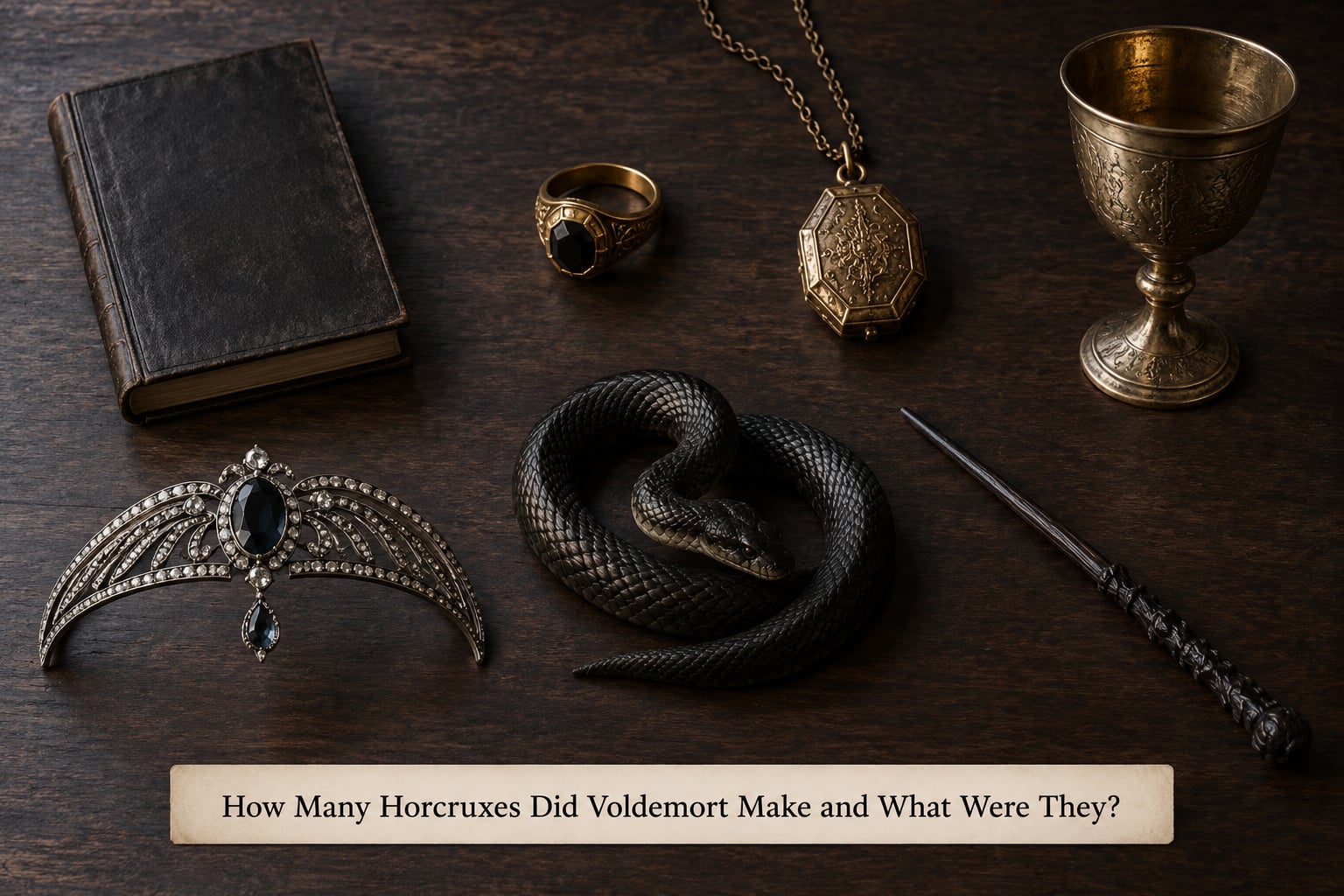
Here is the whole list in the order Voldemort made them, with the murder that paid for each one and the person who finally broke it.
| No. | Object | Murder victim | Destroyed by | Method |
|---|---|---|---|---|
| 1 | Tom Riddle’s diary | Myrtle Warren | Harry Potter | Basilisk fang, 1993 |
| 2 | Nagini | Bertha Jorkins | Neville Longbottom | Sword of Gryffindor, 1998 |
| 3 | Marvolo Gaunt’s ring | Tom Riddle Sr. and his parents | Albus Dumbledore | Sword of Gryffindor, 1996 |
| 4 | Salazar Slytherin’s locket | An unknown Muggle | Ron Weasley | Fiendfyre, 1997 |
| 5 | Helga Hufflepuff’s cup | Hepzibah Smith | Hermione Granger | Basilisk fang, 1998 |
| 6 | Rowena Ravenclaw’s diadem | An unknown Albanian | Harry Potter | Fiendfyre in the books, basilisk fang in the films |
| 7 | Harry Potter, by accident | Nobody — the rebounding curse | Voldemort himself | Avada Kedavra, 1998 |
Two details in that table cause most of the argument. The diary was the first, made in 1942 while Voldemort was still a student at Hogwarts, and the killing curse that came back at him in 1981 put a fragment of his soul into Harry without Voldemort ever casting the horcrux spell. And Nagini appears second in creation order but last in destruction order, which is why the snake gets called both the sixth and the eighth Horcrux depending on who is counting.
Why the Answer Is Six Intentional, Seven Objects or Eight Fragments
How many Horcruxes did Voldemort make and what were they? The full breakdown
A Horcrux is an object that holds a fragment of a wizard’s soul. The wizard murders someone, the soul tears, and a spell traps part of it inside an object so the wizard keeps living as long as that object survives. Voldemort planned to build seven, which is why Albus Dumbledore says in Harry Potter and the Deathly Hallows that Voldemort intended to make himself immortal by splitting his soul seven times.
He never finished that plan. Six objects were made deliberately. The seventh fragment arrived in the form of a surprised baby, and the eighth came from the murder Voldemort committed with his own snake. The cleanest way to hold all three numbers at once:
- Six Horcruxes were created deliberately by Voldemort.
- Seven objects or people held a fragment of his soul at the moment he regained a body.
- Eight soul fragments existed after he murdered Nagini in 1995, because the fragment in his own body crossed into a creature that was already a Horcrux.
That is why the phrase “six Horcruxes” and the phrase “seven Horcruxes” can both be found in the books, and why the phrase “eight” turns up in fandom discussion. Dumbledore uses six when he means deliberate objects, because the wand was never a horcrux. Snape and many readers say seven, counting Harry. And eight only appears once you count the second fragment inside Nagini.
Voldemort’s Horcruxes, One by One
Tom Riddle’s diary — the first Horcrux
The diary is the one readers meet first, in Chamber of Secrets, and it is also the object that proves horcruxes existed long before the trio went looking. Riddle used it to record a memory of being tortured at Hogwarts, then handed it to Ginny Weasley. The memory became real, and a weakened Ginny drained life from Harry.
Voldemort made it after killing Myrtle Warren in the bathroom on the first floor. He put so much of his soul in that diary that when the memory played out in 1993, it nearly destroyed him again. Harry destroyed it with a fang from the basilisk he had just killed, piercing the page in the Chamber in his second year.
Marvolo Gaunt’s ring — the Resurrection Stone Horcrux
The ring is the only Horcrux that doubles as a Deathly Hallow, since it is set with the Resurrection Stone. Dumbledore tracked it to a cave on an island in the sea, where Voldemort used the Inferi as servants and left the ring in a makeshift jewelry case between the bodies.
Its fragment came from the murders of Tom Riddle senior and his parents in 1929, and the ring’s Ingersoll inscription names Marvolo Gaunt, the wizard whose name Voldemort later used as a disguise. Dumbledore destroyed the ring in 1996 with the Sword of Gryffindor and lost his left arm doing it. That sacrifice is why the wand in Harry’s grave is later given to him, and why the ring briefly held the most dangerous object in the cave.
Salazar Slytherin’s locket — the most wanted one
The locket cost Voldemort the murder of a Muggle, a Snatcher working in a small shop. It is the object Bellatrix Lestrange hides in the Lestrange vault at Gringotts, the one she tortures her uncle for, and the one she tells her husband is fake when she brings him the real one.
Regulus Black found the real locket during his one turn as a Death Eater, and Kreacher took it back to their cave on his instruction before Regulus went to his death. The trio had no way of knowing that for most of their hunt, which is why the locket is the longest thread in the story: Ron smashes it with Hermione’s fire, conjured from Snape’s worst memory, in a tent in the Forest of Dean.
Helga Hufflepuff’s cup — the easiest one to reach
Horace Slughorn sold the cup to Hepzibah Smith, a collector who had one weakness: she liked showing off a Hufflepuff artifact she had no right to own. Voldemort attended that party, watched, and followed her home.
Bellatrix used the cup in 1996 to hold Voldemort’s memory of reading the Daily Prophet as a Ministry official, then Raziel was killed and the cup was placed in Bellatrix’s vault. Harry, Ron and Hermione found it in the Room of Requirement during their search for the locket. Hermione destroyed it with the basilisk fang from the Chamber, saved in Snape’s will and handed over during her visit at Hogwarts.
Rowena Ravenclaw’s diadem — where the films change the story
Voldemort stole the diadem from an Albanian, though Harry later sees a version of that murder through Voldemort’s eyes and recognizes the victim as a man he killed, suggesting the wizard he robbed might have been involved. The diadem carried the memory of Ravenclaw’s own entrance examination, and when it was on her head she had a mind more brilliant than anyone alive.
It ended up above the Room of Requirement, wrapped in dirty rags, which is why Ginny found it first. The destruction is the one genuine book-versus-film split: in the books Harry pulls the diadem on and then Crabbe casts Fiendfyre, killing himself; in the films Harry uses the basilisk fang on it, same as the diary and the cup.
Nagini — a living Horcrux
Nagini is the odd one out because she was alive. Voldemort killed Bertha Jorkins, a Ministry visitor he followed to a holiday cottage, and put the fragment in the snake rather than an object, which is why Dumbledore points out in the memory that the Horcrux is bound to the body of a living creature.
For roughly fifty years she waited, then helped him kill Harry’s parents in Godric’s Hollow in 1981. She guarded the Horcruxes in Albania, warned Voldemort when someone came near them, and was the last thing still with him in the forest when he regained a body in 1995.
Was Voldemort’s Wand the Seventh Horcrux?
No, and this is the piece of fan arithmetic worth putting down gently. Harry’s wand really was Voldemort’s, taken from him in the forest that night in 1981, and Voldemort really did murder with it before Harry owned it. Those facts feed a theory that the wand holds a fragment.
Canon does not support it. Dumbledore states that Voldemort made six Horcruxes and never made a seventh, and nobody in the books ever destroys a wand to break a soul. The seventh fragment went into Harry by the backfire of a killing curse, not by the horcrux spell, and that is the only split Voldemort did not perform on purpose.
There is a reason the theory is so persistent. A wand holding a piece of his soul would explain why Voldemort could not simply crush or hand off the wand, and it fits the pattern of him putting part of himself into everything around him. It is an interpretation, though, not something the text states. If you meet an article listing the wand as a Horcrux, that is the writer filling the gap, not a seventh object.
Why Nagini Was Both the Sixth and the Eighth Horcrux
That title looks contradictory until you separate the soul from the container. As an object holding Voldemort’s soul, Nagini is the sixth Horcrux he made, created in 1942 from Bertha Jorkins’s murder. As the vessel for a second fragment, she is the reason the count reaches eight.
Here is what happened in the forest in 1995. Voldemort was using Nagini as his body and had no human form of his own. To create a new body, he used her to kill himself, the same way he had once used her to kill Harry’s parents. The murder tore his soul again, exactly as every other horcrux murder had, and the fragment could not stay in a body that no longer existed.
It crossed into the nearest available container, which was the snake in front of him. Because she was already a Horcrux, she now held two fragments: the sixth and the eighth. Dumbledore describes this to Harry as Voldemort’s soul fragment moving into the creature that was closest to him.
This is also why Voldemort can be killed. While he has a body, he is effectively a Horcrux in his own right. Once the eighth fragment left him, the protective loop broke. He had to stay alive to be protected, and dying is what finally undid him.
After that night he never made another Horcrux. His soul was already too damaged and unstable to survive further splitting, and the Horcruxes he had made were beginning to work against him. The locket’s influence in 1996 pushed him toward a new body, and the ring drew him to his own graveyard. Voldemort’s immortality scheme had started consuming its maker.
How the Horcruxes Were Destroyed
Dumbledore destroyed one of the containers, the trio destroyed four, and Voldemort destroyed the last two himself. The order also explains why the story ends the way it does.
| Object | Destroyed by | Method | Books vs films |
|---|---|---|---|
| Diary | Harry, with Ron and Hermione | Basilisk fang, 1993 | Same in both |
| Ring | Dumbledore | Sword of Gryffindor, 1996 | Same in both |
| Locket | Ron Weasley | Fiendfyre from Snape’s memory, 1997 | Same in both |
| Cup | Hermione Granger | Basilisk fang, 1998 | Same in both |
| Diadem | Harry Potter | Fiendfyre in the books | Basilisk fang in the films |
| Nagini | Neville Longbottom | Sword of Gryffindor, 1998 | Same in both |
| Harry | Voldemort | Avada Kedavra, 1998 | Same in both |
Only three things in the whole series actually break a Horcrux: a basilisk fang, Fiendfyre, and Avada Kedavra. The Sword of Gryffindor works through basilisk venom baked into the metal, which is why Neville can end it with a sword he pulls from a hat. A curse that can be reversed or repaired will not do it, so Voldemort’s own ring held a curse that almost took Dumbledore’s head instead of his arm.
Harry destroys his own fragment without meaning to. In the forest, Voldemort uses Nagini’s body to kill him with Avada Kedavra, and the fragment Voldemort put in Harry by accident is destroyed along with him, the same way it destroyed Dumbledore. Snape learned Harry was a Horcrux from Dumbledore on his deathbed, which is the memory that cracks him open in the Shrieking Shack.
Frequently Asked Questions
Did Voldemort make seven or eight Horcruxes?
Six, deliberately. Voldemort created the diary, the ring, the locket, the cup, the diadem and Nagini on purpose, and his plan was to reach seven. Harry became an accidental seventh when the killing curse rebounded in 1981. Voldemort’s murder of Nagini that same night split his soul again and put an eighth fragment inside a snake that was already a Horcrux.
Why was Nagini considered a Horcrux?
Voldemort killed Bertha Jorkins and put a fragment of his own soul inside the snake, which is why she is bound to the body of a living creature rather than to an object. When he used her in 1995 to create a new body, the killing tore his soul again and the fragment moved into her, giving her two pieces. Destroying her therefore destroyed the last piece of Voldemort.
What were Voldemort’s six intended Horcruxes?
Tom Riddle’s diary, Marvolo Gaunt’s ring, Salazar Slytherin’s locket, Helga Hufflepuff’s cup, Rowena Ravenclaw’s diadem and Nagini. Voldemort intended to create a seventh object but never did. Harry Potter held the seventh fragment anyway, placed there by the rebounding killing curse rather than by the horcrux spell.
In what order did Voldemort create the Horcruxes?
The diary came first, in 1942, while he was still a student at Hogwarts, and Nagini came soon after, also in 1942. The four Hogwarts objects came later, in the years he spent at the castle, and the books never fix their order precisely. The safe statement is that the diary and the snake predate the ring, the locket, the cup and the diadem by years.
Why could Voldemort not create another Horcrux after Nagini?
His soul was already badly damaged by the curse that rebounded off Harry in 1981, and each split weakened him further. The locket’s influence pushed him toward a body, the ring drew him to his own graveyard and the diary nearly killed him when its memory played out. By the time he regained a body in 1995, Voldemort was too unstable to survive another split.
Conclusion
Start with the table at the top, because the object list is the part everything else hangs on: diary, ring, locket, cup, diadem and Nagini, with Harry as the seventh holder of a fragment. Six deliberate objects, seven holders, eight fragments once the murder of Nagini is counted, and that is the whole seven-versus-eight debate settled.
If you only keep one thing from how many Horcruxes Voldemort made and what were they, keep that spread: he set out to split his soul seven times, only ever finished six on purpose, and ended up with a baby in Godric’s Hollow and a snake in the forest holding the other two.
What to take away is narrower than it looks. Voldemort was not defeated because the trio found a clever trick, but because every one of the people he used as a container had to be reached, and one of them was a baby in Godric’s Hollow. The hunt in the seventh book is eight years of ordinary work: cages in cupboards, a memory nobody trusted, a diary found in a bag and a snake under a student’s hat.