Spoiler warning: this guide covers events from Harry Potter and the Deathly Hallows, including who kills whom. If you are still in the first four books or have only seen the first two films, stop reading here.
A Horcrux is an object, or a living creature, into which a wizard has sealed a deliberately detached piece of their own soul so that death cannot be permanent while the fragment survives. How Horcruxes work in Harry Potter comes down to one idea: the piece of soul stays behind in the world and holds the wizard to it, even after the body is gone.
That is the whole mechanism. Everything else, the murder, the spell, the hidden vaults and the strange objects Voldemort chose, is machinery built around that single trick. This guide walks through how Horcruxes preserve part of the soul, how Voldemort protected them, how they were destroyed, and why some of the rules are stricter than most readers assume.
Table of Contents
- What Are Horcruxes in Harry Potter?
- How Does a Horcrux Preserve Part of the Soul?
- What Protection Did Voldemort Use When Making Horcruxes?
- How Were Voldemort’s Horcruxes Destroyed?
- Why Could Horcruxes Not Be Made From Happy or Willing Victims?
- Can Horcruxes Be Made Without Murder?
- What Happens When the Last Horcrux Is Destroyed?
- Frequently Asked Questions
- Conclusion
What Are Horcruxes in Harry Potter?
A Horcrux is a container holding a piece of somebody’s soul that they cut out of themselves on purpose. While that fragment is intact, the wizard cannot pass fully into death. Their body can be destroyed, and it will be rebuilt, but the consciousness tied to that fragment stays anchored to the living world.
Albus Dumbledore explains it this way: a Horcrux is a vessel of a detached fragment of the soul of its maker, and that fragment has no awareness of its own. It does not think, plan or suffer. It simply holds.
“The Horcrux is a vessel of a detached fragment of the soul of its maker. That fragment has no awareness of its own life or consciousness.”
Albus Dumbledore, Harry Potter and the Deathly Hallows
So Voldemort is not a ghost while a Horcrux exists. He is something stranger: a man whose body keeps failing, whose appearance deteriorates, and who has to keep rebuilding himself from raw magical material, with a piece of himself permanently parked in a ring, a locket or a cup somewhere he cannot remember.
The first Horcrux recorded in the books is not Voldemort’s. Magick Moste Evile, the book bound in human skin that Slughorn once sold him, warns that the horcruxes are unnameable, which tells us wizards knew about the practice long before Tom Riddle used it.
How Does a Horcrux Preserve Part of the Soul?
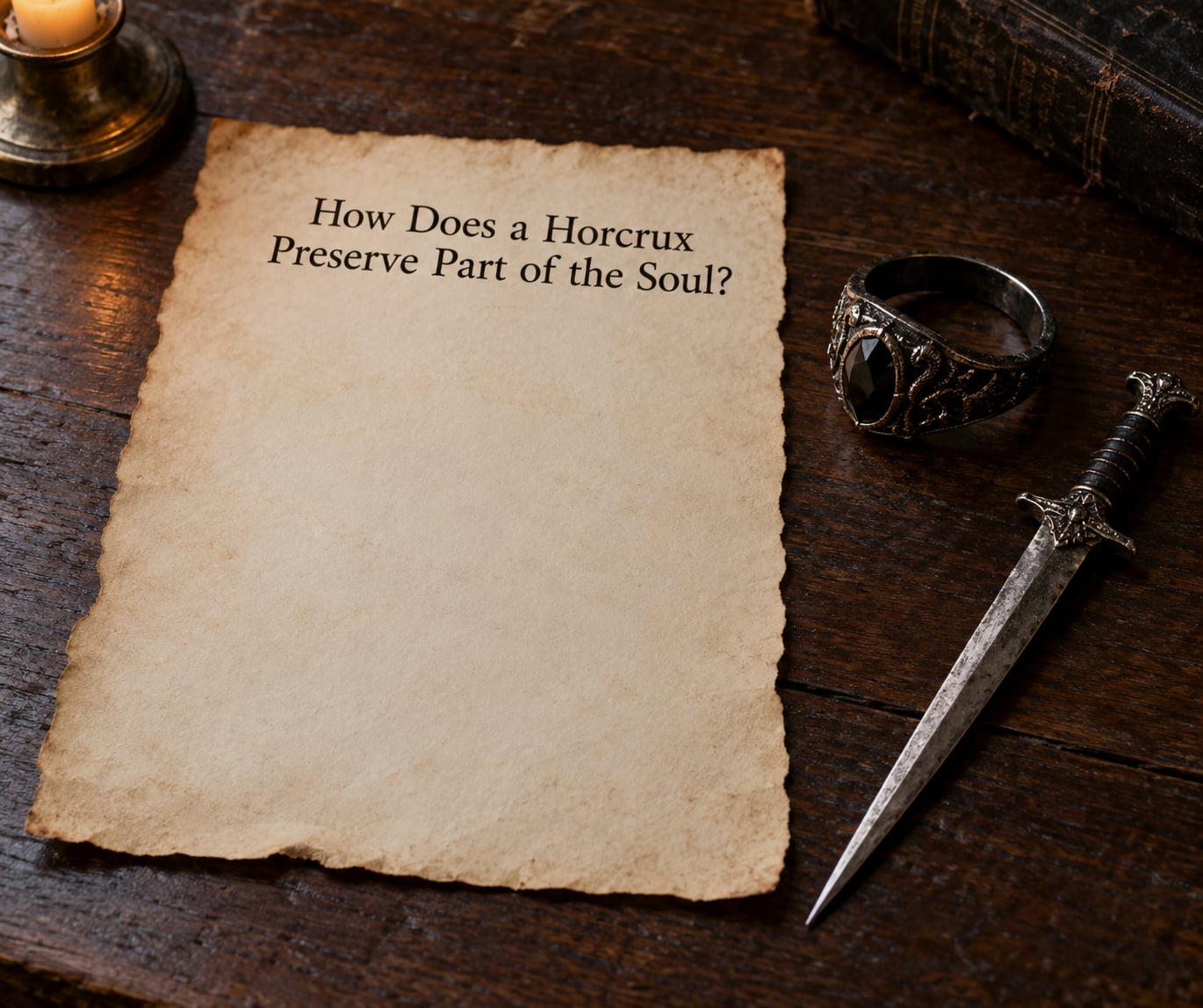
How Horcruxes work in Harry Potter, mechanically, comes down to a four-stage ritual. Only three of the stages are ever described in the books, and the fourth is the one everyone argues about.
- Commit a deliberate murder. The first act has to be a killing, and it has to be intentional. Dumbledore points out that Voldemort would have needed an unwilling victim each time, somebody utterly defenseless, because the victim supplies the shock that damages the soul.
- Cast the Horcrux-making spell. A spell tears the fragment free and pushes it out of the body. Hermione concludes the formula from what she has read in the books: the receptacle is prepared by dark magic to receive a fragmented piece of a soul that has been deliberately detached from its original form.
- Commit a third, horrific act. Dumbledore states that Voldemort performed an act so awful that even Dumbledore did not want to describe it. Rowling has never confirmed what it was, and the books deliberately leave it off the page.
- Bind the fragment to an object. The piece of soul attaches itself to a receptacle, which must be an object of personal value to the maker, or a living creature.
The emotional cost shows up immediately. Dumbledore says Voldemort’s soul was rendered so unstable by the act that it was not the soul of a man in the ordinary sense, and that it made him callous and cruel in ways he had never been before.
The three consequences of splitting the soul
Dehumanisation. Voldemort began as a charming, ordinary boy. Each murder removed something from him, and by the last of his Horcruxes he had the flattened nose he used in place of a wand, because he no longer wanted to look human.
Instability. A mutilated soul cannot hold its shape. Voldemort’s appearance degrades into a flattened, snout-faced thing no larger than a baby, and his emotions swing violently, the way a badly repaired object does.
Limbo. When the body dies, the soul passes into a waiting state instead of departing. Voldemort described that half-existence as nothing more than waiting to be born again, which is exactly what he planned for.
What Protection Did Voldemort Use When Making Horcruxes?
Making a Horcrux was the easy part. Voldemort then spent years ensuring nobody could find them, and he used four methods.
- Memory modification. He enchanted large numbers of people, including most of his followers, to have no memory of his appearance. He was so thorough about it that Bellatrix Lestrange, who watched him drink from the locket twice, insisted under questioning that the locket was a worthless trinket.
- False memories. His first murder at Hepzibah Smith’s house left him in an altered state, and he came out believing he had poisoned her from a cask of unicorn blood.
- Decoy hiding places. The locket alone was kept in three separate places: heavily guarded at his mother’s old house, inside a false tip jar at the shop where he worked, and finally hidden in the Room of Requirement inside a Record-Collating Chamber, which vanished once he was dead.
- Helpers and traps. He put the diary in Ginny Weasley’s school bag and let Lucius Malfoy carry the locket without ever telling either of them what it was.
Dumbledore also records Voldemort admitting he had tampered with Snape’s mind, forcing him to remember keeping an object safe without understanding what it was. The part of the plan Voldemort never managed was making the objects survive a Death Eater’s curiosity.
How Were Voldemort’s Horcruxes Destroyed?
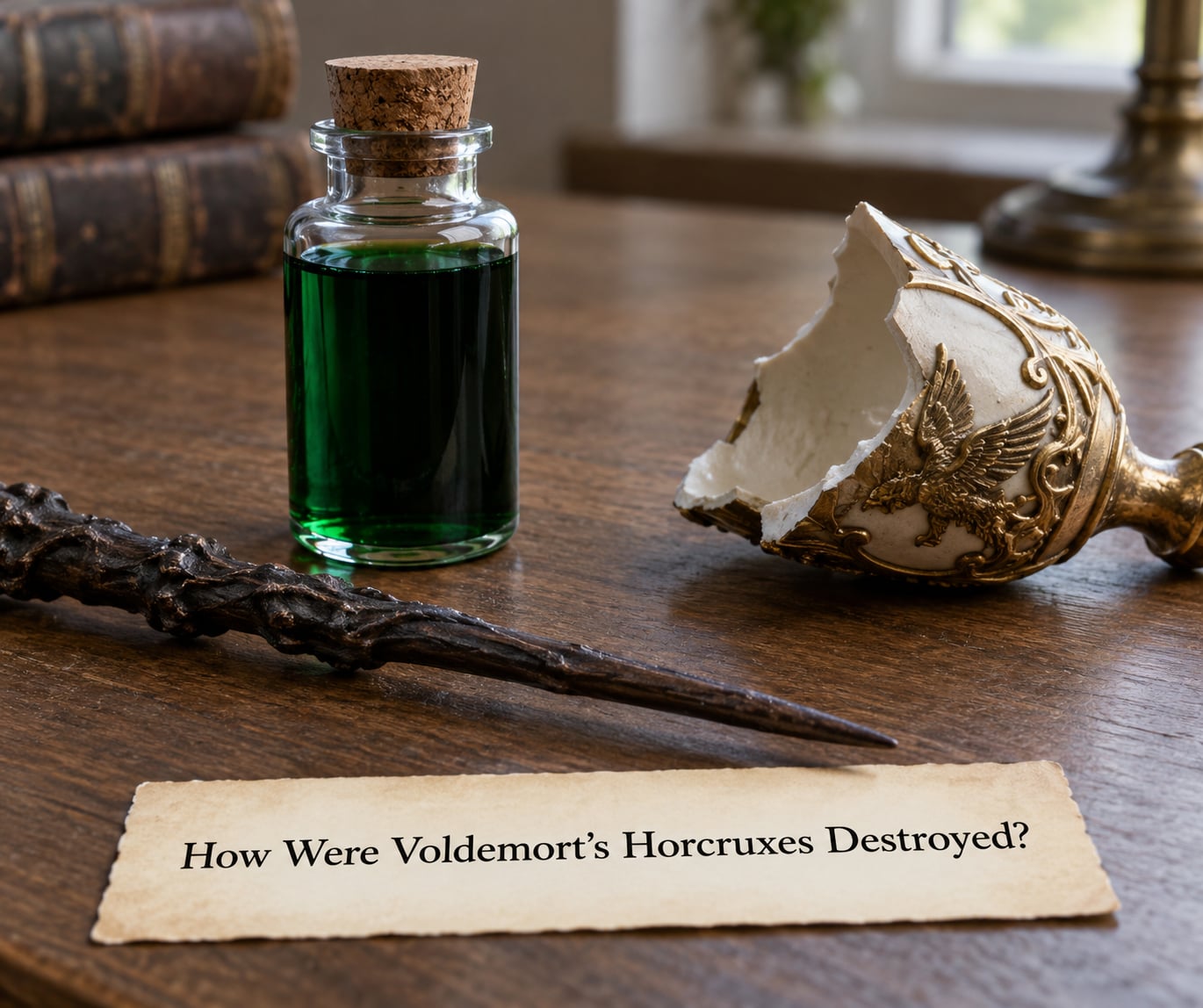
Only damage beyond any possible physical or magical repair destroys a Horcrux. Wiping a counter-curse off it does nothing. Fire barely makes a mark. Basilisk venom, Fiendfyre and the Sword of Gryffindor do the job, because the blade can cut through things that are supposed to be unbreakable.
Every Horcrux destroyed also had the effect of stripping away one layer of Voldemort’s protection, and each loss made the next one easier to find. Hermione works this out on the train, and the logic is what turns the final book into a checklist.
| Horcrux | Victim | Destroyed by | Method |
|---|---|---|---|
| Tom Riddle’s diary | Tom Riddle Senior | Harry Potter | Basilisk fang, in the Chamber of Secrets |
| Marvolo Gaunt’s ring | Morfin Gaunt | Fred Weasley | Fiendfyre |
| Slytherin’s locket | Bertha Jorkins | Ron Weasley | Basilisk fang |
| Hufflepuff’s cup | Hepzibah Smith | Neville Longbottom | Fiendfyre |
| Ravenclaw’s diadem | An unnamed girl | Neville Longbottom | Sword of Gryffindor |
| Nagini | Not applicable, a living creature | Neville Longbottom | Snake venom |
| Harry Potter | Not applicable, an accidental pseudo-Horcrux | Harry Potter | Sacrificial protection, then the Killing Curse |
Five of the seven came apart during the Battle of Hogwarts. The diary had gone years earlier in the Chamber of Secrets, and the last fragment, the one inside Harry, was dealt with in the Great Hall afterwards.
In the books Voldemort does not feel a Horcrux dying. He only senses it once Harry tells him in the Forest, and Dumbledore points out that he had kept a Horcrux hidden inside Harry’s scar for thirteen years without knowing it was there. The films add shots of Voldemort screaming as each object breaks, so if you watched first, that version feels like a contradiction rather than an addition.
Why Could Horcruxes Not Be Made From Happy or Willing Victims?
A Horcrux needs murder, and it needs a victim who did not consent. The books give the reason through Dumbledore’s conversation with Snape: the victim has to be taken completely by surprise, left without any defence, so that the soul splitting lands at full force.
A willing participant cannot supply that. If the victim expects it, understands it, or fights back, the magical shock never lands and the maker’s own soul is not damaged enough to tear. The ritual fails, which is precisely why Voldemort had to plan each killing carefully and work in places where nobody could interfere.
This rule also explains why Voldemort could never make one casually. There is no version of Horcrux magic that works on a friend who says yes, and readers looking for that loophole will not find one in canon.
Can Horcruxes Be Made Without Murder?
Not in canon. Every Horcrux in the books required a killing first, and there is no recorded spell, potion or object that produces a fragment of somebody’s soul without it.
What people sometimes confuse with Horcruxes are two related ideas. The first is the living vessel rule, which allows a Horcrux to be placed in a creature rather than an object, as with Nagini. The second is the pseudo-Horcrux, which is what Harry became.
Harry never committed a murder and never cast the spell. Voldemort’s Killing Curse passed through him without touching his soul, because Harry was already protected, and in doing so it tore a fragment of Voldemort’s soul into his body. Harry is a Horcrux by accident, which means he could be destroyed by the curse meant for him.
There is also a limit nobody can push past. Voldemort believed he needed seven pieces of his soul for maximum protection, counted the murder of his own body as one of them, and stopped. That leaves him with a soul too damaged to hold together properly, which is why he stays a shadow between 1981 and 1995, and it is also why he could never replace a Horcrux once one was lost.
The most widely circulated guess about the unrevealed third act is that it involves eating part of the victim, borrowed from Cronus in Greek myth and from wendigo stories. It is a fan theory and nothing more. Rowling has never confirmed it.
What Happens When the Last Horcrux Is Destroyed?
When the final fragment in Harry is removed, Voldemort loses the last thing anchoring him to the living world. He becomes fully mortal again, in the worst possible sense of the word, and Harry is able to cast the Killing Curse at him without the spell rebounding.
That immunity is the neat piece of symmetry at the centre of the whole mechanic. Because a fragment of Voldemort’s soul was lodged in Harry, Voldemort could not kill Harry with his own curse without destroying the fragment. Protection cut both ways.
Once Harry walks into the Great Hall and offers himself, the protection transfers. Voldemort’s curse destroys the fragment in Harry, Harry survives because of his mother’s sacrifice, and Voldemort is left as an ordinary man with an ordinary soul.
No fragment can be put back into a person once it is gone. There is no repairing, no rebottling and no second attempt, which is why the hunt is a countdown rather than a search for a way to undo the damage.
Frequently Asked Questions
How many Horcruxes did Voldemort make?
Voldemort made six Horcruxes on purpose: the diary, the ring, the locket, the cup, the diadem and Nagini. He intended a seventh, the piece inside Harry, but never performed the act himself. Dumbledore counts the murder of Voldemort’s own body as the eighth piece, which is why Voldemort believed seven was the number he needed.
How many Horcruxes can one person actually make?
There is no stated maximum, but a soul can only be split so far before it cannot hold together. Voldemort believed seven was the ideal number and stopped there, leaving his soul so mutilated that it could not survive properly between 1981 and 1995. That damage is why he could never replace a Horcrux after one was destroyed.
What can destroy a Horcrux?
Only damage beyond any possible physical or magical repair. In practice that means basilisk venom, Fiendfyre and the Sword of Gryffindor. A Horcrux worn by a person, such as Harry, can be removed by the Killing Curse. Ordinary fire, a curse or a failed hex does nothing to a fragment that is already beyond magical repair.
Why is Harry immune to Avada Kedavra?
Voldemort’s Killing Curse failed against Harry because a fragment of Voldemort’s own soul was lodged in Harry, so the curse destroyed that fragment instead of killing him. That protection applied to Harry only. When the fragment was finally removed by Voldemort’s own curse in the Great Hall, Harry survived for a different reason, his mother’s sacrificial protection.
Did Bellatrix Lestrange know she had a Horcrux?
No. Voldemort modified her memory so she would not recognise his appearance, and she insisted under questioning that Slytherin’s locket was a worthless object she had been forced to carry. Nobody outside Voldemort knew what most of the Horcruxes were, which is why the trio spends months in the books asking Dumbledore instead of asking the Death Eaters.
Was the Marauder’s Map a Horcrux?
No evidence supports it. The Marauder’s Map is never named among Voldemort’s Horcruxes, and the Elder Wand and the Philosopher’s Stone get the same treatment. Those three are popular fan guesses because they are powerful old objects. Only the diary, the ring, the locket, the cup, the diadem, Nagini and Harry count.
Conclusion
If you take one thing from this, take the anchoring idea. A Horcrux is not a magical object that happens to hold a soul. It is a deliberately separated piece of a soul, given to an object or a creature, and that piece keeps its maker in the world as long as it stays intact.
Everything follows from that. The murder damages the soul enough to tear. The spell pushes the fragment out. The protection keeps the object hidden while the maker rebuilds his body over and over. And nothing brings it back, because a fragment destroyed past repair leaves a hole that no magic closes.
That is why Voldemort’s defeat was never really about finding seven objects. It was about breaking one connection, again and again, until the man standing in the Great Hall had nothing holding him there.