Wandlore is the wizarding discipline that studies wands: what they are made of, why they behave the way they do, and which wizard a given wand will accept. A wand core is the magical substance sealed inside the wood, usually taken from a magical creature. Wood, core, length and flexibility together decide how a wand feels in the hand and who it will serve.
That sounds tidier than it really is. Rowling gave us a small set of firm facts — three Supreme Cores, wands that choose, allegiance that transfers when a wand is won in a real duel — and left a great deal deliberately vague. Ollivander keeps steering readers toward tendencies instead of rules, which is exactly why the fandom is still arguing about core tier lists a generation later.
So this guide splits the subject three ways. Book canon comes first, because that is where the mechanics actually live. Then the film additions, which are mostly staging. Then the video game cores, which is where a lot of the confusion starts. Anything I could not trace to one of those three gets left out or flagged as interpretation.
One thing to keep in mind before we start. Most interesting wandlore questions have a clean answer and a messy one, and the clean one is usually the wrong one. “Dragon heartstring is the strongest core” reads like a fact. It is actually a description of how a core behaves in a fight — which is not the same thing at all.
There is also one negative rule that governs the entire field: nobody can look at a wand and tell you what is inside it. Ollivander himself has to be told. Everything else in this guide follows from that.
Table of Contents
- What Is Wandlore?
- What Are the Three Parts of a Wand?
- How Does a Wand’s Wood Affect Its Properties?
- How Does a Wand’s Core Affect Its Behavior?
- Wand Cores and Their Typical Properties at a Glance
- What Does the Added Magical Ingredient Do?
- How Do Will, Allegiance, and Loyalty Influence a Wand?
- How Does Ollivander Choose a Wand for a Wizard?
- Do All Wands Choose Their Wizard?
- What Makes a Wand Powerful?
- Why Do Books and Films Describe Some Wands Differently?
- Frequently Asked Questions
- Conclusion
What Is Wandlore?
Wandlore is the study of wands — their origins, their materials, the laws governing which wizard they will serve, and what happens to them when a wand changes hands, wins a duel, or wilts from a bad owner. It is an old, respected magical discipline rather than a hobby, and the books treat it that way.
How Wandlore and Wand Cores Work at a Basic Level
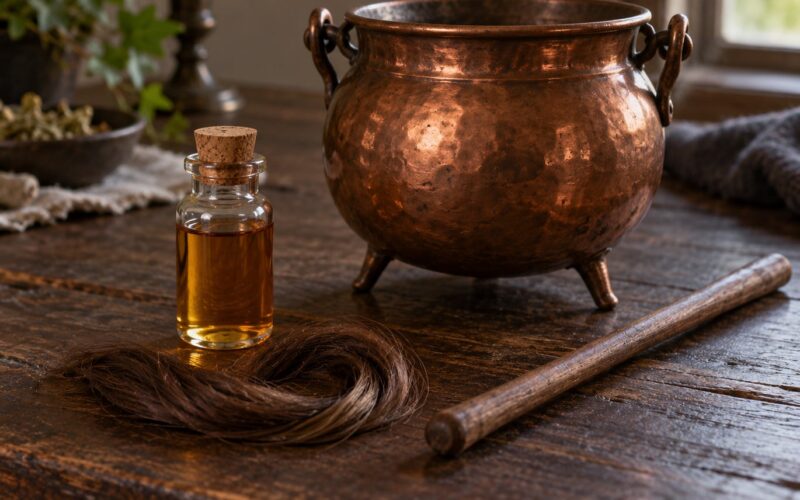
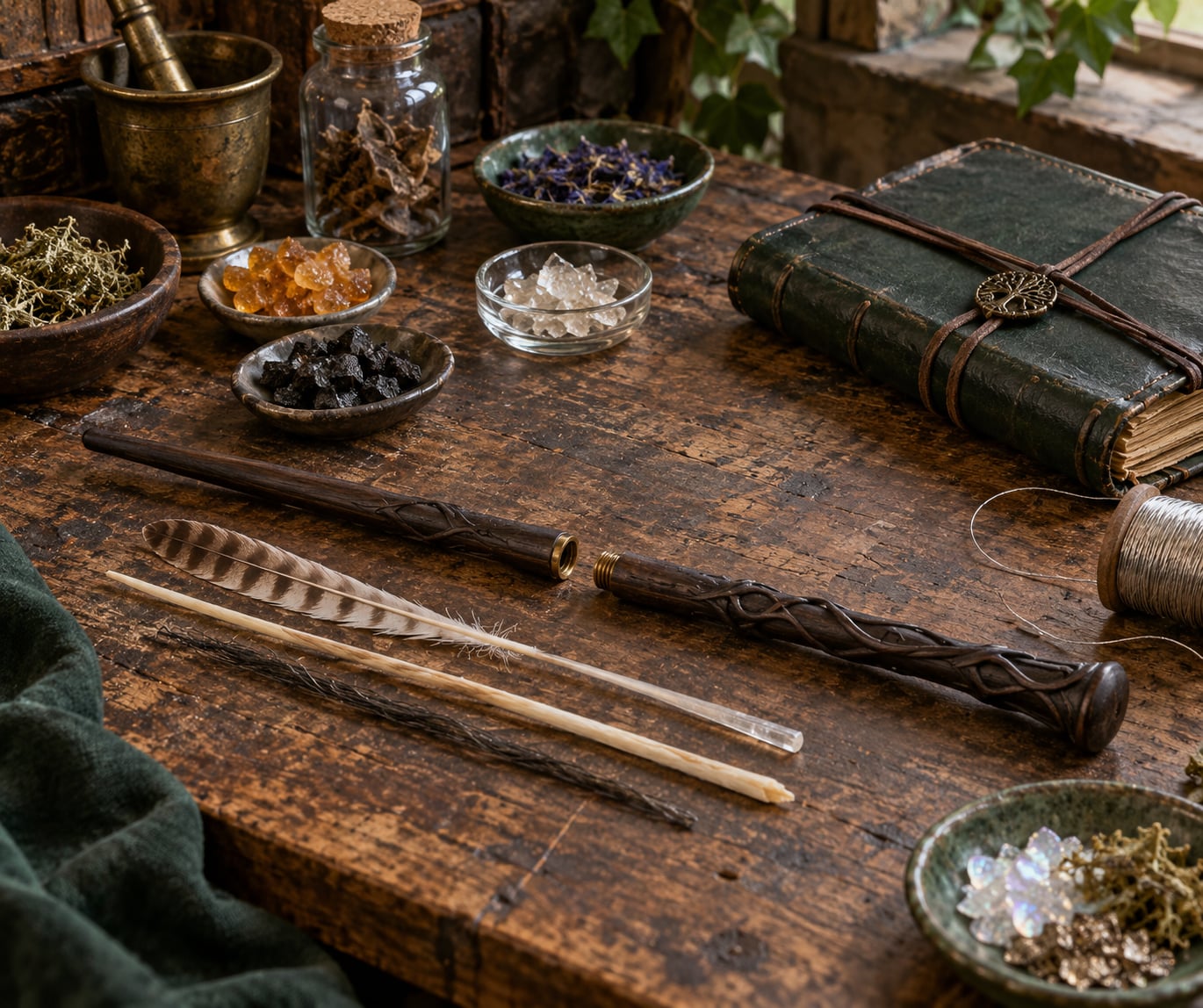
Every wand is built from three ingredients. The wood supplies the body and much of the personality. The core is the magical substance buried in the middle, and it decides temperament: how powerful the wand feels, how loyal it is, how willing it is to change allegiance. A third ingredient may be added — something that is neither plant nor beast, or something that serves a purpose the maker did not explain.
None of the three is powerful on its own. A core does not choose a wizard; it settles into a piece of wood and waits. What gives each wand its individual behaviour is the interaction between the three parts and the person holding them, which is why two wands with identical wood and core can behave nothing alike.
The useful mental model is a three-stage one: the maker supplies the materials, the wand settles into a temperament, and the right user triggers it. Wandlore is the study of everything that happens in those three stages.
What Are the Three Parts of a Wand?
A standard wand has a length of wood, a core running through the centre, and — when the maker judges it necessary — a third ingredient. Length varies from around nine to fourteen inches, which Ollivander treats as the normal range, and flexibility is described as supple or unyielding. Both are meaningful choices rather than decoration.
The core is the part nobody outside the shop can check. Ollivander is the one who dips his fingers into the loose wand stock and feels for the core, which is why he can confirm a wand’s composition only after a wizard has tried it and felt it work.
The added ingredient is genuinely optional. Ollivander uses it when he wants to fine-tune a wand’s nature, and he has been vague about his reasoning in a way that reads as private rather than mysterious. Some wizards in his circle assume he adds something that makes a wand easier to win; others think it is closer to superstition, carried forward because his shop does things the same way it always has.
Anatomy of a Typical Wand
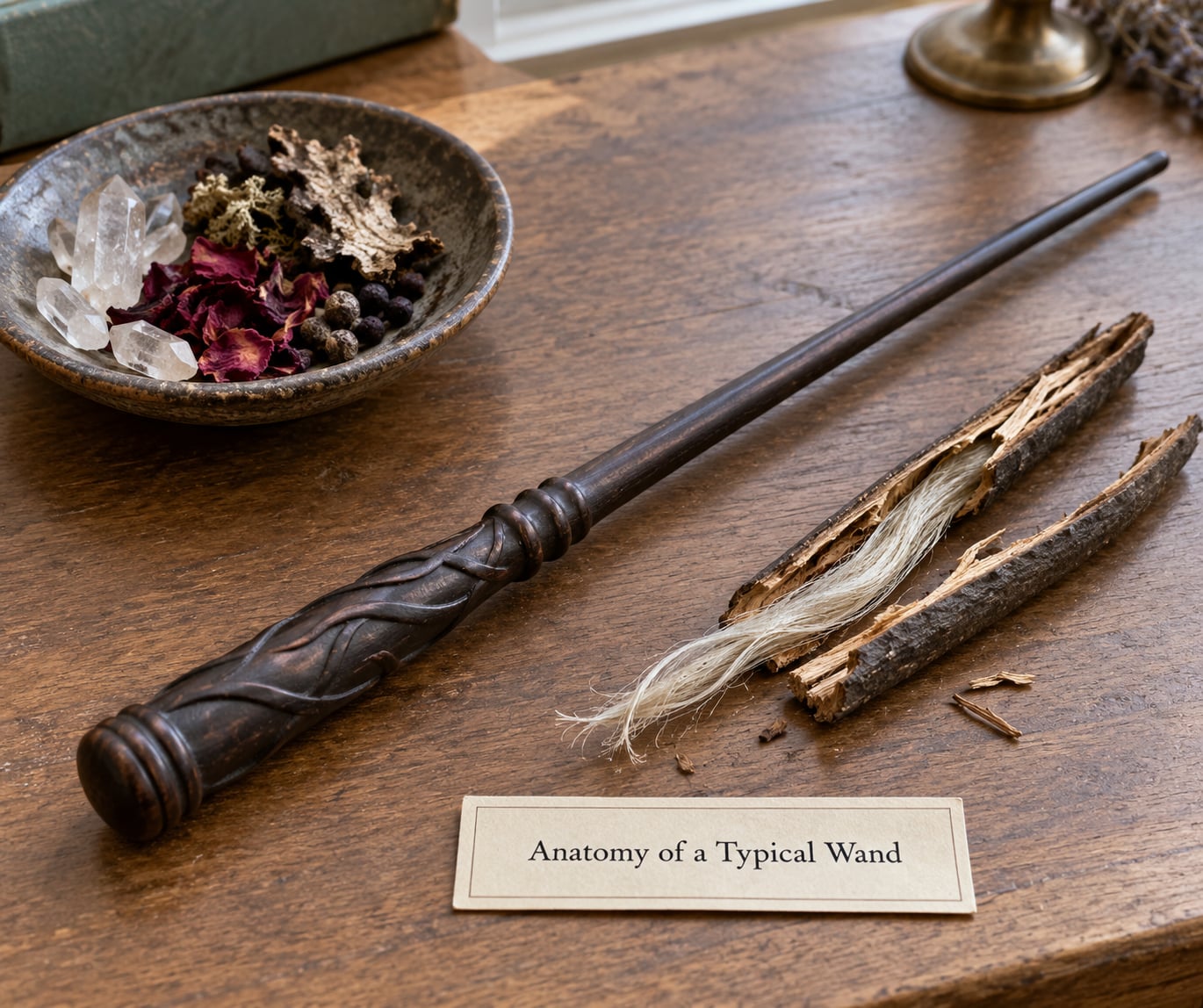
There is no universal wand design. Wands vary in length, girth, colour, and flexibility, and no two described in the books look alike. What stays constant is internal: the core sits in the middle of the length, and whatever else has been added is added around it.
That absence of a template is worth sitting with, because it is the reason the films struggled. A wand has to look specific and magical while the source material deliberately leaves its proportions vague.
How Does a Wand’s Wood Affect Its Properties?
Wood sets temperament, personality and reliability, and Ollivander describes a remarkable range of trees in a few words each. The associations are strong enough to be useful and loose enough that they are not rules. A cherry wand is not going to behave like a dogwood wand every single time, and Ollivander says as much.
- Willow is associated with a wandering, whimsical temperament and a habit of appearing and disappearing at inconvenient moments. Ron’s first wand was willow, and it snapped in two in the flying car.
- Ash Ollivander describes as selective for wizards who show themselves poised and self-assured. Ron’s second wand was ash, the third in a line of Weasley wands.
- Hawthorn sits in a middle position, with an affinity for protection and defensive magic. Draco’s wand is hawthorn, and it rewards aggression without supplying the intent.
- Cherry is described as prone to bursting with excitement, which is a kinder way of saying it is liable to misfire. Neville’s wand is cherry, and it shatters in his hand during his duel with Draco — which surprises Neville considerably.
- Dogwood Ollivander calls impetuous and stubborn, sprouting wildly out of the hands of the careless. It is one of the few woods he actively warns a buyer away from.
- Acacia is said to stick to its owner and stay stuck, for the sticker’s benefit rather than the owner’s.
- Yew is the wood he calls sprite and stubborn, and the one that ejects spells unpredictably, and it belongs to both Harry Potter and Tom Riddle. Two wands, one feather, and the same temper.
- Ebony he describes as reluctant to ally itself, and as the wood of a wand that sheds blood.
- Elder is the rarest wood in the trade and the strangest. In the wizarding world’s own tales, an elder wood wand refuses to answer a wizard’s command and tries to get away from them. Ollivander treats elder as too rare to stock, and it is unrelated to the Elder Wand, whose wood the books never name.
One correction worth making here, because it circulates constantly. The books never name the wood of Hermione’s wand, and pages that confidently assign her one are usually borrowing from somewhere else. What the books do say is where she got it: it turned up in the Forest of Dean, and Harry tells her it is not really theirs, which is a slightly awkward answer to the question of who chose it.
How Does a Wand’s Core Affect Its Behavior?
The core decides how a wand feels to cast with: how much it resists, how much it forgives, and how readily it answers a new hand. Ollivander is careful to describe cores as tendencies, and the four that dominate the books are the ones he keeps in stock.
Phoenix tail feather — the most independent of the three. Ollivander calls it choosy and pointed to say so, and the two wands we know carrying phoenix feathers, Harry’s and Voldemort’s, both ignore ownership for long stretches. A phoenix feather wand chooses its wizard and then does very much as it likes.
Dragon heartstring — the most forceful. Ollivander describes it as powerful, capable of a range of magic, and prone to bursting into flame or shooting bolts at innocuous targets, particularly when its wizard is in a temper. Fan consensus treats it as potent but volatile, and the book behaviour backs that up.
Unicorn tail hair — the most even-tempered and loyal, and the least forgiving of a wizard who cannot be bothered with it. It is associated with a long life, and with refusing to play badly.
These three are the Supreme Cores, and Ollivander stocks only these three. Anything else he treats as substandard, which is a trade judgement about predictability rather than a verdict on power — he believes a wand should serve one wizard reliably, and a rare core that fights its owner defeats that purpose. Fans often read that as fear of competition; it may just be craft.
There are far more cores than those three, named across the books and on Rowling’s wizard site for people asking about wands directly. The Elder Wand’s core, a thestral tail hair, is the most famous example: a creature barely discussed anywhere else in the story, supplying the most powerful wand in the series. Charlie Weasley’s kneazle whisker is the other named non-supreme case, and it is the reason Ron’s second wand is as much a family object as a tool.
Veela hair deserves its own note, because it is a fan favourite that Ollivander refuses on principle. Veela are not creatures in the sense the other cores come from — they are beings of a higher order than humans — and Ollivander has never sought theirs. Reddit keeps asking whether that is a hard rule or his personal preference. It reads as personal. He also refuses, in the same breath, a range of other things, and the pattern is a wandmaker declining to use material he considers inappropriate, not a law of magic.
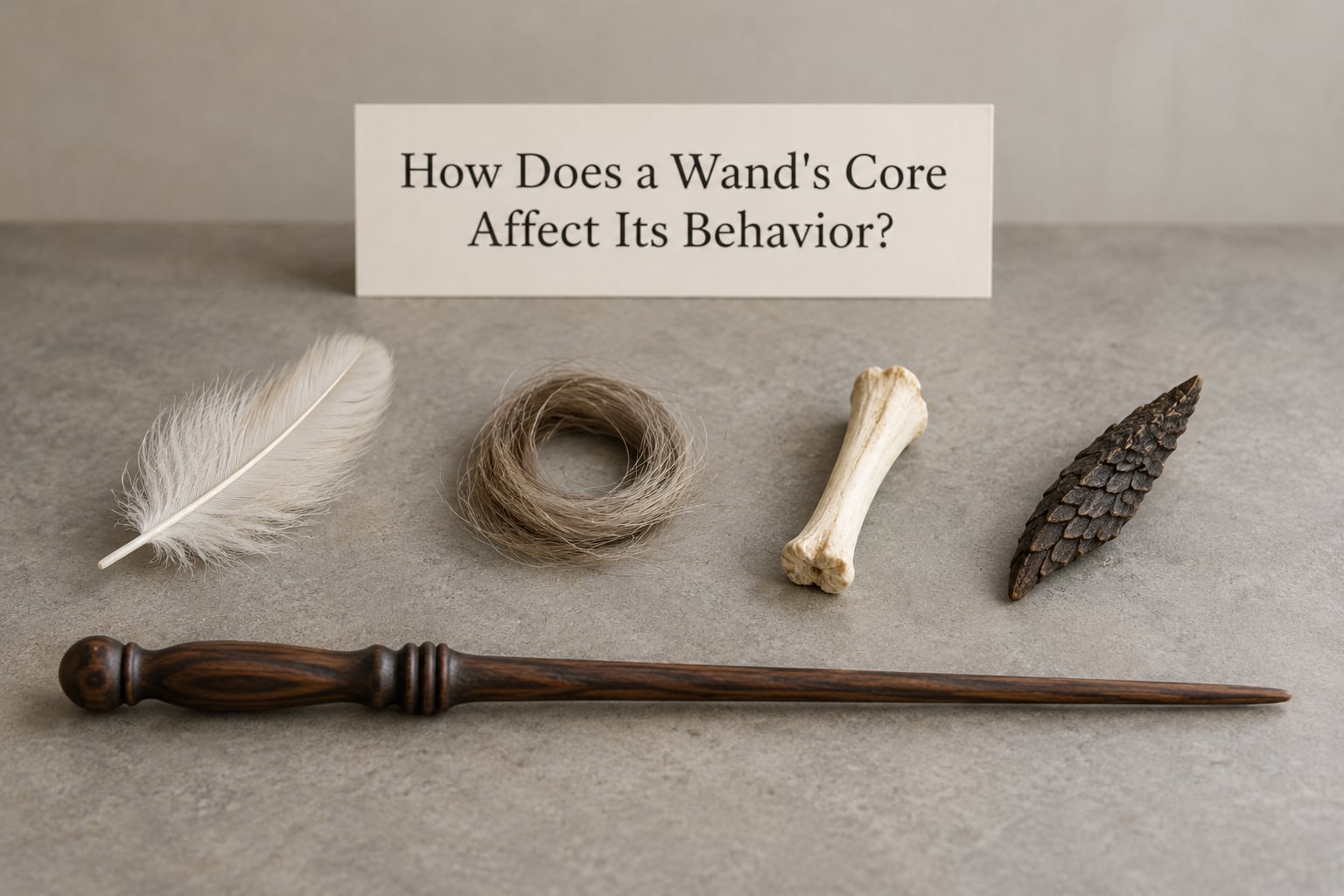
Beyond the three, Ollivander names a long catalogue: dittany stalk, thunderbird tail feather, fairy wing, white river monster spine, snallygaster heartstring, wampus cat hair, kelpie hair, troll whisker, jackalope antler, rougharou hair, and others. He mentions in passing cores that are changeable rather than fixed, and cores taken from beings that are partly human, and says wands built with those are extremely rare. The books never rank them. The tier lists you have read on forums are fan construction, and useful only as fan construction.
Wand Cores and Their Typical Properties at a Glance
This table collects the cores named in the books. Treat the behaviour column as Ollivander’s impressions, not a spec sheet — his own hedge about general notes rather than absolutes applies to every row below.
| Core | Source | Behaviour as described | Where it shows up |
|---|---|---|---|
| Phoenix tail feather | Bird | Choosy, independent, extremely loyal once bonded | Harry Potter, Tom Riddle, the Elder Wand in some readings of wand lineage debate |
| Dragon heartstring | Dragon | Powerful, wide range, volatile in a temper | Most common Supreme Core in the books |
| Unicorn tail hair | Unicorn | Even-tempered, loyal, longs for a long life | Ron, Hermione, Neville |
| Thestral tail hair | Thestral | Not separately described; core of the Elder Wand | The Elder Wand |
| Kneazle whisker | Kneazle | Not separately described | Charlie Weasley’s wand |
| Veela hair | Veela | Wands using it are described as erratic, even temperamental | Not carried by Ollivander, who refuses the material |
| Dittany stalk | Plant | Not separately described | Named by Ollivander |
| Thunderbird tail feather | Bird | Not separately described | Named by Ollivander |
| Fairy wing | Fairy | Not separately described | Named by Ollivander |
| White River Monster spine | Creature | Not separately described | Named by Ollivander |
| Snallygaster heartstring | Creature | Not separately described | Named by Ollivander |
| Kelpie hair | Kelpie | Not separately described | Named by Ollivander |
| Troll whisker | Troll | Not separately described | Named by Ollivander |
| Wampus cat hair | Wampus cat | Not separately described | Named by Ollivander, who notes it is gathered by the Cherokee in North America |
| Jackalope antler | Jackalope | Not separately described | Named by Ollivander |
| Rougarou hair | Rougarou | Not separately described | Named by Ollivander |
| Basilisk tongue | Basilisk | Not separately described | Named by Ollivander |
| Bowtruckle tongue | Bowtruckle | Not separately described | Named by Ollivander |
| Ashwinder egg | Plant | Not separately described | Named by Ollivander; also a game core |
Read the empty rows as a warning rather than an omission. When a core has no described behaviour, any claim about how it feels in the hand is invention, and the internet is full of them.
What Does the Added Magical Ingredient Do?
The third ingredient is the least explained part of the whole system. Ollivander’s stated reason is that he needs to add something to achieve a particular effect, and that he prefers to leave the reader to work out what it was. He mentions leech juice, powdered snake, and a beetle’s leg as ingredients he has used, without connecting any of them to a specific wand.
The practical answer is that it nudges the balance. A maker who wants a wand to be slightly more difficult to win, or slightly more attached to whoever holds it, has one more lever besides swapping the wood. The reader’s suspicion that this ingredient is doing something unusually convenient with allegiance is not unreasonable. It is also not something the books confirm, and Ollivander gives no examples that would let you check.
How Do Will, Allegiance, and Loyalty Influence a Wand?
Allegiance is the wand’s willingness to serve a particular wizard, and it moves in defined ways. Ollivander’s rules are simple enough to state, and fans misstate them often enough to be worth stating carefully.
- A wand chooses. It picks an owner, and it is not negotiable by the owner. Ollivander’s phrase is that the wand chooses the wizard, and he means it the other way round from how most people use it.
- Allegiance transfers when a wand is won in earnest. Defeat the master in a genuine duel and the wand may bend to the victor.
- Practice does not count. Ollivander is explicit that a wand is not won in a practice bout, and readers routinely forget the clause that makes the whole system work. A duel club match does nothing. Sparring with a partner does nothing. A wand propped against a wall and fallen behind does nothing.
- Ownership and allegiance are different things. He owns the wand; it may be loyal to somebody else entirely. Dumbledore’s phoenix wand is the standing example, passing to a student who had no claim on it while the previous owner’s allegiance was arguably still intact.
- A wand can be lost without being won. Dropped, forgotten, buried, won in a competition, or left in a tent in the rain. Plenty of wands have changed hands this way, and most of them never got clever about it.
- A wand that hates its owner will not pretend otherwise. Mistreatment produces wands that misfire, and Ollivander treats this as a craft problem with a solution: get a new wand.
Now the part that breaks the model, and it is the most famous scene in wandlore. Harry’s wand and Voldemort’s both carry a feather from Fawkes, which makes them brother wands. When their holders duel, the wand magic that fires is Priori Incantatem — the last spell the defeated wizard used, cast at the winner, involuntarily and without control. Harry’s wand hits Voldemort’s and unleashes Avada Kedavra back along the connection. Then Dumbledore severs that connection by cutting Voldemort’s wand through the neck.
Less famous but more instructive: Harry’s wand beats Lucius Malfoy’s despite being shorter and less experienced in a duel. Ollivander says only that it is a curious business, and the fandom has been arguing about the mechanics for years. The honest reading is that wandlore does not fully explain it, and a theory built entirely on core values is a theory pretending to more certainty than the text offers.
The Elder Wand is the exception that proves the rule. Ollivander describes it as an unsentimental wand, one that does not want to be owned and answers only to a wizard with the strength to take it. That is why Voldemort could not use it and Dumbledore could, and why Dumbledore spent years planning rather than waving.
How Does Ollivander Choose a Wand for a Wizard?
The selection is trial and error, and Ollivander describes it as exactly that. He tries different woods, different cores, and different lengths against a wizard’s hand until something responds. The wizard’s job during the process is to swish and feel, not to decide.
What he is looking for is a reaction. A wand that will not move is wrong. A wand that misfires wildly is wrong. The one that fits is the one that produces magic cleanly, and it does so because the core, the wood and the user happen to agree.
Contrast this with the older traditions, where wand suitability was assessed separately from the wizard. Where a wand’s qualities were catalogued in advance and matched to a person the way you would match a tool, Ollivander’s method treats the fit as something discovered rather than designed. That shift is arguably the most important development in wandlore, and it is the reason his shop works the way it does.
Do All Wands Choose Their Wizard?
No, and the shorthand is where most fan arguments go wrong. Choosing comes in at least four strengths, and the books use all of them.
Preference is the weakest form. A wand works for someone it did not choose, adequately, without enthusiasm. Most wands, most of the time.
Synergy is what you get in the shop: the combination suits the wizard well enough that magic comes easily. This is the ordinary, healthy case, and it is the one the films dramatise.
Deliberate selection is a wand that will only work properly for one person. Dumbledore’s wand behaves this way with Harry, and refuses to work for others.
Destiny is the rarest claim and the weakest supported. Harry’s wand and Voldemort’s are linked because of the shared feather and a murder, not because the wand foresaw the outcome.
Several wands work well for more than one owner over their lives. Ron’s family runs on hand-me-downs. Ollivander’s shop hands the same wand to different wizards in the same afternoon. The idea that a wand has exactly one destined owner is the fan reading, and the books keep declining to confirm it.
What Makes a Wand Powerful?
Not the core, on its own. No core, wood or ingredient makes a wand the most powerful in the world. Power comes from the fit between the three parts and the person casting, and from the wizard doing the casting.
A wand that is wrong for its user will produce weak, unreliable magic no matter how exotic the core. A wand that is right will do nothing dramatic on its own — it just stops getting in the way. The wands in the books that seem overwhelmingly powerful are overwhelmingly powerful because of who is holding them and what they are willing to do.
This is also where the honest answer to “which core is strongest” lives. Dragon heartstring is the most forceful core, phoenix tail feather the most independent, unicorn tail hair the most dependable. Those are three different strengths and they are not interchangeable, and Ollivander’s refusal to rank them is not evasion. He is a craftsman describing materials. A materials list is not a power chart, and the forums that turn one into the other are arguing about a question the books decline to pose.
Why Do Books and Films Describe Some Wands Differently?
Because the films needed scenes the books did not have. The wand shop in the first film is short and mostly atmospheric. The extended selection sequence in the sixth film is longer, more ceremonial, and gives Ollivander more dialogue than Rowling gave him, which means some of the most quoted lines about wands choosing their wizards are film lines rather than book lines. That distinction matters more than it sounds, because the films also show a shop stocked and labelled in ways the books never describe.
Nothing in the film material adds a new mechanical rule. What the films add is staging: longer silences, boxes of sample wood, and a lot of leaning toward the camera. Treat those as direction, not as wandlore.
The video games add far more, and here is the split that matters if you have played Hogwarts Legacy or Hogwarts Mystery. The following cores come from the game and Wizarding World materials rather than the novels.
| Core | Book canon? | Notes |
|---|---|---|
| Billywig shell | No | Game and Wizarding World material only |
| Grindylow tooth | No | Game and Wizarding World material only |
| Hippogriff talon | No | Game and Wizarding World material only |
| Mandrake root | No | Game and Wizarding World material only |
| Pixie wing | No | Game material; the books name a fairy wing instead |
| Basilisk scale | No | Game and Wizarding World material; the books name a basilisk tongue |
| Troll horn | No | Game material; the books name a troll whisker |
| Ashwinder egg | Yes | Named by Ollivander in the books, then reused in the game |
| Jackalope horn | Yes, as an antler | Named by Ollivander; the game renames it |
| Kneazle fur | Yes, as a whisker | Charlie Weasley’s wand supplies the book version |
The gameplay framing is different too. In the game, core choice reads as a trade between damage and defence. In the books, core choice reads as temperament and loyalty. Players who come to the novels expecting a stat block usually end up disappointed, and the disappointment is a translation error rather than a retcon.
Frequently Asked Questions
Can a wand work without its intended owner?
Yes, with qualifications. A wand will still produce magic in an untrained hand, usually badly, and most wands work adequately for whoever holds them. What it will not do is reach the same results as its chosen wizard, and it will not transfer its allegiance to a new owner because of proximity or inheritance. Allegiance changes when a wand is won in a real duel, which is why an inherited wand often behaves like a stranger until it is earned.
Can a broken wand be repaired?
Sometimes, and never quite to what it was. Ollivander treats repair as possible but uncommon, since a snapped wand leaves the core exposed and the join between core and wood is the fragile part. He also notes that unicorn hair wands are the exception, and do not wilt the way other wands do when their owner turns bad. Ron’s first wand was not repaired, which is a decision readers revisit more than they probably should.
Do wands favor a particular type of magic?
Not in the way the games suggest. Hawthorn is associated with defensive and protective magic, and the Elder Wand is unusually willing to produce lethal spells, but the books never set up a system where a core specialises in a school of magic. How wandlore and wand cores work is closer to temperament than to a loadout: the core decides how the wand feels, and the wizard decides what it is used for.
Why do wand cores resist identification?
Because nothing about the outside of a wand gives the core away, and no spell in the books reveals one. Ollivander identifies cores by reaching into his loose stock and feeling for them, and even he can only confirm a composition properly once a wand has worked in someone’s hand. This is why wand identification is a shopkeeper’s knowledge rather than a consumer one, and why second-hand wands come with no core disclosure at all.
Is wand selection just destiny?
Only in the storybook version. Ollivander is explicit that a wand chooses its wizard, and the books use that language seriously, but choosing is not the same as being irreplaceable. Plenty of wands serve more than one owner across a long life, and a wand fits because of how a core, a piece of wood and a person happen to agree, not because a prophecy says so. Destiny is the reading fans add; the books leave it open.
Conclusion
Wandlore is not a power chart. It is a description of fit: a core that sets temperament, a wood that sets personality, a maker’s judgement about length and flexibility, and a user whose ability is the missing ingredient that no table can list.
Start with a wand you already love. Write down its wood, its core, and its length if you can find them, then watch how its owner actually uses it — the spells that come easily, the ones that misfire, the moments it acts without being asked. That three-step read is the whole discipline in miniature, and it is a better use of your time than arguing about which core is strongest.