If you want the short version: the Sorting Hat decides by reading the student, not the student’s reputation. It weighs what you value, the potential you have not grown into, what you actually want, and the house that will stretch you most, then announces a result it never revises. Almost everything beyond that is inference, which is why the arguments never end.
I have gone back to the ceremony scenes more times than I care to admit, mostly because every clean explanation online eventually stops explaining anything. It gives you a list of traits, calls Gryffindor courage and Slytherin ambition, and moves on. The books do something stranger and more interesting than that.
Table of Contents
- How the Sorting Hat Decides Your House
- What Qualities Does the Sorting Hat Consider?
- How Does the Sorting Hat Read a Student’s Character?
- How the Sorting Hat Makes the Decision
- Does the Sorting Hat See Your Future?
- Can the Sorting Hat Change a Student’s House?
- How the Hat’s Decision Differs in the Books and Films
- What the Sorting Hat’s Choice Does and Does Not Reveal
- Common Theories About How the Sorting Hat Decides
- Frequently Asked Questions
- Conclusion
How the Sorting Hat Decides Your House
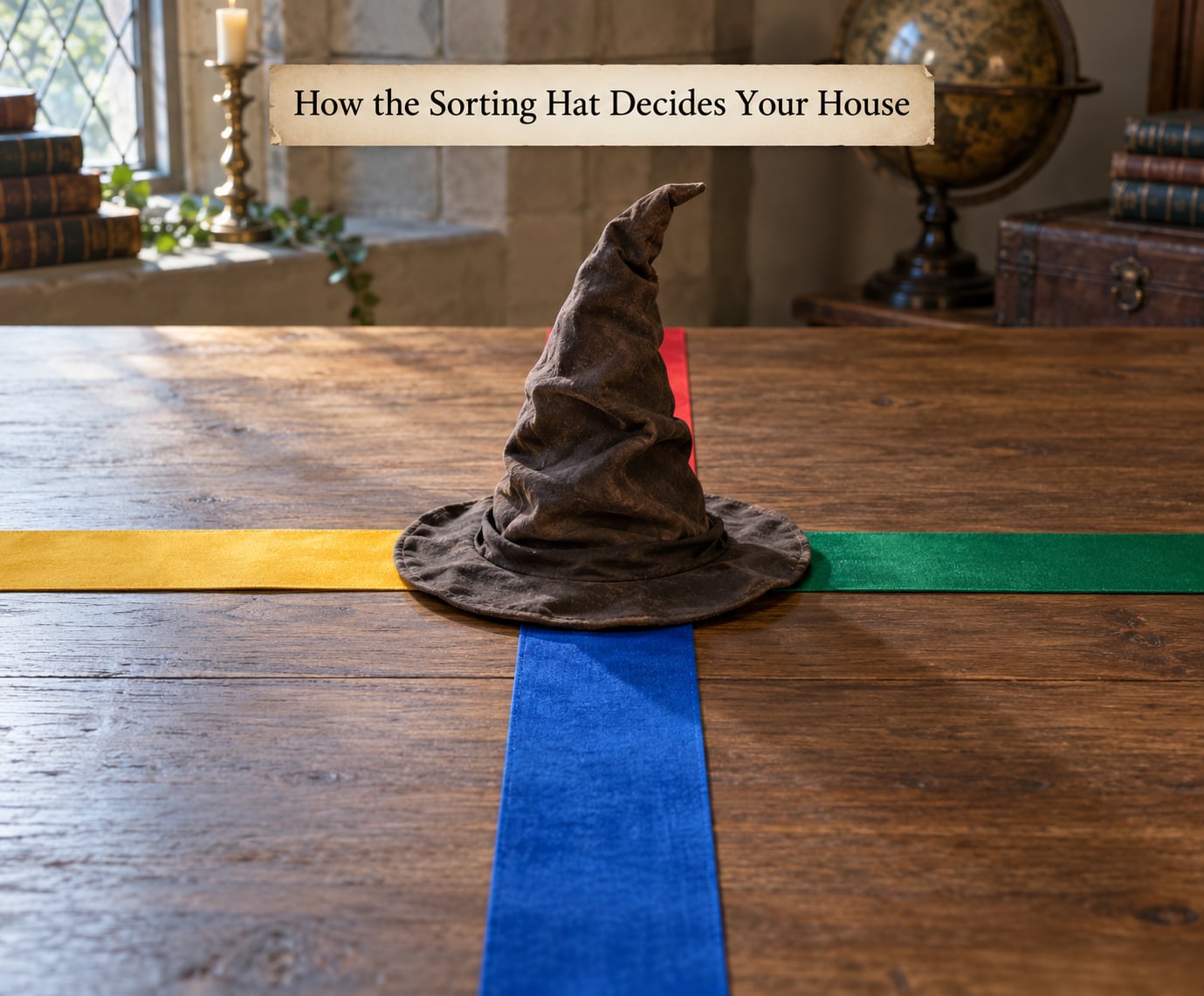
Here is the honest answer: the Sorting Hat decides by reading the student with Legilimency and weighing four things — the values you hold, the potential you have not yet grown into, the house you actually want, and the house that will challenge you most. It announces a final answer immediately, and it never changes its mind in public.
That is the ceiling of what canon gives you. There is no rubric, no scoring system, no list of requirements printed anywhere in the seven books. Anyone telling you the Hat runs a magical aptitude test is describing a fan theory, not the text.
The Hat itself says almost as much during Harry’s own sorting. It tells him he has plenty of Gryffindor in him and more than a little Slytherin, and it asks him which house he thinks he belongs in. The decision comes back to him as a question rather than a verdict, which is the entire mechanism in one exchange.
So when people ask how the Sorting Hat decides your house, the real answer is that it makes a judgement about you on one specific night, using information only it can gather, and then closes the topic.
What Qualities Does the Sorting Hat Consider?
Values first, and this is the distinction most explainers get wrong. The Hat does not sort on talent, on marks, or on the behaviour a child happens to display while standing on a stool in front of four long tables.
It sorts on what the student holds dear, and on what those values are likely to grow into. A cunning child who lies to get what they want and a cunning child who lies because they are frightened are read very differently, and the difference is the whole point of the quote Dumbledore gives Harry after his sorting: it is our choices that show what we truly are, far more than our abilities.
| Founder and house | What the house values | What readers usually picture |
|---|---|---|
| Godric Gryffindor — Gryffindor | Chivalry, bravery, nerve | Daring, nerve under fire |
| Helga Hufflepuff — Hufflepuff | Loyalty, patience, hard work, fairness | Kindness and effort |
| Rowena Ravenclaw — Ravenclaw | Intelligence, creativity, ambition, curiosity | Being the cleverest in the room |
| Salazar Slytherin — Slytherin | Cunning, resourcefulness, determination, ambition | Blood purity and pure-blood pride |
None of those qualities belongs to a single house. Harry is stubborn and hard-working, Hermione is brave, Ron is cunning when he needs to be, and Hermione’s own account of her Sorting makes clear that being clever was never the deciding factor. A child can be ambitious and land in Hufflepuff, and a child can be gentle and land in Slytherin, and the Hat will not explain itself either way.
Why Hufflepuff gets the students nobody else wants
Hufflepuff is the fallback house. When a first-year shows no single founder trait strongly enough to pull them elsewhere, the Hat tends to settle there, and this is canon rather than fan theory — it is why “the leftover house” keeps showing up as an insult in the books.
That rule matters more than it looks. It means the four houses are not a personality test with four outcomes. They are three targeted matches and one general admission, which quietly skews the numbers before anyone starts arguing about bloodlines.
How Does the Sorting Hat Read a Student’s Character?
Through Legilimency, which is the disciplined mind-reading that the books treat as a magical skill rather than telepathy, and which the Hat uses without any apparent effort. It gets the inside of the student’s head while the student is standing on a stool holding on to the brim.
What comes out of that reading is not a behaviour report. There is no moment where the Hat watches a child fail a test and marks it down. What it seems to register is the child’s instincts, the things they want, the way they treat people weaker than them, what they’d do if no one was watching, and the shape of the person they are in the middle of becoming.
Family expectation is part of the material, but not in the way the pure-blood families assume. Neville Longbottom was raised to believe he belonged in Hufflepuff and said so out loud, and the Hat overruled him. Draco Malfoy was raised expecting Slytherin and got it in seconds. Same family pressure, opposite outcomes, because what the child actually is outweighs what the parents hoped for.
There is no checklist in the books, and no magical test. The closest thing to a stated principle comes from how the Hat describes Neville to him: what Neville has chosen to define himself as matters more than what others, or Neville himself, assumed.
How the Sorting Hat Makes the Decision
The ceremony in the Great Hall at the Start-of-Term Feast follows the same order every year, and understanding the sequence explains most of what the Hat seems to do.
- The Hat is brought out and placed on a four-legged stool at the centre of the hall, and it warns the students to settle down before singing its song for the new year.
- McGonagall adds the students who were left out of the previous year’s sorting, a group of nervous older pupils who have already had a year of failing to fit in.
- First-years are called alphabetically, by surname, which is why the ceremony takes as long as it does.
- Each student sits, pulls the Hat onto their head, and the deliberation begins. This is where the reading happens and where the time varies wildly.
- The Hat announces a house aloud, and the table named cheers.
During the deliberation the Hat usually asks two questions: where do you see yourself, and where do you really belong. The first is the easy one, because most children answer it with whatever they want. The second is the one that matters, and it is the reason the Hat is not simply obeying the student.
What makes this genuinely strange is that the two answers are allowed to contradict each other. Neville wanted Hufflepuff and belonged, by the Hat’s reckoning, in Gryffindor. Hermione had no trouble answering either question and got Gryffindor anyway. The Hat is not running a popularity poll among the four tables.
Does the Sorting Hat See Your Future?
It knows more than it should, and the books never explain how. It issues a warning at the Sorting about a year with more worry than usual, it can recall family sorting patterns going back generations, and near the end of the series it confirms to Harry that it considered placing Tom Riddle in Gryffindor before the scar changed its mind.
It also, in its own words, never admits being wrong. In the Hogwarts Mystery side quest “Out of Sorts”, the Hat explains that it sorts for the house which will make the student happiest, judging by their mental reaction to the house name itself, which is why it is so rarely wrong about anyone.
Treat that one as game canon rather than book canon, and treat the foreknowledge as a mystery rather than a mechanism. The Hat’s awareness shapes the decision, but nothing in the books says it reads a timeline. It reads the person in front of it, and that person happens to carry more history than most.
Can the Sorting Hat Change a Student’s House?
Yes in the sense that it will sometimes move off its first inclination once it has read the student properly. It is not a system where you request a house and receive it, though, and the canon splits into three distinct cases that are worth keeping separate.
- Honoured. Harry essentially refuses Slytherin, and Gryffindor is where he lands. Severus Snape wants Slytherin and gets it, though not for the reasons his housemates assume.
- Refused. Neville asks for Hufflepuff and is told, in effect, that he does not get to choose that. The Hat is at its most certain about him.
- Near-miss. Hermione is weighed seriously for another house before Gryffindor wins out. The exchange where the Hat nearly places her in Slytherin and she insists on Gryffindor is presented on screen; in the books her sorting is much briefer, so the Ravenclaw comparison most fans argue about is an interpretation, not a printed near-miss.
Afterwards, no. There is no transfer process anywhere in the books, and Dumbledore’s remark that we sort too soon is the closest the series comes to an explanation. The Hat is not a starting position you can renegotiate in year two.
How the Hat’s Decision Differs in the Books and Films
The biggest difference is that the books show the deliberation as private and the films play it out loud. On the page, Harry’s sorting is a few lines where he almost says Slytherin and the Hat responds to the wish. On screen, he says the word in front of the whole hall, McGonagall objects, and the Hat backs down in front of four tables.
That is not a small change. The film makes the Hat look like it gives in under public pressure; the book makes it look like it asked a question and then listened carefully to the answer.
| Element | Books | Films |
|---|---|---|
| Where the deliberation is shown | Reported briefly, mostly internal | Played out as dialogue |
| Harry’s refusal of Slytherin | Almost unspoken; the Hat reads the wish | Spoken aloud for the Great Hall |
| The Hat’s song | Full lyrics, a new set of verses each year | Shortened, with the words heavily cut |
| Neville’s father | No mention of a Slytherin near-miss | Dumbledore says he was almost sorted Slytherin |
| Happiness as the basis of sorting | Not stated | Not stated; appears in the Hogwarts Mystery game |
Two other differences catch people out. The book song is far longer and does a great deal of characterisation work through the Hat’s view of each founder, including some fairly sharp lines about the houses’s blind spots. And in the books the Hat mentions the Sword of Gryffindor to Gryffindors as an almost casual aside, which the films largely drop.
What the Sorting Hat’s Choice Does and Does Not Reveal
It reveals what the Hat read in one eleven-year-old on one night in September. It does not tell you what you will become, and the series is unusually firm about that.
Neville is the clearest example. Sorted Gryffindor, he spends most of the first two years failing at almost everything, nearly loses his wand, and gets sorted into Gryffindor again in the end when he finally stands up to Draco Malfoy. The Hat was not describing a personality. It was pointing at a capacity.
Albus Severus Potter is the other one. He goes into his own Sorting terrified of landing in Slytherin because of his father’s background, and comes out Gryffindor, with Ron Weasley openly delighted about it. The fear was about a family reputation, not about the child.
Read the Sorting as a starting assignment rather than a verdict on a life. Dumbledore’s line about sorting too soon works as the author’s own footnote.
Common Theories About How the Sorting Hat Decides
Six ideas come up constantly. Sorting them by how well the text supports them is the fastest way to end a forum argument.
Bloodline decides the house
Reasonable interpretation, heavily overstated. Malfoy and Tom Riddle are both sorted into Slytherin almost instantly, and the Hat does keep an eye on family history. But Neville is a pure-blood with no Slytherin taint at all, and Ron’s whole family is Gryffindor without a single Slytherin. Bloodline tilts the Hat; it does not decide.
The Sword of Gryffindor placed Harry in Gryffindor
Unsupported speculation. The Sword appears at the Sorting and is offered to the new Gryffindors, and Harry draws it later in the same year. That is two separate events, and the Hat’s own account of deciding Harry comes down to a fragment of Voldemort’s soul and the fact that Harry had already made his wish.
Snape asked for Slytherin and simply got it
Partly canon. Snape’s own account in the final book is that he wanted Slytherin, was wary of what he might become elsewhere, and the Hat agreed. What is interpretation is the assumption that the Hat granted a request on request alone, given how differently Neville’s request went.
The Hat balances house sizes and gender splits
This is the most argued and least supported claim in fandom. Nothing in the books says the Hat works to quotas, and no official year-by-year house population table exists to test it against. The two positions that get argued are that the Hat sorts each child honestly and the averages sort themselves out over a large cohort, or that a founder with four hundred years of practice simply reads better than we expect.
The Hufflepuff fallback rule is the one mechanism in the text that pushes toward even numbers, because it gives the least distinctive students somewhere to go. That is not a quota, but it is the only balancing force anyone can actually point to.
The Hat read Voldemort’s soul fragment in Harry
Canon, in effect. The Hat tells Harry it debated Tom Riddle at length, considered Gryffindor, and would have placed him in Slytherin had it not seen the scar. In her 2001 Leaky Cauldron interview, Rowling said the fragment of Voldemort’s soul inside Harry is the reason Slytherin was even offered. So was the soul fragment, or was it Harry’s own refusal — the books do not cleanly separate the two.
Online house quizzes predict the Sorting
Reasonable for entertainment, useless as evidence. The Hat reads the actual child standing on the stool, and a quiz is reading a stranger’s answers to questions the Hat never asked. A quiz that gets your Hogwarts house right has not predicted anything about how the Sorting would have gone.
Frequently Asked Questions
How does the Sorting Hat actually choose a house?
It reads the student with Legilimency and weighs four things: the values they hold dear, the potential they have not grown into, the house they actually want, and the house that will challenge them most. It then announces a final answer. There is no printed checklist or magical test, so any precise scoring system you find online is fan theory, not canon.
Does the Sorting Hat read your mind?
Yes. The Hat uses Legilimency, the magical discipline that reads what is in someone’s head, and it does so while the student is sitting on the stool wearing it. It tells Neville he belongs in Gryffindor and tells Harry he has Slytherin in him as well, which would be impossible from observation alone. It never announces what it has read, though.
Can a child be sorted into a different house from their parents?
Easily. Ron Weasley is Gryffindor in a family of Gryffindors, but Neville Longbottom was raised expecting Hufflepuff and was sorted Gryffindor anyway, and he was the one who actually asked out loud. Family expectation shapes what a child wants, and the Hat weighs the child rather than the wish, which is why raised expectations and results often diverge.
Why does the Sorting Hat ask where you see yourself and where you belong?
Because the two answers are allowed to disagree, and the second one is the one it uses. Most children name the house they want when asked where they see themselves. Asking where they belong forces the Hat to weigh what it has read against what the student has assumed, and it is the mechanism behind Neville being placed in Gryffindor and Hermione insisting on Gryffindor rather than being talked into another house.
Does the Sorting Hat always give the best house for a student?
It aims to, and the books say it is rarely wrong, though the series deliberately stops short of promising perfection. In the Hogwarts Mystery side quest, the Hat explains that it sorts for the house that will make the student happiest, which is game canon rather than book canon. Peter Pettigrew is the standing counter-example: the Hat read loyalty and chose badly, and spent the rest of the story regretting it.
Conclusion
Here is how the Sorting Hat decides your house: it reads what you value, what you might grow into, what you want, and what will stretch you, then it commits. The mystery is real, but it is a mystery about a magical object’s judgement rather than a puzzle with a missing final clue.
The part worth carrying out of the ceremony scene is the second question. Asked where you see yourself, most children answer with a preference; asked where you belong, the answer can land somewhere they did not expect and somewhere they have to grow into. That is the whole argument the Hat is making, and the reason a Gryffindor who is gentle and a Slytherin who is kind are not contradictions.